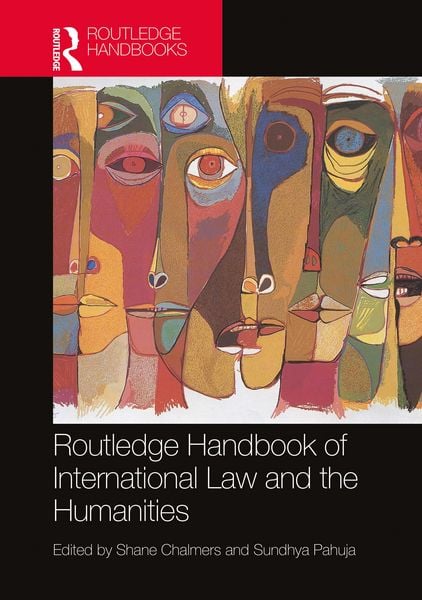
Routledge Handbook of International Law and the Humanities
-
- Hardcover ausgewählt
- Taschenbuch
- eBook
-
Sprache:Englisch
342,99 €
inkl. gesetzl. MwSt.,
Beschreibung
Produktdetails
Einband
Gebundene Ausgabe
Erscheinungsdatum
20.05.2021
Abbildungen
25 SW-Abb., 22 SW-Fotos, 3 SW-Zeichn.
Herausgeber
Shane Chalmers + weitereVerlag
Taylor & FrancisSeitenzahl
506
Maße (L/B/H)
24,6/17,4/3 cm
Gewicht
1040 g
Sprache
Englisch
ISBN
978-0-367-42074-1
This Handbook brings together 40 of the world's leading scholars and rising stars who study international law from disciplines in the humanities - from history to literature, philosophy to the visual arts - to showcase the distinctive contributions that this field has made to the study of international law over the past two decades.
Including authors from Australia, Canada, Europe, India, South Africa, the UK and the USA, all the contributors engage the question of what is distinctive, and critical, about the work that has been done and that continues to be done in the field of 'international law and the humanities'. For many of these authors, answering this question involves reflecting on the work they themselves have been contributing to this path-breaking field since its inception at the end of the twentieth century. For others, it involves offering models of the new work they are carrying out, or else reflecting on the future directions of a field that has now taken its place as one of the most important sites for the study of international legal practice and theory. Each of the book's six parts foregrounds a different element, or cluster of elements, of international law and the humanities, from an attention to the office, conduct and training of the jurist and jurisprudent (Part 1); to scholarly craft and technique (Part 2); to questions of authority and responsibility (Part 3); history and historiography (Part 4); plurality and community (Part 5); as well as the challenge of thinking, and rethinking, international legal concepts for our times (Part 6).
Outlining new ways of imagining, and doing, international law at a moment in time when original, critical thought and practice is more necessary than ever, this Handbook will be essential for scholars, students and practitioners in international law, international relations, as well as in law and the humanities more generally.
Noch keine Bewertungen vorhanden
Verfassen Sie die erste Bewertung zu diesem Artikel
Helfen Sie anderen Kundinnen und Kunden durch Ihre Meinung.
Kurze Frage zu unserer Seite
Vielen Dank für Ihr Feedback
Wir nutzen Ihr Feedback, um unsere Produktseiten zu verbessern. Bitte haben Sie Verständnis, dass wir Ihnen keine Rückmeldung geben können. Falls Sie Kontakt mit uns aufnehmen möchten, können Sie sich aber gerne an unseren Kund*innenservice wenden.
zum Kundenservice