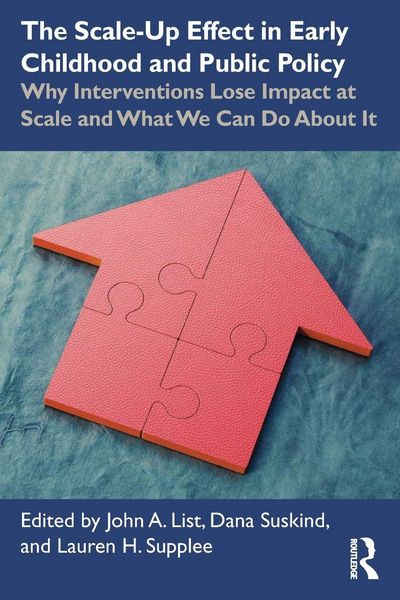
The Scale-Up Effect in Early Childhood and Public Policy Why Interventions Lose Impact at Scale and What We Can Do About It
-
- Hardcover
- Taschenbuch ausgewählt
- eBook
-
Sprache:Englisch
47,99 €
inkl. gesetzl. MwSt.,
Beschreibung
Produktdetails
Einband
Taschenbuch
Erscheinungsdatum
27.05.2021
Abbildungen
15 SW-Abb., 15 SW-Zeichn., 13 Tabellen
Herausgeber
List John + weitereVerlag
Taylor & FrancisSeitenzahl
454
Maße (L/B/H)
22,9/15,2/2,4 cm
Gewicht
653 g
Sprache
Englisch
ISBN
978-0-367-42247-9
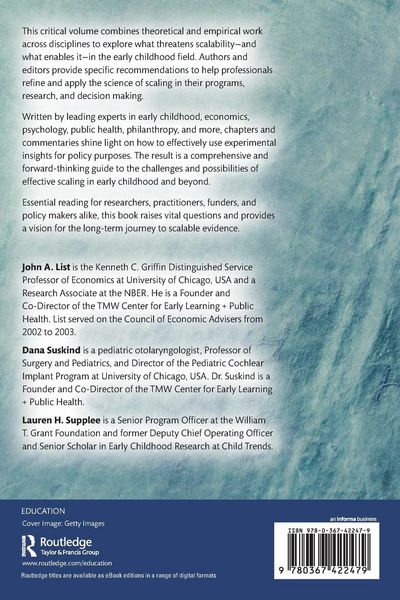
This critical volume combines theoretical and empirical work across disciplines to explore what threatens scalability-and what enables it-in the early childhood field. Authors and editors provide specific recommendations to help professionals refine and apply the science of scaling in their programs, research, and decision making.
Written by leading experts in early childhood, economics, psychology, public health, philanthropy, and more, chapters and commentaries shine light on how to effectively use experimental insights for policy purposes. The result is a comprehensive and forward-thinking guide to the challenges and possibilities of effective scaling in early childhood and beyond.
Essential reading for researchers, practitioners, funders, and policy makers alike, this book raises vital questions and provides a vision for the long-term journey to scalable evidence.
Noch keine Bewertungen vorhanden
Verfassen Sie die erste Bewertung zu diesem Artikel
Helfen Sie anderen Kundinnen und Kunden durch Ihre Meinung.
Kurze Frage zu unserer Seite
Vielen Dank für Ihr Feedback
Wir nutzen Ihr Feedback, um unsere Produktseiten zu verbessern. Bitte haben Sie Verständnis, dass wir Ihnen keine Rückmeldung geben können. Falls Sie Kontakt mit uns aufnehmen möchten, können Sie sich aber gerne an unseren Kund*innenservice wenden.
zum Kundenservice