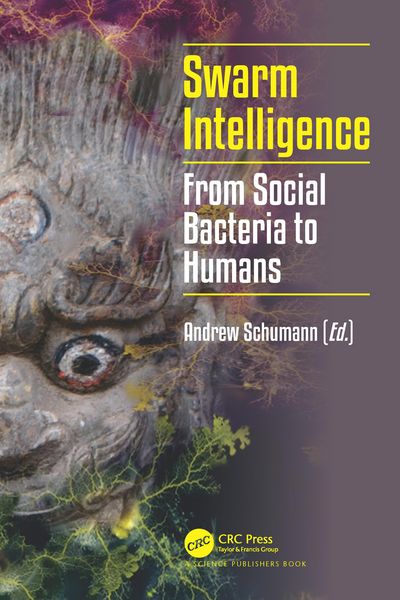
Swarm Intelligence From Social Bacteria to Humans
-
- Taschenbuch
- eBook ausgewählt
-
Form:Einzelkauf Download
-
Sprache:Englisch
-
eBook Format:PDF
- PDF 98,70 € ausgewählt
- ePUB 98,70 €
98,70 €
inkl. gesetzl. MwSt.Beschreibung
Produktdetails
Format
Kopierschutz
Ja
Family Sharing
Nein
Text-to-Speech
Nein
Erscheinungsdatum
03.11.2020
Herausgeber
Andrew SchumannVerlag
Taylor & Francis eBooksSeitenzahl
190 (Printausgabe)
Auflage
1. Auflage
Sprache
Englisch
EAN
9780429650246
The notion of swarm intelligence was introduced for describing decentralized and self-organized behaviors of groups of animals. Then this idea was extrapolated to design groups of robots which interact locally to cumulate a collective reaction. Some natural examples of swarms are as follows: ant colonies, bee colonies, fish schooling, bird flocking, horse herding, bacterial colonies, multinucleated giant amoebae Physarum polycephalum, etc. In all these examples, individual agents behave locally with an emergence of their common effect.
An intelligent behavior of swarm individuals is explained by the following biological reactions to attractants and repellents. Attractants are biologically active things, such as food pieces or sex pheromones, which attract individuals of swarm. Repellents are biologically active things, such as predators, which repel individuals of swarm. As a consequence, attractants and repellents stimulate the directed movement of swarms towards and away from the stimulus, respectively.
It is worth noting that a group of people, such as pedestrians, follow some swarm patterns of flocking or schooling. For instance, humans prefer to avoid a person considered by them as a possible predator and if a substantial part of the group in the situation of escape panic (not less than 5%) changes the direction, then the rest follows the new direction, too. Some swarm patterns are observed among human beings under the conditions of their addictive behavior such as the behavior of alcoholics or gamers.
The methodological framework of studying swarm intelligence is represented by unconventional computing, robotics, and cognitive science. In this book we aim to analyze new methodologies involved in studying swarm intelligence. We are going to bring together computer scientists and cognitive scientists dealing with swarm patterns from social bacteria to human beings. This book considers different models of simulating, controlling, and predicting the swarm behavior of different species from social bacteria to humans.
Noch keine Bewertungen vorhanden
Verfassen Sie die erste Bewertung zu diesem Artikel
Helfen Sie anderen Kundinnen und Kunden durch Ihre Meinung.
Kurze Frage zu unserer Seite
Vielen Dank für Ihr Feedback
Wir nutzen Ihr Feedback, um unsere Produktseiten zu verbessern. Bitte haben Sie Verständnis, dass wir Ihnen keine Rückmeldung geben können. Falls Sie Kontakt mit uns aufnehmen möchten, können Sie sich aber gerne an unseren Kund*innenservice wenden.
zum Kundenservice