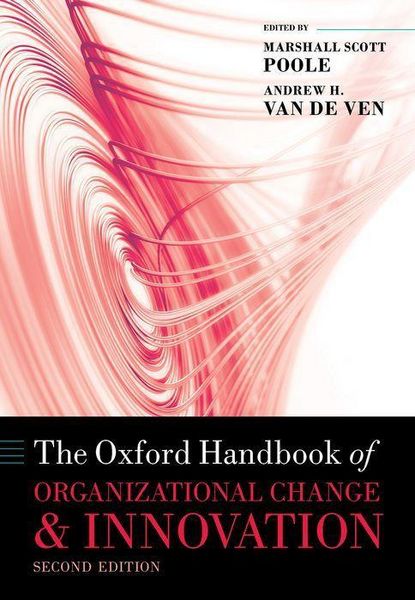
Produktbild: The Oxford Handbook of Organizational Change and Innovation

The Oxford Handbook of Organizational Change and Innovation

155,99 €

inkl. gesetzl. MwSt., Versandkostenfrei


Beschreibung

Produktdetails

Einband

Gebundene Ausgabe

Erscheinungsdatum

20.07.2021

Herausgeber

Marshall Scott Poole + weitere

Verlag

Oxford University Press

Seitenzahl

962

Maße (L/B/H)

24,9/18/6,1 cm

Gewicht

1822 g

Auflage

2nd edition

Sprache

Englisch

ISBN

978-0-19-884597-3

Beschreibung

Produktdetails

Einband

Gebundene Ausgabe

Erscheinungsdatum

20.07.2021

Herausgeber

Verlag

Oxford University Press

Seitenzahl

962

Maße (L/B/H)

24,9/18/6,1 cm

Gewicht

1822 g

Auflage

2nd edition

Sprache

Englisch

ISBN

978-0-19-884597-3

EU-Ansprechpartner

Zeitfracht Medien GmbH
Ferdinand-Jühlke-Straße 7
99095 Erfurt
DE
produktsicherheit@zeitfracht.de

Herstelleradresse

Oxford University Press
Great Clarendon Street
OX2 6DP Oxford
GB
EXPORTtradequeries@oup.com

Noch keine Bewertungen vorhanden

Verfassen Sie die erste Bewertung zu diesem Artikel

Helfen Sie anderen Kundinnen und Kunden durch Ihre Meinung.

Kundinnen und Kunden meinen

Bewertungen (0)

Die Leseprobe wird geladen.
  • Produktbild: The Oxford Handbook of Organizational Change and Innovation
    • 1: Andrew H. Van de Ven and Marshall Scott Poole: Introduction: Central Issues In The Study of Organizational Change and Innovation

    • I. Teleological Models of Change

    • 2: W. Warner Burke: Historical Currents in Scholarship of Organization Change

    • 3: Jean Bartunek, Linda Putnam, and Myeong-gu Seo: Dualities and Tensions in Ongoing Development of Organization Development

    • 4: Alexandra Rheinhardt and Dennis A. Gioia: Upside-Down Organizational Change: Sensemaking, Sensegiving, and the New Generation

    • 5: Davide Ravasi and Majken Schultz: Organization Identity and Culture Change

    • 6: Saras D. Sarasvathy and S. Venkataraman: An Effectual Entrepreneurial Model of Organizational Change:Acting on, Reacting to, and Interacting With Markets as Artifacts

    • II. Dialectical Models of Change

    • 7: Timothy J. Hargrave): The Paradox Perspective and the Dialectics of Contradictions Research

    • 8: Runtian Jing: Eastern Yin-Yang Model of Change

    • 9: Gerald F. Davis and Eun Woo Kim: Social Movements and Organizational Change

    • 10: Craig Prichard and Douglas Creed: Agency in Social Movements as Sources of Change

    • 11: Laurie Lewis: Stakeholder Model of Change

    • 12: Rosie Oswick, Cliff Oswick, and David Grant: Critical Approaches and Perspectives on Organizational Change

    • III. Life Cycle Models of Change

    • 13: Marshall Scott Poole and Andrew H. Van de Ven: The Life Cycle Process Model

    • 14: Alfred Marcus and Joel Malen: Hedging: Organziational Responses to the Formulation, Implementation, and Enforcement of Government Mandated Changes

    • 15: Brian T. Pentland and Kenneth T. Goh: Organizational Routines and Organizational Change

    • 16: Vibha Gaba and Alan D. Meyer: Discontinuous Change in Organizations and Fields

    • 17: Evelyn Micelotta, Michael Lounsbury, and Royston Greenwood: Institutional Change

    • IV. Evolutionary Models of Change

    • 18: Joel A. C. Baum and Hayagreva Rao: Evolutionary Dynamics of Organziational Populations and Communities

    • 19: Anne Miner, Mary Crossan, and Cara Maurer: VSR Models of Change as Normative Practical Theory

    • 20: Kevin J. Dooley: Conceptualizing Organizational Change Through the Lens of Complexity Science

    • 21: Daniel Albert and Martin Ganco: Landscape Models of Complex Change

    • V. Hybrid Change Process Models

    • 22: Raghu Garud and Marja Turunen: Microfoundations of Innovation as Process: Usher's Cumulative Synthesis Model

    • 23: James W. Dearing: Diffusion of Innovations

    • 24: Jennifer Woolley: Processes of Emergence and Change in Industry and Ecosystem Infrastructure

    • 25: Michele Shumate and Zachary Gibson: Interorganizational Network Change

    • 26: Moshe Farjoun: The Becoming of Change in 3D: Dialectics, Darwin, and Dewey

    • VI. Core Aspects in all Change Models

    • 27: Tor Hernes, Anthony Hussenot, and Kätlin Pulk: Time and Temporality of Change Processes: Applying An Event-Based View to Integrate Episodic and Continuous Change

    • 28: Quy Huy Nguyen and Timo Vuori: Emotionality and Change

    • 29: Theodore E. Zorn and Jennifer Scott: Must We Change? The Dark Side of Change and Change Resistance

    • 30: Saku Mantere and Rene Wiedner: Change That Concludes

    • 31: Theories of Organizational Change as Assemblages

    • VII. Reflections

    • 32: Kathleen M. Sutcliffe: From Resistance to Resilience

    • 33: Haridimos Tsoukas: The Performative "Picture": Thinking About Change as if Change Mattered

    • 34: Moshe Farjoun: Dialectical Change Models: An Escher-Inspired Reflection

    • 35: Stanley Deetz: Connecting More Deeply with Life in Organizations

    • 36: Martha S. Feldman: Exogneous and Endogenous Change: Entangled Views