KI-Beratung Beta

Gutscheinbedingungen

**Gültig am 20.11.2026 ab einem Mindestbestellwert von 30€ auf Spielzeug, Schreibwaren, Filme, Geschenke & Trends, Musik, tolino eReader & Zubehör, Hörbücher und Hörbuch-Downloads, nicht preisgebundene Bücher und Kalender online auf thalia.at und in der Thalia App. Einzelne Artikel können ausgeschlossen sein. Aufgrund der Buchpreisbindung sind deutschsprachige Bücher und eBooks ausgenommen. Zusätzlich ausgenommen sind Abos & Flatrates, Games, Geschenkkarten/-boxen, Shelfies, Software, Zeitschriften sowie einzelne Artikel von tonies®. Pro Einkauf einmal einlösbar. Click & Collect nur bei Onlinevorabzahlung möglich. Keine Barauszahlung. Nicht kombinierbar mit anderen Aktionen und Gutscheinen. Gutschein wird auf max. 500€ Bestellwert angerechnet. Nicht gültig für Versandkosten und Services. Preisgebundene Artikel sind vom Mindestbestellwert ausgeschlossen.

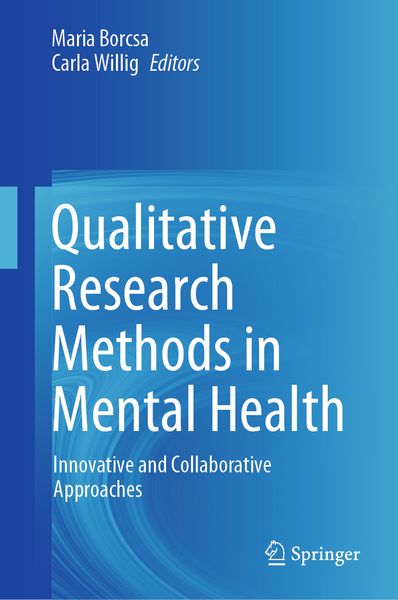
  • Produktbild: Qualitative Research Methods in Mental Health
  • Produktbild: Qualitative Research Methods in Mental Health

Qualitative Research Methods in Mental Health Innovative and Collaborative Approaches

139,99 €

inkl. gesetzl. MwSt., Versandkostenfrei


Beschreibung

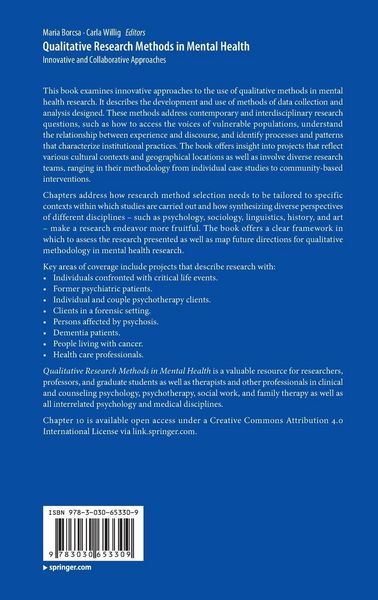
This book examines innovative approaches to the use of qualitative methods in mental health research. It describes the development and use of methods of data collection and analysis designed. These methods address contemporary and interdisciplinary research questions, such as how to access the voices...

Beschreibung

This book examines innovative approaches to the use of qualitative methods in mental health research. It describes the development and use of methods of data collection and analysis designed. These methods address contemporary and interdisciplinary research questions, such as how to access the voices of vulnerable populations, understand the relationship between experience and discourse, and identify processes and patterns that characterize institutional practices. The book offers insight into projects that reflect various cultural contexts and geographical locations as well as involve diverse research teams, ranging in their methodology from individual case studies to community-based interventions.

Chapters address how research method selection needs to be tailored to specific contexts within which studies are carried out and how synthesizing diverse perspectives of different disciplines – such as psychology, sociology, linguistics, history, and art – make a research endeavor more fruitful. The book offers a clear framework in which to assess the research presented in the book as well as map future directions for qualitative methodology in mental health research.

Key areas of coverage include projects that describe research with: • Individuals confronted with critical life events. • Former psychiatric patients. • Individual and couple psychotherapy clients. • Clients in a forensic setting. • Persons affected by psychosis. • Dementia patients. • People living with cancer. • Health care professionals. 

Qualitative Research Methods in Mental Health is a valuable resource for researchers, professors, and graduate students as well as therapists and other professionals in clinical and counseling psychology, psychotherapy, social work, and family therapy as well as all interrelated psychology and medical disciplines.

Rezension

“This diversity of perspectives is well represented in the various chapters of the book. … the chapters do present–in various degrees–the epistemological and procedural founding of the actual qualitative methodology applied in each particular study. … from the methods perspective the prospective reader can expect to be introduced to a large variety of qualitative approaches. … this book should be enjoyed with time and with respect for the rich variety … .” (Jarl Wahlström, European Journal of Psychotherapy & Counselling, December 1, 2021)

Portrait

Maria Borcsa is Professor of Clinical Psychology at the University of Applied Sciences in Nordhausen (UASN), Germany, licensed psychological psychotherapist (CBT), family therapist, trainer and supervisor and founding member of the Institute of Social Medicine, Rehabilitation Sciences and Healthcare Research at UASN. She has published research papers, books and book chapters in the domain of family therapy and systemic practice in German, French, Italian and Greek. She has been board member of the European Family Therapy Association (EFTA) (2007-2016) and President of EFTA from 2013 to 2016.
Carla Willig is Professor of Psychology at City, University of London, UK. She is also a  Chartered Health Psychologist and a registered Counselling Psychologist in private practice. A major theme in her work to date has been a concern with research methodology. She has published empirical and theoretical papers and book chapters concerned with epistemological and methodological questions. She is an associate editor of the Journal of Health Psychology , a member of the editorial board of Qualitative Research in Psychology , and a member of the International Advisory Board of the Journal of Psychological Therapies .

Produktdetails

Einband

Gebundene Ausgabe

Erscheinungsdatum

01.07.2021

Abbildungen

XX, 265 p. 12 illus., 6 illus. in color.

Herausgeber Maria Borcsa + weitere

Produktdetails

Einband

Gebundene Ausgabe

Erscheinungsdatum

01.07.2021

Abbildungen

XX, 265 p. 12 illus., 6 illus. in color.

Herausgeber
Verlag Springer
Seitenzahl

265

Maße (L/B/H)

24,1/16/2,2 cm

Gewicht

548 g

Auflage

1st ed. 2021

Sprache

Englisch

ISBN

978-3-030-65330-9

Herstelleradresse

Springer-Verlag GmbH
Europaplatz 3
69115 Heidelberg
DE

Email: ProductSafety@springernature.com

Noch keine Bewertungen vorhanden

Verfassen Sie die erste Bewertung zu diesem Artikel

Helfen Sie anderen Kundinnen und Kunden durch Ihre Meinung.

Kundinnen und Kunden meinen

Bewertungen (0)

  • Produktbild: Qualitative Research Methods in Mental Health
  • Produktbild: Qualitative Research Methods in Mental Health
  • Chapter 1. Qualitative research in mental health – innovation and collaboration.- Chapter 2. Psychiatrists' perceptions of schizophrenia and its recovery: a thematic analysis.- Chapter 3. Approaching psychotherapy case studies in a metasynthesis: Deficit vs. conflict in treatment of medically unexplained symptoms.- Chapter 4. Walking interviews: Including vulnerable populations in research.- Chapter 5. Using Researcher reflexivity and multiple methods to study the experience of cancer-related distress.- Chapter 6. Listening for what is not being said: Using discourse analytic approaches in mental health research.- Chapter 7. Re-claiming the power of definition – the value of reflexivity in research on mental health at risk.- Chapter 8. Interpersonal Process Recall in systemic research: Investigating couple therapists’ personal and professional selves.- Chapter 9. Bringing mental health back into the dynamics of social coexistence: Emotional Textual Analysis.- Chapter 10. Engraved in the body. Ways of reading Finnish people’s memories of mental hospitals.- Chapter 11. Qualitative research in mental health: Reflections on research questions, methods and knowledge.