
Gutscheinbedingungen

**Gültig bis 14.09.2026 auf Spielzeug, Schreibwaren, Filme, Geschenke & Trends, Musik, tolino eReader & Zubehör, Hörbücher, nicht preisgebundene Bücher und Kalender in der Thalia App. Einzelne Artikel können ausgeschlossen sein. Aufgrund der Buchpreisbindung sind deutschsprachige Bücher und eBooks ausgenommen. Zusätzlich ausgenommen sind Abos & Flatrates, Games, Geschenkkarten/-boxen, Shelfies, Software, Zeitschriften sowie einzelne Artikel von tonies®. Pro Einkauf einmal einlösbar. Nur gültig mit im Onlineshop hinterlegter Bonuscard. Click & Collect nur bei Onlinevorabzahlung möglich. Keine Barauszahlung. Nicht kombinierbar mit anderen Aktionen und Gutscheinen. Gutschein wird auf max. 500€ Bestellwert angerechnet. Nicht gültig für Versandkosten und Services.

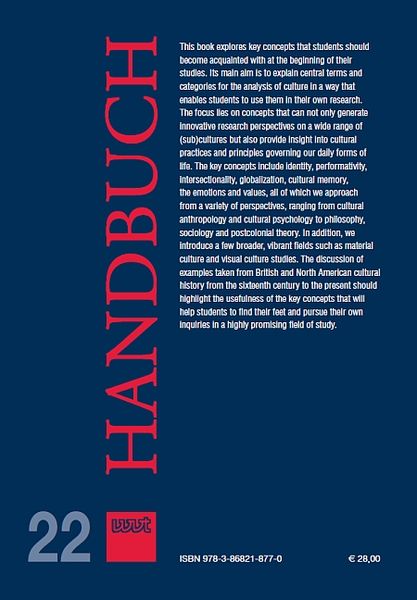
  • Produktbild: Key Concepts for the Study of Culture
  • Produktbild: Key Concepts for the Study of Culture
Band 22

Key Concepts for the Study of Culture An Introduction

1

28,80 €

inkl. gesetzl. MwSt., zzgl. Versandkosten


  • Kostenlose Lieferung ab 30 € Einkaufswert
  • Versandkostenfrei für Bonuscard-Kund*innen

Beschreibung

Produktdetails

Einband

Taschenbuch

Erscheinungsdatum

02.11.2020

Abbildungen

mit 66 Abbildungen

Verlag

WVT Wissenschaftlicher Verlag Trier

Seitenzahl

374

Maße (L/B/H)

22,5/15,7/1,8 cm

Gewicht

671 g

Farbe

Marine

Sprache

Englisch

ISBN

978-3-86821-877-0

Beschreibung

Produktdetails

Einband

Taschenbuch

Erscheinungsdatum

02.11.2020

Abbildungen

mit 66 Abbildungen

Verlag

WVT Wissenschaftlicher Verlag Trier

Seitenzahl

374

Maße (L/B/H)

22,5/15,7/1,8 cm

Gewicht

671 g

Farbe

Marine

Sprache

Englisch

ISBN

978-3-86821-877-0

Herstelleradresse

Wissenschaftlicher Verlag Trier
Bergstr. 27
54295 Trier
DE
wvt@wvttrier.de

Kundinnen und Kunden meinen

Informationen zu Bewertungen

Zur Abgabe einer Bewertung ist eine Anmeldung im Konto notwendig. Die Authentizität der Bewertungen wird von uns nicht überprüft. Wir behalten uns vor, Bewertungstexte, die unseren Richtlinien widersprechen, entsprechend zu kürzen oder zu löschen.

Die Bewertungen sind nach Format, Anzahl Sterne und Datum sortiert.

  • Bewertung

    1/5

    11.02.2023

    Buch (Taschenbuch)

    Ich wünschte ich hätte es nicht kaufen müssen.

    (Bezüglich der Kapitel von Vera Nünning) Ich habe dieses Buch für meine Vorlesung bei Vera Nünning kaufen müssen und bin geschockt. Für eine Frau mit Prof. Titel ist dieses Buch wirklich grottenschlecht. Ich bin dankbar, dass es Korrekturgelesen wurde, da Ihre Sätze teilweise keinen Sinn ergeben (z.b. S. 175, letzte zwei Zeilen). Zusätzlich drehen sich die Kapitel einfach nur im Kreis und kommen nicht auf den Punkt. Immer wieder wird einfach das gleiche mit anderen Wörtern wiederholt. Definitionen der Begrifflichkeiten werden auch nur selten wirklich klar gegeben. Dass Abbildungen dreist recycelt werden, ist da wirklich eines meiner kleineren Probleme (S. 20, figure 4 und S. 183, figure 5). Nicht nur werde ich nie wieder ein Buch, das von Nünning geschrieben werde kaufen, sondern auch nie wieder eine Ihrer Vorlesungen besuchen.

Kundinnen und Kunden meinen

5

0

4

0

3

0

2

0

1

1

Bewertungen (1)

  • Produktbild: Key Concepts for the Study of Culture
  • Produktbild: Key Concepts for the Study of Culture
  • TABLE OF CONTENTS

    1. Meanings and Functions of Culture and Cultural Key Concepts 1

    Major Characteristics of Cultures 2 · Selected Key Concepts for an Understanding of Cultures 9 · Definitions of and Approaches to Culture 12 · Implications of the Meaning-Oriented, Semiotic Understanding of Culture 15 · Dealing With the ‘Other’ 25 · Basic Differences between Cultures 29 · Major Functions of Culture 33 · Aims and Structure of this Book 34 · Bibliography 39

    VERA NÜNNING

    2. Cultural Ways of Worldmaking 43

    Premises for Understanding Ways of Worldmaking 44 · Getting Things Wrong in the Sixteenth Century: ‘Bloody Mary’ – and ‘Fake News’ 46 · Visual Ways of Worldmaking 50 · Narrative as a Means of Worldmaking 59 · Ways of (Narrative) Worldmaking in Cultural History Books 62 · Getting Things Wrong Today: Common Misconceptions and Processes of Worldmaking 72 · Conclusion 80 · Bibliography 81

    VERA NÜNNING

    3. Emotions 85

    ‘Irrational’ Emotions? Definitions 86 · Culture and Emotions 88 · Redefining Emotions in the Eighteenth Century: The Culture of Sensibility as a Case Study of Cultural Change 90 · Discourses Involved in Changing the Role of the Emotions in the Eighteenth Century 95 · The Role of Material Culture with Regard to the New Appreciation of Emotions 102 · Social Practices and Institutions Expressing and Influencing the New Understanding of the Emotions 105 · Criticism of the Culture of Sensibility 108 · Lasting Impact and Further Changes 112 · Bibliography 115

    VERA NÜNNING, CORINNA ASSMANN

    4. Civilization 119

    Introduction: Civilization, Cultural Studies and Norbert Elias 119 · ‘Civilization’: History, Politics, Aesthetics 121 · Civilization and the ‘Saddle Period’ 122 · Case Studies: Christopher Columbus, Cotton Mather, Philip Freneau 127 · Culture as a Civilizing Process: Norbert Elias and Cultural Studies 136 · Bibliography 143

    PHILIPP LÖFFLER

    5. Performance (Studies) and Performativity 147

    Introduction – Definitions 147 · The Study of Performance Before Performance Studies: Some Foundations in Philosophy 151 · The Birth of the Discipline in Anthropology, Ethnography and Sociology 153 · Performative Theories of Language: Austin and Derrida 157 · Performance, Performativity, and Identity: Judith Butler and Pierre Bourdieu 160 · Performance Studies Today: An Interdisciplinary Discipline 162 · Bibliography 165

    MARGIT PETERFY

    6. Identity: Cultural Ways of Making Selves 169

    Defining Selves and Identities 171 · Culture, Narrative and Identity 178 · Creating Selves in the Twenty-First Century 182 · Collective Identities 187 · Us vs. Them: The ‘War on Terror’ Narrative as a Mode of Stabilizing Collective Identity in Times of Crisis 191 · Building Bridges: Functions of Narrative 198 · Bibliography 200

    VERA NÜNNING

    7. Intersectionality in/and Cultural Studies 205

    Introduction 205 · Academic Precursors: The Rise of Race, Class and Gender Studies 207 · The Grounds of Identity: Inwardness Around 1800 213 · Contemporary Responses 218 · Problems of Definition 221 · Conclusion: The Uses of Intersectionality 225 · Bibliography 226

    PHILIPP LÖFFLER

    8. Visual Studies and Culture 231

    Introduction: What Is the ‘Visual Turn’ and Why Should It Concern Us? 231 · How Images Work: Neurophysiological, Cognitive and Psychological Foundations 236 · A (New) World of Man-Made Images 239 · The ‘Pictorial Turn’ and Symbolic and Interpretative Constellations 244 · The Politics of Visibility: The Power of Images 248 · Bibliography 254

    MARGIT PETERFY

    9. Globalization and Cultural Studies 259

    Introduction 259 · Globalization 261 · Globalization and the End of the Cold War 263 · Conclusion: Globalization and Cultures of Unpredictability 271 · Bibliography 272

    PHILIPP LÖFFLER

    10. Material Culture and Intermediality 275

    Introduction – From Material Culture to Intermediality 275 · The Philosophy of Material Culture: From Cultural Materialism to Neo-Materialist Interpretations 276 · Hermeneutic Approaches and Some Influential Methodological Frameworks 279 · Material Culture in Books – Books as Material Culture 282 · Intermediality: From the ‘Sister Arts’ to ‘Media Convergence’ 285 · Bibliography 290

    MARGIT PETERFY

    11. Cultural Memory 295

    Culture and Memory 296 · Individual and Collective Memory 296 · Characteristics and Functions of Cultural Memory 301 · The ‘Indian Mutiny’ or Rebellion as a British and Indian Site of Memory 306 · Conclusion 316 · Bibliography 319

    CORINNA ASSMANN, VERA NÜNNING

    12. Culture and Values 323

    Why Values? 325 · Definitions and Characteristics of Values 328 · Cultural Hierarchies of Values 333 · The Significance and Functions of Values 337 · Hierarchies of Values in Eighteenth-Century Britain 341 · Challenges to Major Hierarchies of Values in the Twenty-First Century 351 · Open Questions and Challenges 353 · Bibliography and Recommendations for Further Reading 356

    VERA NÜNNING

    List of Illustrations 359