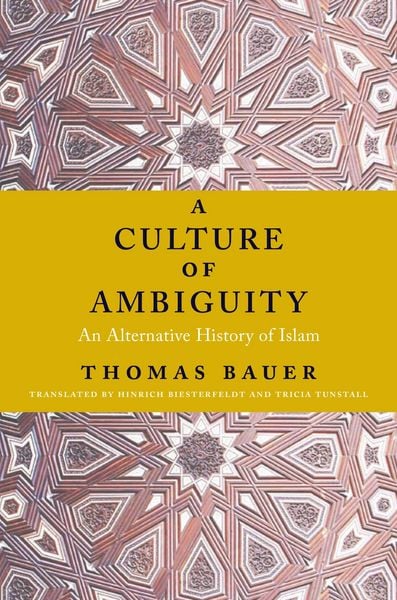
A Culture of Ambiguity An Alternative History of Islam
-
- Taschenbuch
- eBook ausgewählt
-
Form:Einzelkauf Download
-
Sprache:Englisch
- Deutsch 5,49 €
- Englisch 36,00 € ausgewählt
36,00 €
inkl. gesetzl. MwSt.Beschreibung
Produktdetails
Format
ePUB
Kopierschutz
Nein
Family Sharing
Nein
Text-to-Speech
Ja
Erscheinungsdatum
08.06.2021
Verlag
Columbia University PressSeitenzahl
(Printausgabe)
Übersetzt von
Hinrich Biesterfeldt + weitere
Sprache
Englisch
EAN
9780231553322
In the Western imagination, Islamic cultures are dominated by dogmatic religious norms that permit no nuance. Those fighting such stereotypes have countered with a portrait of Islam's medieval "Golden Age," marked by rationality, tolerance, and even proto-secularism. How can we understand Islamic history, culture, and thought beyond this dichotomy?
In this magisterial cultural and intellectual history, Thomas Bauer reconsiders classical and modern Islam by tracing differing attitudes toward ambiguity. Over a span of many centuries, he explores the tension between one strand that aspires to annihilate all uncertainties and establish absolute, uncontestable truths and another, competing tendency that looks for ways to live with ambiguity and accept complexity. Bauer ranges across cultural and linguistic ambiguities, considering premodern Islamic textual and cultural forms from law to Quranic exegesis to literary genres alongside attitudes toward religious minorities and foreigners. He emphasizes the relative absence of conflict between religious and secular discourses in classical Islamic culture, which stands in striking contrast to both present-day fundamentalism and much of European history. Bauer shows how Islam's encounter with the modern West and its demand for certainty helped bring about both Islamicist and secular liberal ideologies that in their own ways rejected ambiguity-and therefore also their own cultural traditions.
Awarded the prestigious Leibniz Prize, A Culture of Ambiguity not only reframes a vast range of Islamic history but also offers an interdisciplinary model for investigating the tolerance of ambiguity across cultures and eras.
Noch keine Bewertungen vorhanden
Verfassen Sie die erste Bewertung zu diesem Artikel
Helfen Sie anderen Kundinnen und Kunden durch Ihre Meinung.
Kurze Frage zu unserer Seite
Vielen Dank für Ihr Feedback
Wir nutzen Ihr Feedback, um unsere Produktseiten zu verbessern. Bitte haben Sie Verständnis, dass wir Ihnen keine Rückmeldung geben können. Falls Sie Kontakt mit uns aufnehmen möchten, können Sie sich aber gerne an unseren Kund*innenservice wenden.
zum Kundenservice