Gutscheinbedingungen

**Gültig nur für Bestellungen an die Wunsch-Poststation bis 10.06.2026 auf Spielzeug, Schreibwaren, Filme, Geschenke & Trends, Musik, tolino eReader & Zubehör, Hörbücher und Hörbuch-Downloads (außer Abo), nicht preisgebundene Bücher und Kalender online auf thalia.at und in der Thalia App. Einzelne Artikel können ausgeschlossen sein. Aufgrund der Buchpreisbindung sind deutschsprachige Bücher und eBooks ausgenommen. Zusätzlich ausgenommen sind preisgebundene Artikel, Abos & Flatrates, eBooks, Games, Geschenkkarten/-boxen, Shelfies, Software, Zeitschriften sowie einzelne Artikel von tonies®. Pro Einkauf einmal einlösbar. Kein Click & Collect möglich. Keine Barauszahlung. Nicht kombinierbar mit anderen Aktionen und Gutscheinen. Gutschein wird auf max. 500€ Bestellwert angerechnet. Nicht gültig für Versandkosten und Services.

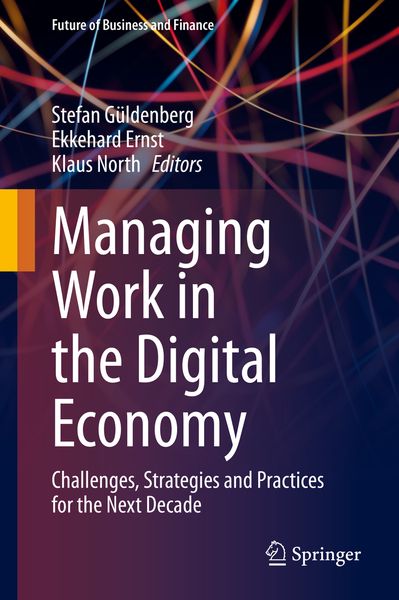
  • Produktbild: Managing Work in the Digital Economy
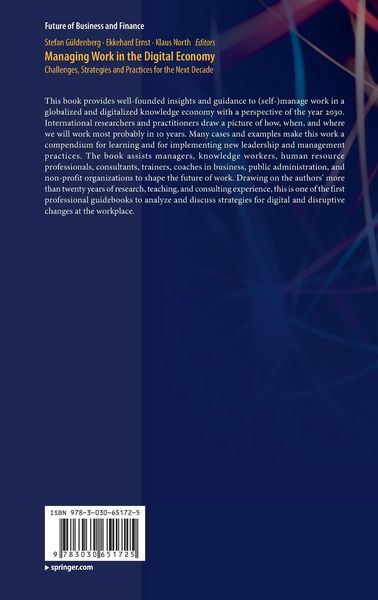
  • Produktbild: Managing Work in the Digital Economy
- 10%

Managing Work in the Digital Economy Challenges, Strategies and Practices for the Next Decade

10% sparen

83,99 € UVP 93,49 €

inkl. gesetzl. MwSt., Versandkostenfrei


Beschreibung

Produktdetails

Einband

Gebundene Ausgabe

Erscheinungsdatum

23.03.2021

Herausgeber

Stefan Güldenberg + weitere

Verlag

Springer

Seitenzahl

247

Maße (L/B/H)

24,1/16/2 cm

Gewicht

565 g

Auflage

1st ed. 2021

Sprache

Englisch

ISBN

978-3-030-65172-5

Beschreibung

Portrait

Prof. Stefan Güldenberg is a pioneer and leading expert on the future of work, digital strategies, sustainable leadership, and knowledge management. He is a university professor, platform founder, strategy consultant, executive coach, and knowledge entrepreneur. He studied Business Mathematics, Philosophy, and English at the University of Ulm, then received his doctorate and habilitation at the Vienna University of Economics and Business. Stefan has 25 years of experience in research, knowledge transfer, and practice. He conducts research on and supports the development of strategy and transformation processes. Stays abroad led him, among others, to Harvard University, the Massachusetts Institute of Technology (MIT), and the National University of Singapore. He is the current Vice President Practice of the European Academy of Management (EURAM) and General Secretary of the New Club of Paris, a think tank and agenda-setter for the knowledge economy.

Dr. Ekkehard Ernst is an internationally recognized expert on the Future of Work at the International Labour Organization. In recent years, his research focused on the implications of artificial intelligence, robots, and blockchain applications on job growth, inequality, and the transition to a sustainable society. In 2017, Ekkehard co-founded Geneva Macro Labs, a Swiss Do-Tank, to offer a platform to identify, develop and implement solutions to address global challenges and existential risks to promote and advance the United Nations Sustainable Development Agenda. Previously, he worked at the Organization for Economic Cooperation and Development (OECD) and the European Central Bank. Ekkehard Ernst has studied in Mannheim, Saarbrucken, and Paris, and holds a Ph.D. from the École des Hautes Études en Sciences Sociales. He regularly advises external partners on labor market issues, including the European Parliament, The Conference Board, the UK Productivity Insights Network, McKinsey, Roland Berger, and Foresight Alliances.

Prof. Klaus North is the Professor of International Management at Wiesbaden Business School, Germany, and previously has been a senior researcher at the International Labour Office (ILO).  His current research covers knowledge and innovation management, human resource development, and digitalization. He has published numerous papers and has written 12 books which were also translated into several languages. His textbook “Knowledge Management – Value Creation Through Organizational Learning” (Springer, 2018) has become an established work on the subject. He frequently consults with major firms and public institutions worldwide and teaches in business programs internationally.  


Produktdetails

Einband

Gebundene Ausgabe

Erscheinungsdatum

23.03.2021

Herausgeber

Verlag

Springer

Seitenzahl

247

Maße (L/B/H)

24,1/16/2 cm

Gewicht

565 g

Auflage

1st ed. 2021

Sprache

Englisch

ISBN

978-3-030-65172-5

Herstelleradresse

Springer-Verlag GmbH
Tiergartenstr. 17
69121 Heidelberg
DE

Email: ProductSafety@springernature.com

Kundinnen und Kunden meinen

0 Bewertungen

Informationen zu Bewertungen

Zur Abgabe einer Bewertung ist eine Anmeldung im Konto notwendig. Die Authentizität der Bewertungen wird von uns nicht überprüft. Wir behalten uns vor, Bewertungstexte, die unseren Richtlinien widersprechen, entsprechend zu kürzen oder zu löschen.

Die Bewertungen sind nach Format, Anzahl Sterne und Datum sortiert.

Verfassen Sie die erste Bewertung zu diesem Artikel

Helfen Sie anderen Kund*innen durch Ihre Meinung

Kundinnen und Kunden meinen

0 Bewertungen filtern

  • Produktbild: Managing Work in the Digital Economy
  • Produktbild: Managing Work in the Digital Economy
  • Prologue.-  Part A Life in 2030.- The World in 2030 – Looking Back Ten Years From Now (Dewan/Ernst/Gravel).- How Humans and Machines Interact (Heinke).- Vignette: Cobot on a Couch: Living with Robotic Companions in 2030 (Richert/Neef) .- Part B Work in 2030.- Job Scenarios 2030 – How the World of Work has Changed around the Globe (Samaan)..- Vignette: A Day in the Life of a Medical Doctor in 2030 (Schnurr) .- New Forms of Creating Value: Platform-Enabled Gig Economy Today and in 2030 (Hamann/Güldenberg).- Working in 2030: Heaven or Hell: Why Regulations, Standards and Workers’ Representation Will Still Matter (Gruber-Risak).- Values vs. Technology? Why We Need to Consider a New Foundation of Work (Hamann).- Part C Leadership in 2030.- The New Roles of Leaders and Leadership in 2030 (Güldenberg).- Digital Leadership and Technology (Güldenberg/Langhof).- Making Collaboration Work (Stoller-Schai).- Vignette: Ella’s Day – Work AnywhereAnytime (Josef). Part D Careers in 2030.-p Smart HRM in 2030 – Conversational HR, Connected Robotics and Controlle.- Analytics (Gärtner/Kern).- Learning in the Year 2030 (North).- Vignette: Communities, Challenges, Curiosity and Coaches – A Corporate Learner in 2030 (Robes) .- Epilogue