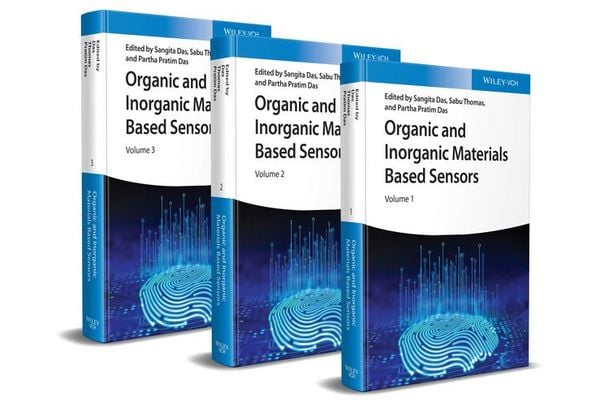
Produktbild: Organic and Inorganic Materials Based Sensors
- 13%

Organic and Inorganic Materials Based Sensors

13% sparen

399,99 € UVP 461,60 €

inkl. gesetzl. MwSt., Versandkostenfrei


Beschreibung

Produktdetails

Einband

Gebundene Ausgabe

Erscheinungsdatum

24.01.2024

Abbildungen

Tabellen, schwarz-weiss, farbige Illustrationen, schwarz-weiss Illustrationen

Herausgeber

Sangita Das + weitere

Verlag

Wiley-VCH

Seitenzahl

1216

Maße (L/B/H)

24,4/17/7,4 cm

Gewicht

2774 g

Auflage

1. Auflage

Sprache

Englisch

ISBN

978-3-527-34955-5

Beschreibung

Portrait

Dr. Sangita Das is working as post-doctoral research fellow at Durham University, England, UK. She received her B. Sc. Degree with Honours in Chemistry in 2008 from University of Calcutta, West Bengal, India. She obtained her M. Sc. Degree in Chemistry with Organic specialization in 2010 from University of Calcutta, Kolkata, West Bengal, India. She had qualified the all India (CSIR-JRF) NET, and then she joined "The Goswami Group", Department of Chemistry, IIEST for her Doctoral work under the supervision of Prof. Shyamaprosad Goswami and obtained her Ph.D degree in 2016. She is now working as a Newton International Fellow in UK. Her current research activities include the development of compounds as HDAC inhibitors, experimental and theoretical investigations of electronic structure of transition metal complexes with redox noninnocent ligands, computational chemistry.

Prof. Sabu Thomas is currently Vice Chancellor of Mahatma Gandhi University, Kerala, India and the Founder Director and Professor of the International and Interuniversity Centre for Nanoscience and Nanotechnology, Mahatma Gandhi University, Kerala, India. He is also a full professor of Polymer Science and Engineering at the School of Chemical Sciences of Mahatma Gandhi University, Kottayam, Kerala, India. Prof. Thomas is an outstanding leader with sustained international acclaims for his work in Nanoscience, Polymer Science and Engineering, Polymer Nanocomposites, Elastomers, Polymer Blends, Interpenetrating Polymer Networks, Polymer Membranes, Green Composites, Nanomedicine and Green Nanotechnology. He has received a number of national and international awards.

Dr. Partha Pratim Das is presently working as a postdoctoral researcher in the Institute of High-Pressure Mineral Physics and Chemistry, Yonsei University, South Korea. He has completed both the B.Sc. (2008) and M.Sc. (2010) in Chemistry from Calcutta University, India. He has received Ph.D. in Science (Chemistry) in 2016 from Jadavpur University, India. His research area is focused on nanotechnology, synthesis and structure-properties correlation studies of different multifunctional nanomaterials under various conditions for mainly clean and sustainable energy and environmental applications.

Produktdetails

Einband

Gebundene Ausgabe

Erscheinungsdatum

24.01.2024

Abbildungen

Tabellen, schwarz-weiss, farbige Illustrationen, schwarz-weiss Illustrationen

Herausgeber

Verlag

Wiley-VCH

Seitenzahl

1216

Maße (L/B/H)

24,4/17/7,4 cm

Gewicht

2774 g

Auflage

1. Auflage

Sprache

Englisch

ISBN

978-3-527-34955-5

Herstelleradresse

Wiley-VCH GmbH
Boschstrasse 12
69469 Weinheim
DE
product_safety@wiley.com

Noch keine Bewertungen vorhanden

Verfassen Sie die erste Bewertung zu diesem Artikel

Helfen Sie anderen Kundinnen und Kunden durch Ihre Meinung.

Kundinnen und Kunden meinen

Bewertungen (0)

  • Produktbild: Organic and Inorganic Materials Based Sensors
  • Volume 1:

    Chapter 1. Introduction: State of the Art, New Challenges and Opportunities of Sensory Devices, Polymer Based Nano-Bio Materials, Opto-Electrochemical Devices as Sensors

    Chapter 2. Introduction to Metal-Organic Frameworks

    Chapter 3. Organic Sensors: Materials and Applications

    Chapter 4. Organic-Inorganic Composite Semiconductor Sensors

    Chapter 5. Exciplex-Excimer Emission from Organic Molecular Dyad

    Chapter 6. Organic-Inorganic Hybrid Hydrogels as Smart Strain Sensors

    Chapter 7. Organic Molecules as Sensory Devices for Selected Toxic Heavy Metals

    Chapter 8. Metal-Organic Frameworks with Electronic Devices and Chemical Sensors

    Chapter 9. Electronic Metal-Organic Framework Sensors

    Chapter 10. MOF Thin Films as Electrochemical Sensor

    Chapter 11. Chemometrics and Sensor Arrays

    Chapter 12. Organic Small-Molecule Mechanofluorochromic Materials

    Chapter 13. Organelle-Specific DNA pH Sensors

    Chapter 14. Colorimetric Chemosensors for the Detection of Environment Polluting Arsenite and Cyanide

    Chapter 15. Organic Electronics and Their Applications as Sensors

    Chapter 16. DNA Biosensorsf

    Chapter 17. Bio-Inspired Transistors

    Chapter 18. Aggregation Induced Emission Bioprobe for Protein Detection and Imaging to Screen the Human Diseases

    Chapter 19. Biodegradable Electronics


    Volume 2:

    Chapter 20. Hybrid Nanomaterials for Biosensors

    Chapter 21. Nanomaterial-Based Transistors for Chemical and Biological Sensing

    Chapter 22. Nanomaterials in Optical Array Based Sensing

    Chapter 23. Organic Nanocrystals as Optical Sensors

    Chapter 24. Conductive Polymer-Based Sensors

    Chapter 25. Organic Polymers for Sensing Devices

    Chapter 26. Polymeric Materials with Mechanochromic Properties

    Chapter 27. Conductive Polymers in Gas Sensors

    Chapter 28. Hybrid Sensor Configurations

    Chapter 29. Flexible Dual-Gate Organic Field-Effect Transistors for Pressure Sensing

    Chapter 30. Optical Sensor in Optoelectronic Applications

    Chapter 31. Reversible Guest-Induced Long-Lasting Luminescence

    Chapter 32. Vapochromic and Vapoluminescent Sensors: Optical Versions of Electronic Noses

    Chapter 33. Electronic Tongue


    Volume 3:

    Chapter 34. Luminescent and Photonic Materials for Sensing Applications

    Chapter 35. Self-Recovering Mechanochromic Luminescence

    Chapter 36. Chiral Sensor Based on Field Effect Transistor

    Chapter 37. Electrochemical and Biomedical Sensors Based on Layered Double Hydroxides

    Chapter 38. Molecular Imprinting Technology Based Electrochemical Sensors for Biomolecules

    Chapter 39. Aggregation-Induced Emission and Piezochromic Luminescence Phosphor

    Chapter 40. pH Sensor Designed for Cancer Cell Discrimination

    Chapter 41. Resistive Sensors for Continuous Monitoring of Air Pollution

    Chapter 42. Toxic E-Waste Terminator: Green and Biodegradable Electronics

    Chapter 43. Carbon Disposable Multifunctional Sensors

    Chapter 44. Sensor Ecosystems for Health Self-Monitoring: Focus on Diabetes Management

    Chapter 45. Investigation of Microwave Resonant Sensors for Use in Detecting Changes of Non-Invasive Blood Glucose Concentration

    Chapter 46. Application of Biosensors for Detection and Monitoring of Water Quality

    Chapter 47. Sensor Principles for Digital Sound Twin

    Chapter 48. Ultra-Sensitive Phosphorescence Sensor

    Chapter 49. Advances in Gold Nanoparticles for Optical Detection of Nerve Agents