KI-Beratung Beta

Gutscheinbedingungen

**Gültig am 25.11.2026 auf fremdsprachige Bücher online auf thalia.at und in der Thalia App. Einzelne Artikel können ausgeschlossen sein. Ausgenommen sind preisgebundene Artikel & eBooks. Pro Einkauf einmal einlösbar. Click & Collect nur bei Onlinevorabzahlung möglich. Keine Barauszahlung. Nicht kombinierbar mit anderen Aktionen und Gutscheinen. Gutschein wird auf max. 500€ Bestellwert angerechnet. Nicht gültig für Geschenkkarten, Versandkosten und Services.

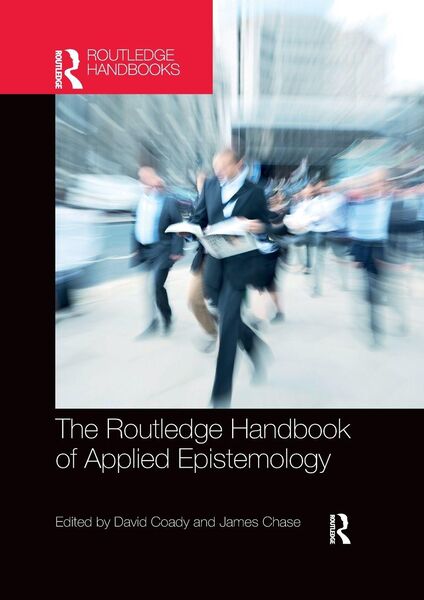
  • Produktbild: The Routledge Handbook of Applied Epistemology
  • Produktbild: The Routledge Handbook of Applied Epistemology

The Routledge Handbook of Applied Epistemology

69,99 €

inkl. gesetzl. MwSt., Versandkostenfrei


Beschreibung

While applied epistemology has been neglected for much of the twentieth century, it has seen emerging interest in recent years, with key thinkers in the field helping to put it on the philosophical map. Although it is an old tradition, current technological and social developments have dramatically changed...

Beschreibung

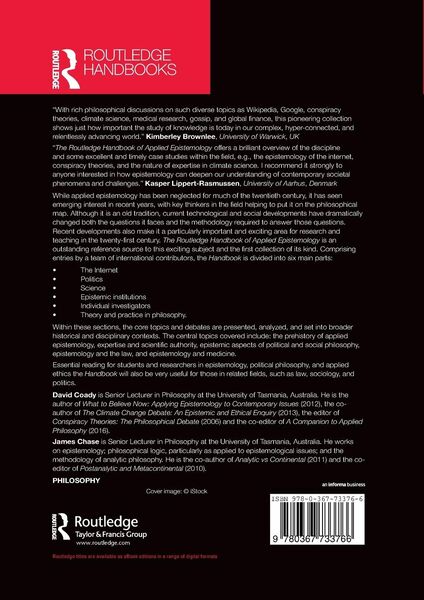
While applied epistemology has been neglected for much of the twentieth century, it has seen emerging interest in recent years, with key thinkers in the field helping to put it on the philosophical map. Although it is an old tradition, current technological and social developments have dramatically changed both the questions it faces and the methodology required to answer those questions. Recent developments also make it a particularly important and exciting area for research and teaching in the twenty-first century. The Routledge Handbook of Applied Epistemology is an outstanding reference source to this exciting subject and the first collection of its kind. Comprising entries by a team of international contributors, the Handbook is divided into six main parts:


  • The Internet

  • Politics

  • Science

  • Epistemic institutions

  • Individual investigators

  • Theory and practice in philosophy.

Within these sections, the core topics and debates are presented, analyzed, and set into broader historical and disciplinary contexts. The central topics covered include: the prehistory of applied epistemology, expertise and scientific authority, epistemic aspects of political and social philosophy, epistemology and the law, and epistemology and medicine.

Essential reading for students and researchers in epistemology, political philosophy, and applied ethics the Handbook will also be very useful for those in related fields, such as law, sociology, and politics.

Rezension

"With rich philosophical discussions on such diverse topics as Wikipedia, Google, conspiracy theories, climate science, medical research, gossip, and global finance, this pioneering collection shows just how important the study of knowledge is today in our complex, hyper-connected, and relentlessly advancing world."

Kimberley Brownlee, University of Warwick, UK

"The Routledge Handbook of Applied Epistemology offers a brilliant overview of the discipline and some excellent and timely case studies within the field, e.g., the epistemology of the internet, conspiracy theories, and the nature of expertise in climate science. I recommend it strongly to anyone interested in how epistemology can deepen our understanding of contemporary societal phenomena and challenges."

Kasper Lippert-Rasmussen, University of Aarhus, Denmark

Produktdetails

Einband

Taschenbuch

Erscheinungsdatum

18.12.2020

Herausgeber David Coady + weitere
Verlag Taylor & Francis

Produktdetails

Einband

Taschenbuch

Erscheinungsdatum

18.12.2020

Herausgeber
Verlag Taylor & Francis
Seitenzahl

358

Maße (L/B/H)

24,6/17,4/1,9 cm

Gewicht

638 g

Sprache

Englisch

ISBN

978-0-367-73376-6

Herstelleradresse

Libri GmbH
Europaallee 1
36244 Bad Hersfeld
DE

Email: gpsr@libri.de

Noch keine Bewertungen vorhanden

Verfassen Sie die erste Bewertung zu diesem Artikel

Helfen Sie anderen Kundinnen und Kunden durch Ihre Meinung.

Kundinnen und Kunden meinen

Bewertungen (0)

Die Leseprobe wird geladen.
  • Produktbild: The Routledge Handbook of Applied Epistemology
  • Produktbild: The Routledge Handbook of Applied Epistemology
  • Notes on contributors. PART I Introduction 1. The return of applied epistemology, James Chase and David Coady. PART II The internet. 2. The World Wide Web, Paul Smart and Nigel Shadbolt. 3. Wikipedia, Karen Frost-Arnold. 4. Googling, Hanna Kiri Gunn and Michael P. Lynch. 5. Adversarial epistemology on the internet, Don Fallis. PART III Politics. 6. John Stuart Mill on free speech, Daniel Halliday and Helen McCabe. 7. Epistemic democracy, Jason Brennan. 8. Epistemic injustice and feminist epistemology, Andrea Pitts. 9. Propaganda and ideology, Randal Marlin. PART IV Science. 10. Expertise in climate science, Stephen John. 11. Evidence-based medicine, Robyn Bluhm and Kirstin Borgerson. 12. The precautionary principle in medical research and policy: the case of sponsorship bias, Daniel Steel. 13 Psychology and conspiracy theories, David Coady. PART V Epistemic institutions. 14 Legal burdens of proof and statistical evidence, Georgi Gardiner. 15. Banking and finance: disentangling the epistemic failings of the 2008 financial crisis, Lisa Warenski. 16. Applied epistemology of education, Ben Kotzee. PART VI Individual investigators. 17. Disagreement, Tim Kenyon. 18. Forecasting, Steve Fuller. 19. Rumor, Axel Gelfert. 20. Gossip, Tommaso Bertolotti and Lorenzo Magnani. 21. The applied epistemology of conspiracy theories: an overview, M R.X Dentith and Brian L. Keeley. PART VII Theory and practice in philosophy. 22. Philosophical expertise, Bryan Frances, 23. Ethical expertise, Christopher Cowley. 24. The demise of grand narratives? Postmodernism, power-knowledge, and applied epistemology, Matthew Sharpe. Index.