KI-Beratung Beta

  • Produktbild: Mathematics of Planet Earth
  • Produktbild: Mathematics of Planet Earth
Band 5

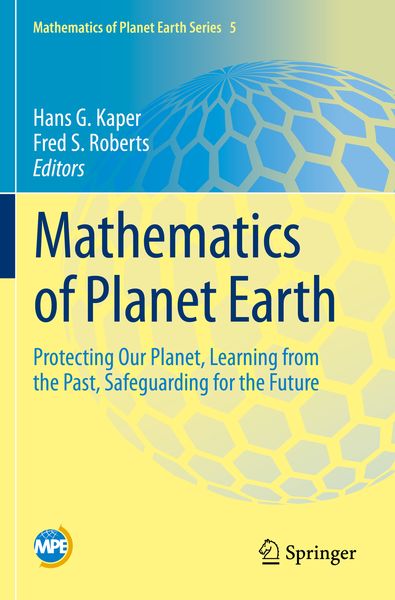
Mathematics of Planet Earth Protecting Our Planet, Learning from the Past, Safeguarding for the Future

161,99 €

inkl. gesetzl. MwSt., Versandkostenfrei


Beschreibung

Since its inception in 2013, Mathematics of Planet Earth (MPE) focuses on mathematical issues arising in the study of our planet. Interested in the impact of human activities on the Earth’s system, this multidisciplinary field considers the planet not only as a physical system, but also as a system supporting...

Beschreibung

Since its inception in 2013, Mathematics of Planet Earth (MPE) focuses on mathematical issues arising in the study of our planet. Interested in the impact of human activities on the Earth’s system, this multidisciplinary field considers the planet not only as a physical system, but also as a system supporting life, a system organized by humans, and a system at risk.

The articles collected in this volume demonstrate the breadth of techniques and tools from mathematics, statistics, and operations research used in MPE.  Topics include climate modeling, the spread of infectious diseases, stability of ecosystems, ecosystem services, biodiversity, infrastructure restoration after an extreme event, urban environments, food security, and food safety. Demonstrating the mathematical sciences in action, this book presents real-world challenges for the mathematical sciences, highlighting applications to issues of current concern to society. Arranged into three topical sections (Geo- and Physical Sciences; Life Sciences, Ecology and Evolution; Socio-economics and Infrastructure), thirteen chapters address questions such as how to measure biodiversity, what mathematics can say about the sixth mass extinction, how to optimize the long-term human use of natural capital, and the impact of data on infrastructure management. The book also treats the subject of infectious diseases with new examples and presents an introduction to the mathematics of food systems and food security.

Each chapter functions as an introduction that can be studied independently, offering source material for graduate student seminars and self-study. The range of featured research topics provides mathematical scientists with starting points for the study of our planet and the impact of human activities.  At the same time, it offers application scientists a plethora of modern mathematical tools and techniques to address the various topics in practice. Including hundreds of references to the vast literature associated with each topic, this book serves as an inspiration for further research. 


Rezension

“The books in this series are intended to be written and to be read by a broad range of pure or applied mathematicians, engineers, scientists, and other researchers.” (Adhemar Bultheel, European Mathematical Society, November 25, 2019)

Produktdetails

Einband

Taschenbuch

Erscheinungsdatum

13.11.2020

Abbildungen

XIX, 374 p. 100 illus., 80 illus. in color.

Herausgeber Hans G. Kaper + weitere

Produktdetails

Einband

Taschenbuch

Erscheinungsdatum

13.11.2020

Abbildungen

XIX, 374 p. 100 illus., 80 illus. in color.

Herausgeber
Verlag Springer
Seitenzahl

374

Maße (L/B/H)

23,5/15,5/2,2 cm

Gewicht

598 g

Auflage

20001 Auflage 1st edition 2019

Sprache

Englisch

ISBN

978-3-030-22046-4

Herstelleradresse

Springer-Verlag KG
Sachsenplatz 4-6
1201 Wien
AT

Email: ProductSafety@springernature.com

Noch keine Bewertungen vorhanden

Verfassen Sie die erste Bewertung zu diesem Artikel

Helfen Sie anderen Kundinnen und Kunden durch Ihre Meinung.

Kundinnen und Kunden meinen

Bewertungen (0)

  • Produktbild: Mathematics of Planet Earth
  • Produktbild: Mathematics of Planet Earth
  • Part I Geo- and Physical Sciences.- Modeling the Dynamics of Glacial Cycles.- Mathematics of the Not-So-Solid Solid Earth.- Mathematical Challenges in Measuring Variability Patterns for Precipitation Analysis.- Part II Life Sciences.- Mathematics of Malaria and Climate Change.- A Risk-Structured Mathematical Model of Buruli Ulcer Disease in Ghana.- Data-informed Modeling in the Health Sciences.- Part III Ecology and Evolution.- Multistability in Ecosystems: Concerns and Opportunities for Ecosystem Function in Variable Environments.- Measurement of Biodiversity: Richness and Evenness.- The Mathematics of Extinction Across Scales: From Populations to the Biosphere.- Part IV Socio-economics and Infrastructure.- Modeling Food Systems.- Dynamic Optimization, Natural Capital, and Ecosystem Services.- Quantitative Models for Infrastructure Restoration after Extreme Events: Network Optimization meets Scheduling.- The Internet of Things and Machine Learning, Solutions for Urban Infrastructure Management.