Gutscheinbedingungen

**Gültig bis 06.07.2026 auf fremdsprachige Bücher online auf thalia.at, in der Thalia App ab einem Mindestbestellwert von 30€ und in allen Thalia Buchhandlungen in Österreich. In den Buchhandlungen nur gültig auf lagernde Ware. Einzelne Artikel können ausgeschlossen sein. Ausgenommen sind preisgebundene Artikel & eBooks. Pro Einkauf einmal einlösbar. Nur gültig gegen Vorlage oder im Onlineshop hinterlegter Bonuscard. Infos zur Einlösung in der Buchhandlung sind auf der Bonuscard-Vorteilspreisseite zu finden. Click & Collect nur bei Onlinevorabzahlung möglich. Keine Einlösung bei Scan & Go-Bezahlung. Keine Barauszahlung. Nicht kombinierbar mit anderen Aktionen und Gutscheinen. Gutschein wird auf max. 500€ Bestellwert angerechnet. Nicht gültig für Versandkosten und Services.

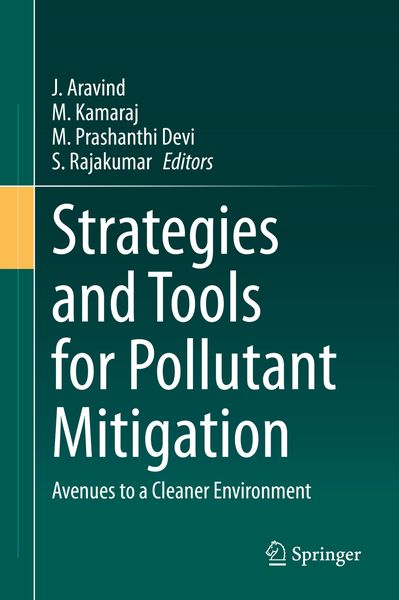
  • Produktbild: Strategies and Tools for Pollutant Mitigation
  • Produktbild: Strategies and Tools for Pollutant Mitigation

Strategies and Tools for Pollutant Mitigation Avenues to a Cleaner Environment

139,99 €

inkl. gesetzl. MwSt., Versandkostenfrei


Beschreibung

Produktdetails

Einband

Gebundene Ausgabe

Erscheinungsdatum

25.03.2021

Herausgeber

J. Aravind + weitere

Verlag

Springer

Seitenzahl

450

Maße (L/B/H)

24,1/16/3,1 cm

Gewicht

852 g

Auflage

1st ed. 2021

Sprache

Englisch

ISBN

978-3-030-63574-9

Beschreibung

Portrait

Dr. J. Aravind is a Professor in the Civil Engineering Department at Dhirajlal Gandhi College of Technology, India. He is an Associate Editor in International Journal of Environmental Science and Technology (Springer Nature), has published 50 plus articles with a cumulative impact factor of 62.96, google h-index 15 (Scopus h-index 10) with total citations of 690  (Scopus citation of 395), also co-editor of Bio-remediation and Sustainable Technologies for Cleaner Environment- Springer Nature, one among top 25% downloads for three consecutive years 2017-19.

Dr. M. Kamaraj is an Associate Professor in the Department of Biotechnology at Addis Ababa Science and Technology University, Ethiopia.  He has seven years of research and teaching experience (India and Ethiopia). He has published 36 research articles (with a cumulative impact factor of 38.25) and 2 book chapters and have a Google h index -11 with total citations of 565.

Dr. M. Prashanthi is an Assistant Professor in the Department of Environmental Management at Bharathidasan University, India, with an experience of fifteen years of research in Environmental Health and Waste Management. Her research work concentrates on mapping of environmental exposures to health issues using RS and GIS techniques. She has published 44 research papers and authored two books. She has edited two books with Springer on Integrated Waste Management in India and Bioremediation and sustainable technologies for cleaner environment.

Dr. S. Rajakumar is an Assistant Professor in the Department of Marine Biotechnology at Bharathidasan University, India. He has a research experience of fourteen years specialising in Environmental Microbiology and Bioremediation, his important research works include Biomethanation and bioconversion of marine weeds, Detoxification of Benzene, Toluene, Ethyl benzene and Xylene (BTEX) and its derivatives and Biodegradation of Arsenic and Lead from Groundwaterand soil. Having published 50 research papers, he has edited two books with Springer publications.


Produktdetails

Einband

Gebundene Ausgabe

Erscheinungsdatum

25.03.2021

Herausgeber

Verlag

Springer

Seitenzahl

450

Maße (L/B/H)

24,1/16/3,1 cm

Gewicht

852 g

Auflage

1st ed. 2021

Sprache

Englisch

ISBN

978-3-030-63574-9

Herstelleradresse

Springer-Verlag KG
Sachsenplatz 4-6
1201 Wien
AT

Email: GPSR Kontakt

Noch keine Bewertungen vorhanden

Verfassen Sie die erste Bewertung zu diesem Artikel

Helfen Sie anderen Kundinnen und Kunden durch Ihre Meinung.

Kundinnen und Kunden meinen

Bewertungen (0)

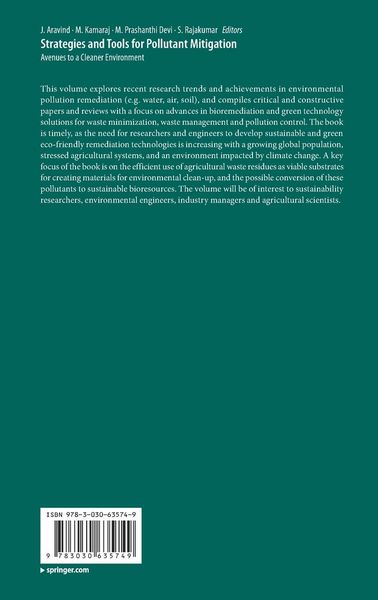
  • Produktbild: Strategies and Tools for Pollutant Mitigation
  • Produktbild: Strategies and Tools for Pollutant Mitigation
  • Part I- Reviews on energy and environment.- Chapter 1. A review on production, properties and applications microbial surfactants as a promising biomolecule for environmental applications (Kidist Mulugeta, M. Kamaraj, Mesfin Tafesse & J. Aravind).- Chapter 2. Hairy Root Applications in Phytoremediation – An updated Review (Anil Kumar Moola, Balasubramanian P, Lakkakula Satish, Sasanala Shamili, Manikandan Ramesh, T. Senthil Kumar & B. D. Ranjitha Kumari).- Chapter 3. Pretreatment of wheat straw using ionic liquids for bioethanol production – A review (Ibsa Neme & Chandra Masi).- Chapter 4. Harnessing the sustainable bioresource, cellulose at the nanoscale for multifarious environmental applications (Ebrahim M. Abda & Rocktotpal Konwarh).- Chapter 5. Allelochemicals as natural herbicides for sustainable agriculture to promote a cleaner environment- A review (Hemalatha Palanivel, Gebiyaw Tilaye, Sathish Kumar Belliathan, Solomon Benor, Solomon Abera & Kamaraj M).- Chapter 6. Strategiesand limitations of water treatment methods for point-of-use application (N. R. Srinivasan, M. Kamaraj & S. Venkatesa Prabhu).- Part II - Cleaner technologies on mitigation of organic and inorganic pollutants.- Chapter 7. Recent trends in application of Bacterial polymers to mitigate organic and inorganic pollutants (P Muthukumaran, J Aravind, M Kamaraj & KK Ramachandran).- Chapter 8. Bioremediation: Efficient technology to combat Pesticide pollutants in Environment (Raman Kumar Ravi & R.Y. Hiranmai).- Chapter 9. Removal of dyes from industrial effluents using bioremediation technique (Narayana Saibaba K.V.).- Chapter 10. A harmless approach on textile effluent detoxification: bioremediation and its recent strategies (R. Kavitha, S. Venkatesa Prabhu & Melkamu Kifetew. M).- Chapter 11. Modern Bioremediation Approaches for Clean and Green Environment (AnkitaMurmu, S. Murugan).- Chapter 12. Arsenic-transforming bacteria – A potential weapon for Arsenic contaminated soil (Radhesh Krishnan Subramanian & Prabhakaran Narayanasamy).- Chapter 13. Phycoremediation of heavy metals, factors involved and mechanisms related to functional groups in the algae cell surface- A review (Abate Ayele, Arumuganainar Suresh & Solomon Benor).- Chapter 14. Heavy Metal Extraction from E-Waste through Bioleaching: A Promising Ecofriendly Approach (S. Venkatesa Prabhu, N.R. Srinivasan & Sintayehu Mekuria. H.).- Chapter 15. Potential of Free Floating Macrophytes for Bioremediation of Heavy Metals – A conceptual Review (Punita Parikh & Krupa Unadkat).- Chapter 16. Bioremediation of heavy metals using Salvinia molesta – a freshwater aquatic weed for pollutant remediation approach (Nithya T.G, Snegapriya P & Kamaraj M).- Chapter 17. Mycoremediation: Fungal-based technology for biosorption of heavy metals – A Review (Abate Ayele, Setegn Haile, Digafe Alemu, Tamiru Tesfay & Kamaraj Murugesan).- Part III - Impact and risk assessments.- Chapter 18. Geospatial modelling of air pollution and its impact on the health of urban residents using spatial statistical models - A review (Janani Selvaraj, Harathi Dayalan & Prashanthi Devi M).- Chapter 19. Health impacts of contaminated water in India: Coping Strategies for Sustainable Development (J.V. Arun & A. Premkumar).- Chapter 20. The potential of biotechnology on soil quality by minimizing agrochemical impact to ensure sustainable agriculture - A review (Solomon Abera)