KI-Beratung Beta

  • Produktbild: The Impact of Feedback in Higher Education
  • Produktbild: The Impact of Feedback in Higher Education
- 10%

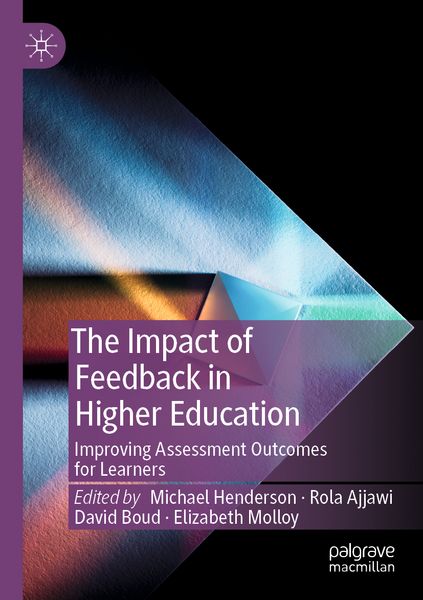
The Impact of Feedback in Higher Education Improving Assessment Outcomes for Learners

10% sparen

157,99 € UVP 175,99 €

inkl. gesetzl. MwSt., Versandkostenfrei


Beschreibung

This book asks how we might conceptualise, design for and evaluate the impact of feedback in higher education. Ultimately, the purpose of feedback is to improve what students can do: therefore, effective feedback must have impact. Students need to be actively engaged in seeking, sense-making and acting...

Beschreibung

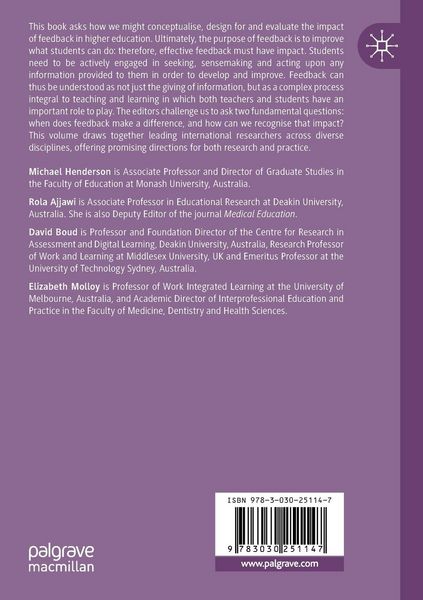
This book asks how we might conceptualise, design for and evaluate the impact of feedback in higher education. Ultimately, the purpose of feedback is to improve what students can do: therefore, effective feedback must have impact. Students need to be actively engaged in seeking, sense-making and acting upon any information provided to them in order to develop and improve. Feedback can thus be understood as not just the giving of information, but as a complex process integral to teaching and learning in which both teachers and students have an important role to play. The editors challenge us to ask two fundamental questions: when does feedback make a difference, and how can we recognise that impact? This volume draws together leading international researchers across diverse disciplines, offering promising directions for both research and practice.

Portrait

Michael Henderson is Associate Professor and Director of Graduate Studies in the Faculty of Education at Monash University, Australia.  Rola Ajjawi is Associate Professor in Educational Research at Deakin University, Australia. She is also Deputy Editor of the journal Medical Education. David Boud is Professor and Foundation Director of the Centre for Research in Assessment and Digital Learning, Deakin University, Australia, Research Professor of Work and Learning at Middlesex University, UK and Emeritus Professor at the University of Technology Sydney, Australia.  Elizabeth Molloy is Professor of Work Integrated Learning at the University of Melbourne, Australia, and Academic Director of Interprofessional Education and Practice in the Faculty of Medicine, Dentistry and Health Sciences.

Produktdetails

Einband

Taschenbuch

Erscheinungsdatum

26.09.2020

Abbildungen

XIX, 303 p. 6 illus., 1 illus. in color.

Herausgeber Michael Henderson + weitere

Produktdetails

Einband

Taschenbuch

Erscheinungsdatum

26.09.2020

Abbildungen

XIX, 303 p. 6 illus., 1 illus. in color.

Herausgeber
Verlag Springer
Seitenzahl

303

Maße (L/B/H)

21/14,8/1,8 cm

Gewicht

421 g

Auflage

20001 Auflage 1st edition 2019

Sprache

Englisch

ISBN

978-3-030-25114-7

Herstelleradresse

Springer-Verlag GmbH
Tiergartenstr. 17
69121 Heidelberg
DE

Email: ProductSafety@springernature.com

Noch keine Bewertungen vorhanden

Verfassen Sie die erste Bewertung zu diesem Artikel

Helfen Sie anderen Kundinnen und Kunden durch Ihre Meinung.

Kundinnen und Kunden meinen

Bewertungen (0)

Weitere Artikel finden Sie in

  • Produktbild: The Impact of Feedback in Higher Education
  • Produktbild: The Impact of Feedback in Higher Education
  • Chapter 1. Why focus on feedback impact?; Michael Henderson, Rola Ajjawi, David Boud and Elizabeth Molloy.- Chapter 2. Identifying feedback that has impact; Michael Henderson, Rola Ajjawi, David Boud and Elizabeth Molloy.- Chapter 3. Beware the simple impact measure: learning from the parallels with student engagement; Joanna Tai, Phillip Dawson, Margaret Bearman and Rola Ajjawi.- Chapter 4. Learners' feedback literacy and the longer term: Developing capacity for impact; David Carless.- Chapter 5. Re-conceptualizing feedback through a sociocultural lens; Rachelle Esterhazy.- Chapter 6. Attending to emotion in feedback; Elizabeth Molloy, Christy Noble, Rola Ajjawi.- Chapter 7. Embracing errors for learning: Intrapersonal and interpersonal factors in feedback provision and processing in dyadic interactions; Jochem E.J. Aben, Filitsa Dingyloudi, Anneke C. Timmermans, Jan-Willem Strjibos.- Chapter 8. Operationalising dialogic feedback to develop students' evaluative judgement and enactmentof feedback; Edd Pitt.- Chapter 9. Turning self-assessment into self-feedback; Ernesto Panadero, Anastasiya Lipnevich and Jaclyn Broadbent.- Chapter 10. How debriefing can inform feedback: practices that make a difference; Margaret Bearman, Walter Eppich, Debra Nestel.- Chapter 11. Impact of personalized feedback: The case of coaching and learning change plans; Jocelyn M Lockyer, Heather A Armson, Karen D Könings, Marygrace Zetkulic, Joan Sargeant.- Chapter 12. Identifying the impact of feedback over time and at scale: Opportunities for learning analytics; Tracii Ryan, Dragan Gašević and Michael Henderson.- Chapter 13. Facilitating students' use of feedback: Capturing and tracking impact using digital tools; Naomi Winstone.- Chapter 14. Improving feedback research in naturalistic settings; Rola Ajjawi, David Boud, Michael Henderson, Elizabeth Molloy.- Chapter 15. Designing feedback for impact; Michael Henderson, Elizabeth Molloy, Rola Ajjawi, David Boud.