KI-Beratung Beta

Gutscheinbedingungen

**Gültig bis 30.11.2026 auf Spielzeug, Schreibwaren, Filme, Geschenke & Trends, Musik, tolino eReader & Zubehör, Hörbücher und Hörbuch-Downloads, nicht preisgebundene Bücher und Kalender online auf thalia.at und in der Thalia App. Einzelne Artikel können ausgeschlossen sein. Aufgrund der Buchpreisbindung sind deutschsprachige Bücher und eBooks ausgenommen. Zusätzlich ausgenommen sind Abos & Flatrates, Games, Geschenkkarten/-boxen, Shelfies, Software, Zeitschriften sowie einzelne Artikel von tonies®. Pro Einkauf einmal einlösbar. Nur gültig mit im Onlineshop hinterlegter Bonuscard. Click & Collect nur bei Onlinevorabzahlung möglich. Keine Barauszahlung. Nicht kombinierbar mit anderen Aktionen und Gutscheinen. Gutschein wird auf max. 500€ Bestellwert angerechnet. Nicht gültig für Versandkosten und Services.

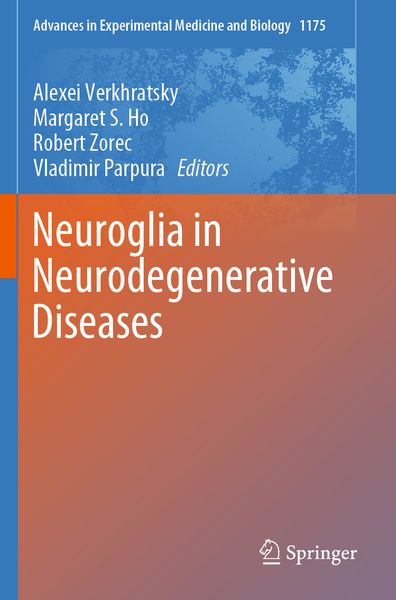
Produktbild: Neuroglia in Neurodegenerative Diseases
Band 1175

Neuroglia in Neurodegenerative Diseases

186,99 €

inkl. gesetzl. MwSt., Versandkostenfrei


Beschreibung

This book provides a comprehensive overview of the role of neuroglia in neurodegenerative diseases. Neuroglia are the most abundant cells in the nervous system and consist of several distinct cell types, such as astrocytes, oligodendrocytes,and microglia. Accumulating evidence suggests that neuroglia...

Beschreibung

This book provides a comprehensive overview of the role of neuroglia in neurodegenerative diseases. Neuroglia are the most abundant cells in the nervous system and consist of several distinct cell types, such as astrocytes, oligodendrocytes,and microglia. Accumulating evidence suggests that neuroglia participate in the neurodegenerative process, and as such are essential players in a variety of diseases, including Alzheimer’s, Parkinson’s, and Huntington’s.

Intended for researchers and students, the book presents recent advances concerning the biology of neuroglia as well as their interaction with neurons during disease progression. In addition, to highlight the function of neuroglia in different types of neurodegenerative disease, it also discusses their mechanisms and effects on protecting or damaging neurons.

Portrait

Professor Alexei Verkhratsky, PhD, D.Sc, Member of Academia Europaea (2003), Member of the German National Academy of Sciences Leopoldina (2013), Member of Real Academia Nacional de Farmacia of Spain (2012), member of Polish Academy of Sciences (2017); member of The Dana Alliance for Brain Initiatives (2012),  distinguished professor of Chengdu University of Traditional Chinese Medicine and Jinan University. Alexei also serves as a Research Professor of the Ikerbasque (Basque Research Council) in Bilbao, where, from 2012, he acts as Adjunct Scientific Director of the Achucarro Basque Centre for Neuroscience. A.Verkhratsky is the editor-in-chief of Cell Calcium, Deputy Editor-in Chief of Cell Death & Disease and member of editorial boards of many journals including Pflugers Archiv, Glia, Acta Physilogica, Purinergic Signalling, ASN Neuro etc. 

Alexei Verkhratsky is an internationally recognised scholar in the field of cellular neurophysiology. His research is conc^23500 times, H-index 81 (Scopus, 2018).

Dr. Margaret Ho is an Associate Professor at School of Life Science and Technology, ShanghaiTech University, China. She is an editorial board member for the journal “ASN Neuro” and a reviewer for a number of journals. Her research focuses on functions of neuroglia in neural circuits and neurodegenerative diseases. She has published more than 20 research articles in this field.

Dr. Vladimir Parpura is Professor at the Department of Neurobiology, The University of Alabama at Birmingham, USA;  and Honorary Professor at University of Rijeka, Croatia. He is President of the American Society for Neurochemistry. He is a Member of Academia Europaea and a Corresponding Member of Slovenian Academy of Sciences and Arts. He discovered astrocyte-neuron glutamate-mediated signaling pathway, i.e. gliotransmission. Parpura has been interfacing neuroscience with nanoscience/nanotechnology, neurochemistry, synthetic biology and biomedical engineering.

Dr. Robert Zorec is Professor at the University of Ljubljana, Faculty of Medicine, a Member of Academia Europaea (London) and the Slovenian Academy of Sciences and Arts (est. 1693 as Academia Operosorum, currently acting as Vice-President), and has been a Member of the Committee for Advanced Therapies at the European Medicine’s Agency (London), 2009-2013. His research focus are molecular mechanisms of regulated exocytosis and single cell physiology studies. Independently of the Nobel Laureate Erwin Neher, he developed his own membrane capacitance measurements technology to monitor vesicle trafficking mechanisms in eukaryotic cells. In the field of neuroglia his work established that, as in neurons, vesicle-based mechanisms operate in these cells, however at  a  much slower time-domain than in neurons, and that these cells represent excitation-energy coupling hubs in the central nervous system. Based on membrane fusion experiments, his lab has developed autologous advanced cell-based medicines (i.e.HybriCure® an immunohybridoma-based immunotherapy) to treat castration resistant prostate cancer with encouraging results for the patients.
Produktdetails

Einband

Taschenbuch

Erscheinungsdatum

17.10.2020

Abbildungen

X, 405 p. 58 illus., 48 illus. in color.

Herausgeber Alexei Verkhratsky + weitere

Produktdetails

Einband

Taschenbuch

Erscheinungsdatum

17.10.2020

Abbildungen

X, 405 p. 58 illus., 48 illus. in color.

Herausgeber
Verlag Springer Singapore
Seitenzahl

405

Maße (L/B/H)

23,5/15,5/2,3 cm

Gewicht

628 g

Auflage

1st ed. 2019

Sprache

Englisch

ISBN

978-981-13-9915-2

Herstelleradresse

Springer-Verlag KG
Sachsenplatz 4-6
1201 Wien
AT

Email: ProductSafety@springernature.com

Noch keine Bewertungen vorhanden

Verfassen Sie die erste Bewertung zu diesem Artikel

Helfen Sie anderen Kundinnen und Kunden durch Ihre Meinung.

Kundinnen und Kunden meinen

Bewertungen (0)

  • Produktbild: Neuroglia in Neurodegenerative Diseases
  • Introduction to neuroglia: history, definition, development and main functions.- Evolution of astroglia.- Physiology of astroglia.- Glicoryne system: glial cells as secretory cells of the CNS.- Physiology of oligodendroglia and NG-2 glia.- Physiology of microglia.- General pathophysiology of neuroglia.- Neuroglia in ageing.- In vivo imaging of neuroglia in neurodegenerative diseases.- Astroglia in leukodystrophies.- Astrocytes in ALS.- Astroglia in Alzheimer's disease.- Oligodendrogia in Alzheimer's disease.- Microglia in AD.- Neuroglia in Parkinson's disease.- Neuroglia in Huntington disease.- Neuroglia as a therapeutic target.- Stem cell derived neuroglia: new tool for research and treatment of neurodegenerative diseases