
Mathematical Communities in the Reconstruction After the Great War 1918–1928 Trajectories and Institutions
-
- Hardcover ausgewählt
- Taschenbuch
- eBook
-
Sprache:Englisch
129,99 €
inkl. gesetzl. MwSt.,
Beschreibung
Produktdetails
Einband
Gebundene Ausgabe
Erscheinungsdatum
28.03.2021
Abbildungen
XVI, 363 p. 45 illus., 16 illus. in color.
Herausgeber
Laurent Mazliak + weitereVerlag
SpringerSeitenzahl
363
Maße (L/B/H)
24,1/16/2,6 cm
Gewicht
735 g
Auflage
21001 Auflage 1st edition 2021
Sprache
Englisch
ISBN
978-3-030-61682-3
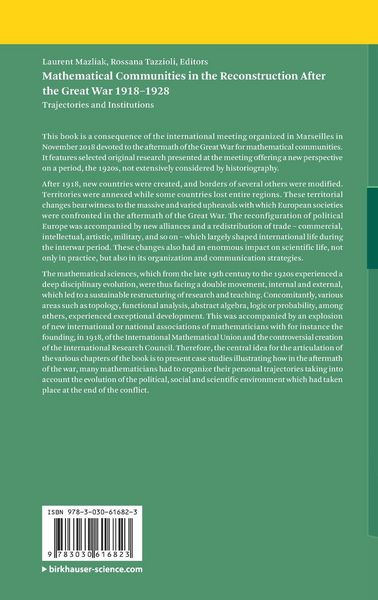
This book is a consequence of the international meeting organized in Marseilles in November 2018 devoted to the aftermath of the Great War for mathematical communities. It features selected original research presented at the meeting offering a new perspective on a period, the 1920s, not extensively considered by historiography.
After 1918, new countries were created, and borders of several others were modified. Territories were annexed while some countries lost entire regions. These territorial changes bear witness to the massive and varied upheavals with which European societies were confronted in the aftermath of the Great War. The reconfiguration of political Europe was accompanied by new alliances and a redistribution of trade – commercial, intellectual, artistic, military, and so on – which largely shaped international life during the interwar period. These changes also had an enormous impact on scientific life, not only in practice, but also in its organization and communication strategies.
The mathematical sciences, which from the late 19th century to the 1920s experienced a deep disciplinary evolution, were thus facing a double movement, internal and external, which led to a sustainable restructuring of research and teaching. Concomitantly, various areas such as topology, functional analysis, abstract algebra, logic or probability, among others, experienced exceptional development. This was accompanied by an explosion of new international or national associations of mathematicians with for instance the founding, in 1918, of the International Mathematical Union and the controversial creation of the International Research Council. Therefore, the central idea for the articulation of the various chapters of the book is to present case studies illustrating how in the aftermath of the war, many mathematicians had to organize their personal trajectories taking into account the evolution of the political, social and scientific environment which had taken place at the end of the conflict.
Noch keine Bewertungen vorhanden
Verfassen Sie die erste Bewertung zu diesem Artikel
Helfen Sie anderen Kundinnen und Kunden durch Ihre Meinung.
Kurze Frage zu unserer Seite
Vielen Dank für Ihr Feedback
Wir nutzen Ihr Feedback, um unsere Produktseiten zu verbessern. Bitte haben Sie Verständnis, dass wir Ihnen keine Rückmeldung geben können. Falls Sie Kontakt mit uns aufnehmen möchten, können Sie sich aber gerne an unseren Kund*innenservice wenden.
zum Kundenservice