Gutscheinbedingungen

**Gültig bis 24.09.2026 ab einem Mindestbestellwert von 30€ auf Spielzeug, Schreibwaren, Filme, Geschenke & Trends, Musik, tolino eReader & Zubehör, Hörbücher und Hörbuch-Downloads, nicht preisgebundene Bücher und Kalender online auf thalia.at und in der Thalia App. Einzelne Artikel können ausgeschlossen sein. Aufgrund der Buchpreisbindung sind deutschsprachige Bücher und eBooks ausgenommen. Zusätzlich ausgenommen sind Abos & Flatrates, Games, Geschenkkarten/-boxen, Shelfies, Software, Zeitschriften sowie einzelne Artikel von tonies®. Pro Einkauf einmal einlösbar. Click & Collect nur bei Onlinevorabzahlung möglich. Keine Barauszahlung. Nicht kombinierbar mit anderen Aktionen und Gutscheinen. Gutschein wird auf max. 500€ Bestellwert angerechnet. Nicht gültig für Versandkosten und Services. Preisgebundene Artikel sind vom Mindestbestellwert ausgeschlossen.

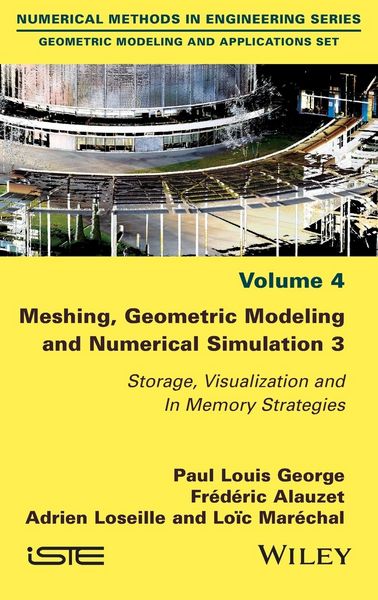
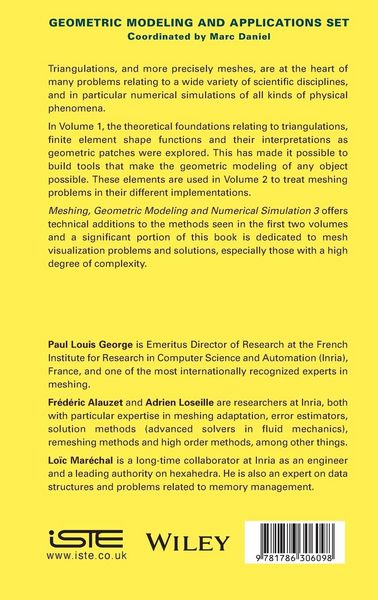
  • Produktbild: Meshing, Geometric Modeling and Numerical Simulation 3
  • Produktbild: Meshing, Geometric Modeling and Numerical Simulation 3

Meshing, Geometric Modeling and Numerical Simulation 3 Storage, Visualization and in Memory Strategies

193,99 €

inkl. gesetzl. MwSt., Versandkostenfrei


Beschreibung

Produktdetails

Einband

Gebundene Ausgabe

Erscheinungsdatum

10.11.2020

Verlag

John Wiley & Sons

Seitenzahl

352

Maße (L/B/H)

24/16,1/2,3 cm

Gewicht

677 g

Auflage

1. Auflage

Sprache

Englisch

ISBN

978-1-78630-609-8

Beschreibung

Produktdetails

Einband

Gebundene Ausgabe

Erscheinungsdatum

10.11.2020

Verlag

John Wiley & Sons

Seitenzahl

352

Maße (L/B/H)

24/16,1/2,3 cm

Gewicht

677 g

Auflage

1. Auflage

Sprache

Englisch

ISBN

978-1-78630-609-8

Herstelleradresse

Libri GmbH
Europaallee 1
36244 Bad Hersfeld
DE

Email: gpsr@libri.de

Noch keine Bewertungen vorhanden

Verfassen Sie die erste Bewertung zu diesem Artikel

Helfen Sie anderen Kundinnen und Kunden durch Ihre Meinung.

Kundinnen und Kunden meinen

Bewertungen (0)

Die Leseprobe wird geladen.
  • Produktbild: Meshing, Geometric Modeling and Numerical Simulation 3
  • Produktbild: Meshing, Geometric Modeling and Numerical Simulation 3
  • Foreword ix

    Introduction xi

    Chapter 1 Data and Basic Techniques 1

    1.1 Basic data structures and basic techniques 1

    1.1.1 Basic data structures 2

    1.1.2 Basic techniques 22

    1.2 Internal data structures 29

    1.2.1 What should be stored in an internal structure and how? 29

    1.2.2 Internal structures, method by method 31

    1.3 External data structures 34

    1.4 Data structures and memory access 36

    Chapter 2 Mesh Transformations, Patching, Merging and Immersion 39

    2.1 Geometric transformations 40

    2.1.1 Conventional geometric transformations 40

    2.1.2 Cutting a non-simplicial element into simplices 46

    2.1.3 Decomposition into simplices of a non-simplicial mesh 48

    2.1.4 Decompositions for a complying connection 56

    2.1.5 Decomposition of a high-degree element 57

    2.2 Reconnection 58

    2.3 Merging 65

    2.4 Immersion 77

    Chapter 3 Renumbering and Memory 81

    3.1 Vertex and node renumbering 82

    3.1.1 Numbering and storage of a matrix in profile mode 82

    3.1.2 Numbering and algorithm performance 84

    3.1.3 Some methods for node renumbering 86

    3.2 Renumbering of the elements 92

    3.2.1 Motivation examples 92

    3.2.2 Some methods for renumbering elements 92

    3.2.3 Renumbering and mesh partition 94

    3.3 Some examples 98

    Chapter 4 High-Degree Mesh Visualization 105

    4.1 Geometric operators and topological operators 106

    4.1.1 Geometric operators 106

    4.1.2 Topological operators 107

    4.2 Representation of curved meshes 107

    4.3 Quick introduction to OpenGL and to the design of a graphics software program 116

    4.4 Some examples 136

    Chapter 5 Visualization of a Solution Field Related to a High-Degree Mesh 145

    5.1 Element recursive subdivision 146

    5.2 Recursive subdivision of a solution field 152

    5.3 Classic or adaptive tessellation 154

    5.4 Toward the design of graphic software based on OpenGL 156

    5.4.1 Palette definition 157

    5.4.2 Cut definition 160

    5.4.3 "Pixel-exact" or "almost pixel-exact" representation 169

    5.4.4 Normals and shading 170

    5.4.5 Level lines and surfaces and application to "wireframe" plots 171

    5.4.6 Representation of non-scalar functions 176

    5.4.7 Simplified scheme for a graphic software program 177

    5.5 Some examples 181

    Chapter 6 Meshes and Finite Element Calculations 185

    6.1 From continuous formulation to discrete notation 187

    6.2 Calculation of an elementary matrix 189

    6.2.1 The special case of the first-degree triangle 190

    6.2.2 A generic notation for all elements 191

    6.2.3 The generic notation for the four chosen elements and heat equation 197

    6.2.4 Lagrange triangle of degree 1 with three nodes 197

    6.2.4.1 Lagrange quadrilateral of degree 1 × 1 with four nodes 201

    6.2.4.2 Straight-sided Lagrange triangle of degree 2 with six nodes 209

    6.2.4.3 Lagrange isoparametric (curved) triangle of degree 2 with six nodes 218

    6.2.4.4 In practice 230

    6.2.5 The generic notation for the four chosen elements, elasticity equation 233

    6.2.6 Lagrange triangle of degree 1 with three nodes 233

    6.2.6.1 The other three elements 235

    6.2.6.2 In practice 235

    6.3 Matrix or right-hand side assembly 237

    Chapter 7 Meshes and Finite Volume Calculation 243

    7.1 Presentation of the finite volume method with a first-order problem 243

    7.1.1 Time discretization 244

    7.1.2 Spatial discretization 245

    7.2 Finite volume methods for two-dimensional Euler equations 249

    7.2.1 Spatial discretization 250

    7.2.1.1 Finite volume cell definition 251

    7.2.1.2 Calculation of upwind conservative fluxes 252

    7.2.2 Time discretization 256