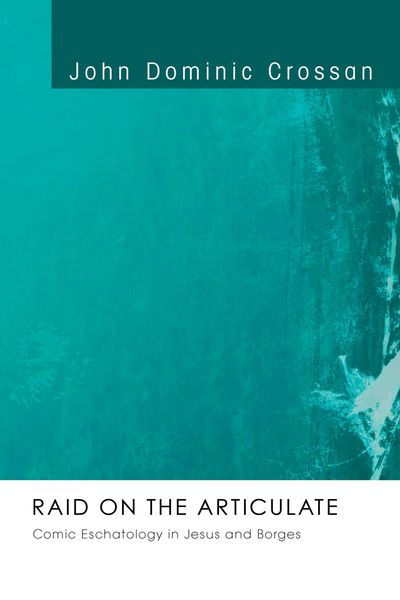
Raid on the Articulate Comic Eschatology in Jesus and Borges
-
- Taschenbuch
- eBook ausgewählt
-
Form:Einzelkauf Download
-
Sprache:Englisch
27,30 €
inkl. gesetzl. MwSt.Beschreibung
Produktdetails
Format
Kopierschutz
Ja
Family Sharing
Nein
Text-to-Speech
Nein
Erscheinungsdatum
01.03.2008
Verlag
Wipf and Stock PublishersSeitenzahl
224 (Printausgabe)
Dateigröße
18022 KB
Sprache
Englisch
EAN
9781725221840
John Dominic Crossan's In Parables demonstrated how Jesus's parables demolished an idolatry of time. In this book, he shows how the parables likewise preclude an idolatry of language.
In a new, creative synthesis, Raid on the Articulate juxtaposes the sayings and parables of Jesus with the works of modern Argentine writer Jorge Luis Borges to reveal fresh interpretations. Crossan locates both men as literary iconoclasts, parablers who can evoke for us the other side of silence. The gift they bring is "cosmic eschatology," the ability to "stand on the brink of nonsense and absurdity and not be dizzy."
The discussion begins with Comedy and Transcendence, "a comedy too deep for laughter." Language is seen most openly and acknowledged most freely as structured play, opening the narrow gate to transcendence. This precludes language being mistaken for the gate itself.
This in turn raises the question of Form and Parody. As Crossan writes, "Why mock the craftsman skilled in silver and gold and not mock the artisan skilled in form and genre? What if the aniconic God became trapped in icons made of language?" In Jesus we find the most magisterial warning against graven words and encapsulation of God in case law, proverb, or beatitude.
When Jesus says, "Whoever seeks to gain his life will lose it" he presents a paradox insoluble by faith in language. Borges performs a similar function in literature when he inserts footnotes referring to nonexistent books. Both are arguing against the idolatry of imprisoning reality in the words that point to it.
Parable and Paradox makes the case for parable as paradox formed into story. It is in this context that Jesus and Borges must be understood. Analyzing many of Jesus's parables, especially "The Good Samaritan," and comparing them structurally to Borges's work, Crossan sees them as single or double reversals of their audiences" most profound expectations. It is these that lend them both their power and their paradox.
Raid on the Articulate concludes with considerations of the plasticity of time in Jesus and Borges and what, finally, we can say about them as men from their "fragile and aphoristic art."
Emphasizing both biblical and literary materials, John Dominic Crossan achieves a deepened understanding of New Testament texts and forms, an understanding possible only when the unique literary aspect of Jesus's sayings is acknowledged.
In a new, creative synthesis, Raid on the Articulate juxtaposes the sayings and parables of Jesus with the works of modern Argentine writer Jorge Luis Borges to reveal fresh interpretations. Crossan locates both men as literary iconoclasts, parablers who can evoke for us the other side of silence. The gift they bring is "cosmic eschatology," the ability to "stand on the brink of nonsense and absurdity and not be dizzy."
The discussion begins with Comedy and Transcendence, "a comedy too deep for laughter." Language is seen most openly and acknowledged most freely as structured play, opening the narrow gate to transcendence. This precludes language being mistaken for the gate itself.
This in turn raises the question of Form and Parody. As Crossan writes, "Why mock the craftsman skilled in silver and gold and not mock the artisan skilled in form and genre? What if the aniconic God became trapped in icons made of language?" In Jesus we find the most magisterial warning against graven words and encapsulation of God in case law, proverb, or beatitude.
When Jesus says, "Whoever seeks to gain his life will lose it" he presents a paradox insoluble by faith in language. Borges performs a similar function in literature when he inserts footnotes referring to nonexistent books. Both are arguing against the idolatry of imprisoning reality in the words that point to it.
Parable and Paradox makes the case for parable as paradox formed into story. It is in this context that Jesus and Borges must be understood. Analyzing many of Jesus's parables, especially "The Good Samaritan," and comparing them structurally to Borges's work, Crossan sees them as single or double reversals of their audiences" most profound expectations. It is these that lend them both their power and their paradox.
Raid on the Articulate concludes with considerations of the plasticity of time in Jesus and Borges and what, finally, we can say about them as men from their "fragile and aphoristic art."
Emphasizing both biblical and literary materials, John Dominic Crossan achieves a deepened understanding of New Testament texts and forms, an understanding possible only when the unique literary aspect of Jesus's sayings is acknowledged.
Noch keine Bewertungen vorhanden
Verfassen Sie die erste Bewertung zu diesem Artikel
Helfen Sie anderen Kundinnen und Kunden durch Ihre Meinung.
Kurze Frage zu unserer Seite
Vielen Dank für Ihr Feedback
Wir nutzen Ihr Feedback, um unsere Produktseiten zu verbessern. Bitte haben Sie Verständnis, dass wir Ihnen keine Rückmeldung geben können. Falls Sie Kontakt mit uns aufnehmen möchten, können Sie sich aber gerne an unseren Kund*innenservice wenden.
zum Kundenservice