KI-Beratung Beta

Gutscheinbedingungen

**Gültig bis 18.11.2026 auf englischsprachige Klassiker (klassiker-32728) online auf thalia.at und in der Thalia App. Einzelne Artikel können ausgeschlossen sein. Ausgenommen sind preisgebundene Artikel & eBooks. Pro Einkauf einmal einlösbar. Click & Collect nur bei Onlinevorabzahlung möglich. Keine Barauszahlung. Nicht kombinierbar mit anderen Aktionen und Gutscheinen. Gutschein wird auf max. 500€ Bestellwert angerechnet. Nicht gültig für Geschenkkarten, Versandkosten und Services.

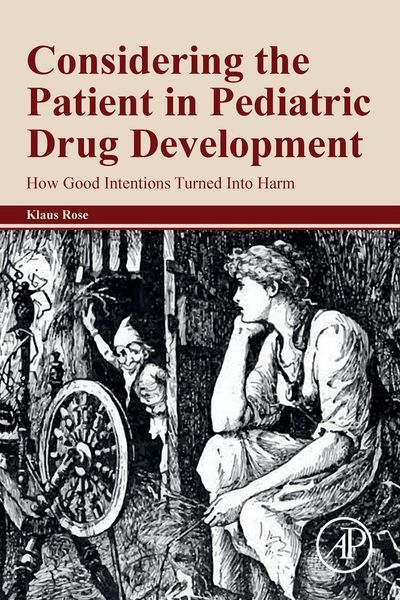
  • Produktbild: Rose, K: Considering the Patient in Pediatric Drug Developme
  • Produktbild: Rose, K: Considering the Patient in Pediatric Drug Developme

Rose, K: Considering the Patient in Pediatric Drug Developme How Good Intentions Turned Into Harm

135,99 €

inkl. gesetzl. MwSt., Versandkostenfrei


Beschreibung

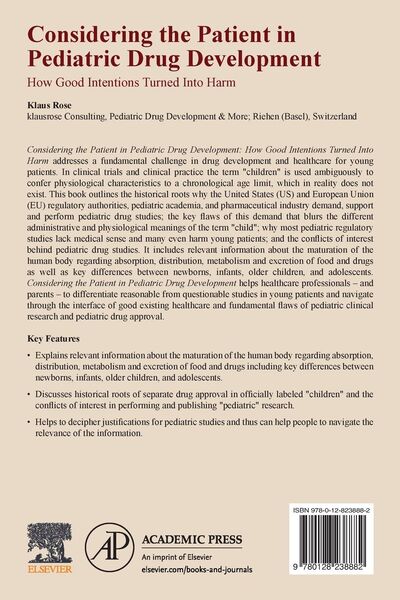
Considering the Patient in Pediatric Drug Development: How Good Intentions Turned into Harm addresses a fundamental challenge in drug development and healthcare for young patients. In clinical trials and clinical practice, the term "children" is used ambiguously to confer physiological characteristics...

Beschreibung

Considering the Patient in Pediatric Drug Development: How Good Intentions Turned into Harm addresses a fundamental challenge in drug development and healthcare for young patients. In clinical trials and clinical practice, the term "children" is used ambiguously to confer physiological characteristics to a chronological age limit, which in reality does not exist. This book outlines why the United States (US) and European Union's (EU) regulatory authorities, pediatric academia, and the pharmaceutical industry demand, support and perform pediatric drug studies, along with the key flaws of this demand that blurs the different administrative and physiological meanings of the term "child."

In addition, the book covers why most pediatric regulatory studies lack medical sense and many even harm young patients and the conflicts of interest behind pediatric drug studies. It includes relevant information about the maturation of the human body regarding absorption, distribution, metabolism and excretion of food and drugs as well as key differences between newborns, infants, older children and adolescents.

Rezension

"The book is educational and interesting. As a pharmacist who worked in a pediatric hospital for five years, I do think the book could have discussed some of the life-saving efforts of pediatric medicine as well." --© Doody's Review Service, 2020, Judith Klevan, BA, BS(Einstein Medical Center Philadelphia), reviewer, expert opinion

Produktdetails

Einband

Taschenbuch

Erscheinungsdatum

27.11.2020

Verlag Elsevier Science & Technology
Seitenzahl

416

Produktdetails

Einband

Taschenbuch

Erscheinungsdatum

27.11.2020

Verlag Elsevier Science & Technology
Seitenzahl

416

Maße (L/B/H)

22,9/15,2/2,2 cm

Gewicht

555 g

Sprache

Englisch

ISBN

978-0-12-823888-2

EU-Ansprechpartner

Elsevier B.V.
Radarweg 29
1043 NX Amsterdam
NL
productsafety@elsevier.com

Herstelleradresse

Elsevier Science & Technology
London Wall 125
EC2Y 5AS London
GB
tradeorders@elsevier.com

Noch keine Bewertungen vorhanden

Verfassen Sie die erste Bewertung zu diesem Artikel

Helfen Sie anderen Kundinnen und Kunden durch Ihre Meinung.

Kundinnen und Kunden meinen

Bewertungen (0)

Die Leseprobe wird geladen.
  • Produktbild: Rose, K: Considering the Patient in Pediatric Drug Developme
  • Produktbild: Rose, K: Considering the Patient in Pediatric Drug Developme
  • Rumpelstiltskin and the miller's daughterConclusion and outlook Introduction Abbreviations and technical explanations Background 1. The process of modern drug development and the challenge of young patients 2. US and EU pediatric legislation 3. A paradigm shift 4. Introduction: specific disease areas 4.1 Tissue-engineered products (TEPs), advanced medicinal4.2 Suicide, depression, and mental disorders in young4.3 Cancer and malignancies in young patients4.4 Chronic arthritis in young and adult patients, and "Juvenile Idiopathic Arthritis? (JIA)4.5 Diabetes4.6 Allergies and allergen-specific immunotherapy (ASIT) in young patients4.7 Epilepsy4.8 Multiple sclerosis4.9 Atopic dermatitis and psoriasis4.10 Cystic fibrosis4.11 Vaccines and antiinfectives5. Neonatology 6. Challenges at the interface of science, drug development, and drug approval beyond specific disease areas 6.1 The on-label/off-label framework in adults and young patients6.2 Developmental pharmacology and the globalization of the children-are-therapeutic-orphans mantra6.3 Extrapolation6.4 Daily deceit in "pediatric? studies6.5 Myths in today's medical world and "pediatric? studies7. Juvenile animal studies8. Child-friendly formulations: tablets, quick-dissolving formulations, liquids, and more9. What do young patients really need?