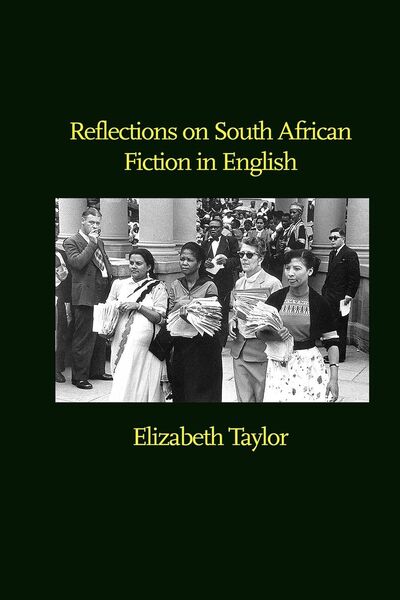
Reflections on South African Fiction in English
-
- Englisch ausgewählt
25,99 €
inkl. gesetzl. MwSt.,
- Kostenlose Lieferung ab 30 € Einkaufswert
- Versandkostenfrei für Bonuscard-Kund*innen
Beschreibung
Produktdetails
Einband
Taschenbuch
Erscheinungsdatum
19.06.2017
Verlag
Amazon Digital Services LLC - KdpSeitenzahl
236
Maße (L/B/H)
22,9/15,2/1,4 cm
Gewicht
349 g
Sprache
Englisch
ISBN
978-1-905510-61-0
Elizabeth Taylor's reflections on South African fiction are rooted in the political and social realities which dictated, until the democratic era, the preoccupations of most writing produced in the country: the politics of oppression and dispossession, identity and racism, gender and miscegenation. From Olive Schreiner's Story of an African Farm (1883) to Sol T. Plaatje's Mhudi (1930), from Alan Paton's Cry, the Beloved Country (1948) to Zoë Wicomb's You Can't Get Lost in Cape Town (1987), from Nadine Gordimer's July's People (1981) to J. M. Coetzee's Disgrace (1999), Zakes Mda's Madonna of Excelsior (2002) and André Brink's Philida (2012), she traces the intimate relationship between politics and literature in this work, and the evolution of greater creative freedom in South African fiction under democratic rule. She concludes by demonstrating that, while South Africa today may not be a perfect nation state, at least all its people from all backgrounds are now at liberty to write about it as they choose.
Elizabeth Taylor grew up in British India and South Africa and is uniquely positioned to examine the colonial legacy. Under apartheid she witnessed first-hand the struggle amongst people of all ethnic backgrounds to find a way of combatting and enduring the situation. Before embarking on her doctorate at Rhodes University (Grahamstown), Elizabeth (Betty) Taylor published travelogues on the Transkei in South African newspapers such as the Cape Times, the Cape Argus and the Eastern Province Herald. Later, while employed as a lecturer in English Literature at Rhodes, she completed a pioneering thesis on early poetry in English written at the Cape. One of the poets dealt with in her thesis, the Scot Thomas Pringle, appears in this book. She then moved to England, where she was appointed to a lectureship at the University of Nottingham. At the height of European opposition to and awareness of apartheid she introduced students to South African fiction in English. She continued to explore South African fiction with successive generations of students long after Nelson Mandela had retired from public life, taking great pleasure in the emergence of a multiplicity of new writers in the post-apartheid era.Noch keine Bewertungen vorhanden
Verfassen Sie die erste Bewertung zu diesem Artikel
Helfen Sie anderen Kundinnen und Kunden durch Ihre Meinung.
Kurze Frage zu unserer Seite
Vielen Dank für Ihr Feedback
Wir nutzen Ihr Feedback, um unsere Produktseiten zu verbessern. Bitte haben Sie Verständnis, dass wir Ihnen keine Rückmeldung geben können. Falls Sie Kontakt mit uns aufnehmen möchten, können Sie sich aber gerne an unseren Kund*innenservice wenden.
zum Kundenservice