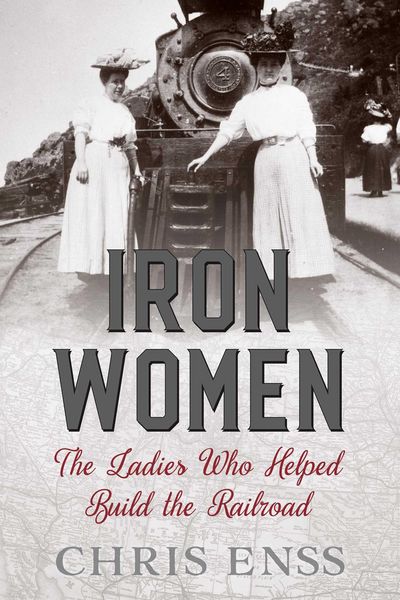
Iron Women The Ladies Who Helped Build the Railroad
-
- Taschenbuch
- eBook ausgewählt
-
Form:Einzelkauf Download
-
Sprache:Englisch
17,27 €
inkl. gesetzl. MwSt.Beschreibung
Produktdetails
Format
ePUB
Kopierschutz
Ja
Family Sharing
Ja
Text-to-Speech
Ja
Erscheinungsdatum
01.03.2021
Verlag
Simon + Schuster LLCSeitenzahl
200 (Printausgabe)
Dateigröße
6445 KB
Sprache
Englisch
EAN
9781493037766
**2022 Will Rogers Medallion Award Silver Winner for Western Non-Fiction**
When the last spike was hammered into the steel track of the Transcontinental Railroad on May 10, 1869, at Promontory Point, Utah, Western Union lines sounded the glorious news of the railroad's completion from New York to San Francisco. For more than five years an estimated four thousand men mostly Irish working west from Omaha and Chinese working east from Sacramento, moved like a vast assembly line toward the end of the track. Editorials in newspapers and magazines praised the accomplishment and some boasted that the work that "was begun, carried on, and completed solely by men." The August edition of Godey's Lady's Book even reported "No woman had laid a rail and no woman had made a survey." Although the physical task of building the railroad had been achieved by men, women made significant and lasting contributions to the historic operation.
However, the female connection with railroading dates as far back as 1838 when women were hired as registered nurses/stewardesses in passenger cars. Those ladies attended to the medical needs of travelers and also acted as hostesses of sorts helping passengers have a comfortable journey. Beyond nursing and service roles, however, women played a larger part in the actual creation of the rail lines than they have been given credit for. Miss E. F. Sawyer became the first female telegraph operator when she was hired by the Burlington Railroad in Montgomery, Illinois, in 1872. Eliza Murfey focused on the mechanics of the railroad, creating devices for improving the way bearings on a rail wheel attached to train cars responded to the axles. Murfey held sixteen patents for her 1870 invention. In 1879, another woman inventor named Mary Elizabeth Walton developed a system that deflected emissions from the smoke stacks on railroad locomotives. She was awarded two patents for her pollution reducing device. Their stories and many more are included in this illustrated volume celebrating women and the railroad.
When the last spike was hammered into the steel track of the Transcontinental Railroad on May 10, 1869, at Promontory Point, Utah, Western Union lines sounded the glorious news of the railroad's completion from New York to San Francisco. For more than five years an estimated four thousand men mostly Irish working west from Omaha and Chinese working east from Sacramento, moved like a vast assembly line toward the end of the track. Editorials in newspapers and magazines praised the accomplishment and some boasted that the work that "was begun, carried on, and completed solely by men." The August edition of Godey's Lady's Book even reported "No woman had laid a rail and no woman had made a survey." Although the physical task of building the railroad had been achieved by men, women made significant and lasting contributions to the historic operation.
However, the female connection with railroading dates as far back as 1838 when women were hired as registered nurses/stewardesses in passenger cars. Those ladies attended to the medical needs of travelers and also acted as hostesses of sorts helping passengers have a comfortable journey. Beyond nursing and service roles, however, women played a larger part in the actual creation of the rail lines than they have been given credit for. Miss E. F. Sawyer became the first female telegraph operator when she was hired by the Burlington Railroad in Montgomery, Illinois, in 1872. Eliza Murfey focused on the mechanics of the railroad, creating devices for improving the way bearings on a rail wheel attached to train cars responded to the axles. Murfey held sixteen patents for her 1870 invention. In 1879, another woman inventor named Mary Elizabeth Walton developed a system that deflected emissions from the smoke stacks on railroad locomotives. She was awarded two patents for her pollution reducing device. Their stories and many more are included in this illustrated volume celebrating women and the railroad.
Noch keine Bewertungen vorhanden
Verfassen Sie die erste Bewertung zu diesem Artikel
Helfen Sie anderen Kundinnen und Kunden durch Ihre Meinung.
Kurze Frage zu unserer Seite
Vielen Dank für Ihr Feedback
Wir nutzen Ihr Feedback, um unsere Produktseiten zu verbessern. Bitte haben Sie Verständnis, dass wir Ihnen keine Rückmeldung geben können. Falls Sie Kontakt mit uns aufnehmen möchten, können Sie sich aber gerne an unseren Kund*innenservice wenden.
zum Kundenservice