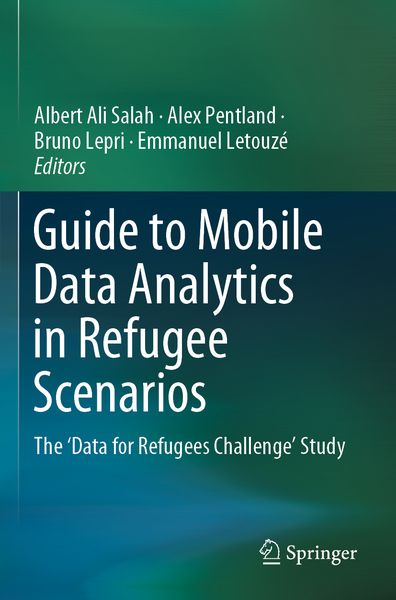
Guide to Mobile Data Analytics in Refugee Scenarios The 'Data for Refugees Challenge' Study
-
- Hardcover
- Taschenbuch ausgewählt
- eBook
-
Sprache:Englisch
99,99 €
inkl. gesetzl. MwSt.,
Beschreibung
Produktdetails
Einband
Taschenbuch
Erscheinungsdatum
18.09.2020
Abbildungen
XVI, 500 p. 169 illus., 149 illus. in color.
Herausgeber
Albert Ali Salah + weitereVerlag
SpringerSeitenzahl
500
Maße (L/B/H)
23,5/15,5/2,6 cm
Gewicht
882 g
Auflage
20001 Auflage 1st edition 2019
Sprache
Englisch
ISBN
978-3-030-12556-1
After the start of the Syrian Civil War in 2011–12, increasing numbers of civilians sought refuge in neighboring countries. By May 2017, Turkey had received over 3 million refugees — the largest refugee population in the world. Some lived in government-run camps near the Syrian border, but many have moved to cities looking for work and better living conditions. They faced problems of integration, income, welfare, employment, health, education, language, social tension, and discrimination. In order to develop sound policies to solve these interlinked problems, a good understanding of refugee dynamics isnecessary.
This book summarizes the most important findings of the Data for Refugees (D4R) Challenge, which was a non-profit project initiated to improve the conditions of the Syrian refugees in Turkey by providing a database for the scientific community to enable research on urgent problems concerning refugees. The database, based on anonymized mobile call detail records (CDRs) of phone calls and SMS messages of one million Turk Telekom customers, indicates the broad activity and mobility patterns of refugees and citizens in Turkey for the year 1 January to 31 December 2017. Over 100 teams from around the globe applied to take part in the challenge, and 61 teams were granted access to the data. This book describes the challenge, and presents selected and revised project reports on the five major themes: unemployment, health, education, social integration, and safety, respectively. These are complemented by additional invited chapters describing related projects from international governmental organizations, technological infrastructure, as well as ethical aspects. The last chapter includes policy recommendations, based on the lessons learned.The book will serve as a guideline for creating innovative data-centered collaborations between industry, academia, government, and non-profit humanitarian agencies to deal with complex problems in refugee scenarios. It illustrates the possibilities of big data analytics in coping with refugee crises and humanitarian responses, by showcasing innovative approaches drawing on multiple data sources, information visualization, pattern analysis, and statistical analysis.It will also provide researchers and students working with mobility data with an excellent coverage across data science, economics, sociology, urban computing, education, migration studies, and more.
Noch keine Bewertungen vorhanden
Verfassen Sie die erste Bewertung zu diesem Artikel
Helfen Sie anderen Kundinnen und Kunden durch Ihre Meinung.
Kurze Frage zu unserer Seite
Vielen Dank für Ihr Feedback
Wir nutzen Ihr Feedback, um unsere Produktseiten zu verbessern. Bitte haben Sie Verständnis, dass wir Ihnen keine Rückmeldung geben können. Falls Sie Kontakt mit uns aufnehmen möchten, können Sie sich aber gerne an unseren Kund*innenservice wenden.
zum Kundenservice