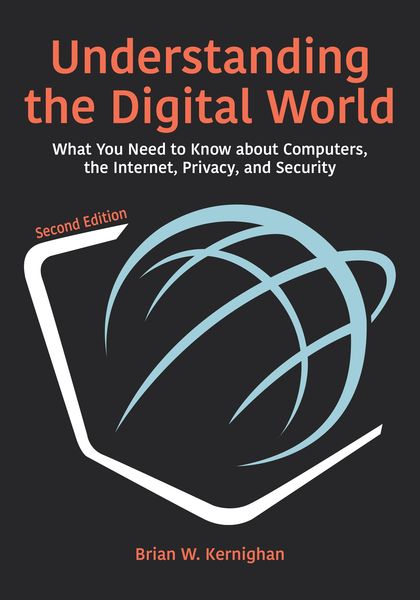
Produktbild: Understanding the Digital World

Understanding the Digital World What You Need to Know about Computers, the Internet, Privacy, and Security, Second Edition

42,99 €

inkl. gesetzl. MwSt., Versandkostenfrei


Beschreibung

Produktdetails

Einband

Taschenbuch

Erscheinungsdatum

30.03.2021

Verlag

University Presses

Seitenzahl

304

Maße (L/B/H)

25,3/18/2,2 cm

Gewicht

839 g

Sprache

Englisch

ISBN

978-0-691-21910-3

Beschreibung

Produktdetails

Einband

Taschenbuch

Erscheinungsdatum

30.03.2021

Verlag

University Presses

Seitenzahl

304

Maße (L/B/H)

25,3/18/2,2 cm

Gewicht

839 g

Sprache

Englisch

ISBN

978-0-691-21910-3

Herstelleradresse

Libri GmbH
Europaallee 1
36244 Bad Hersfeld
DE

Email: GPSR Kontakt

Noch keine Bewertungen vorhanden

Verfassen Sie die erste Bewertung zu diesem Artikel

Helfen Sie anderen Kundinnen und Kunden durch Ihre Meinung.

Kundinnen und Kunden meinen

Bewertungen (0)

  • Produktbild: Understanding the Digital World
    • Preface
    • Introduction
    • Part I: Hardware
      • 1. What Is a Computer?
        • 1.1 Logical Construction
          • 1.1.1 Processor
          • 1.1.2 Primary memory
          • 1.1.3 Secondary storage
          • 1.1.4 Et cetera
        • 1.2 Physical Construction
        • 1.3 Moore's Law
        • 1.4 Summary
        • 2. Bits, Bytes, and Representation of Information
          • 2.1 Analog versus Digital
          • 2.2 Analog-Digital Conversion
            • 2.2.1 Digitizing images
            • 2.2.2 Digitizing sound
            • 2.2.3 Digitizing movies
            • 2.2.4 Digitizing text
          • 2.3 Bits, Bytes, and Binary
            • 2.3.1 Bits
            • 2.3.2 Powers of two and powers of ten
            • 2.3.3 Binary numbers
            • 2.3.4 Bytes
          • 2.4 Summary
          • 3. Inside the Processor
            • 3.1 The Toy Computer
              • 3.1.1 The first Toy program
              • 3.1.2 The second Toy program
              • 3.1.3 Branch instructions
              • 3.1.4 Representation in memory
            • 3.2 Real Processors
            • 3.3 Caching
            • 3.4 Other Kinds of Computers
            • 3.5 Summary
            • Wrap-up on Hardware
            • Part II: Software
              • 4. Algorithms
                • 4.1 Linear Algorithms
                • 4.2 Binary Search
                • 4.3 Sorting
                • 4.4 Hard Problems and Complexity
                • 4.5 Summary
              • 5. Programming and Programming Languages
                • 5.1 Assembly Language
                • 5.2 High-Level Languages
                • 5.3 Software Development
                  • 5.3.1 Libraries, interfaces, and development kits
                  • 5.3.2 Bugs
                • 5.4 Intellectual Property
                  • 5.4.1 Trade secret
                  • 5.4.2 Trademark
                  • 5.4.3 Copyright
                  • 5.4.4 Patent
                  • 5.4.5 Licenses
                • 5.5 Standards
                • 5.6 Open Source Software
                • 5.7 Summary
                • 6. Software Systems
                  • 6.1 Operating Systems
                  • 6.2 How an Operating System Works
                    • 6.2.1 System calls
                    • 6.2.2 Device drivers
                  • 6.3 Other Operating Systems
                  • 6.4 File Systems
                    • 6.4.1 Secondary storage file systems
                    • 6.4.2 Removing files
                    • 6.4.3 Other file systems
                  • 6.5 Applications
                  • 6.6 Layers of Software
                  • 6.7 Summary
                  • 7. Learning to Program
                    • 7.1 Programming Language Concepts
                    • 7.2 A First JavaScript Program
                    • 7.3 A Second JavaScript Program
                    • 7.4 Loops and Conditionals
                    • 7.5 JavaScript Libraries and Interfaces
                    • 7.6 How JavaScript Works
                    • 7.7 A First Python Program
                    • 7.8 A Second Python Program
                    • 7.9 Python Libraries and Interfaces
                    • 7.10 How Python Works
                    • 7.11 Summary
                  • Wrap-up on Software
                  • Part III: Communications
                    • 8. Networks
                      • 8.1 Telephones and Modems
                      • 8.2 Cable and DSL
                      • 8.3 Local Area Networks and Ethernet
                      • 8.4 Wireless
                      • 8.5 Cell Phones
                      • 8.6 Bandwidth
                      • 8.7 Compression
                      • 8.8 Error Detection and Correction
                      • 8.9 Summary
                    • 9. The Internet
                      • 9.1 An Internet Overview
                      • 9.2 Domain Names and Addresses
                        • 9.2.1 Domain Name System
                        • 9.2.2 IP addresses
                        • 9.2.3 Root servers
                        • 9.2.4 Registering your own domain
                      • 9.3 Routing
                      • 9.4 TCP/IP Protocols
                        • 9.4.1 IP, the Internet Protocol
                        • 9.4.2 TCP, the Transmission Control Protocol
                      • 9.5 Higher-Level Protocols
                        • 9.5.1 Telnet and SSH: remote login
                        • 9.5.2 SMTP: Simple Mail Transfer Protocol
                        • 9.5.3 File sharing and peer-to-peer protocols
                      • 9.6 Copyright on the Internet
                      • 9.7 The Internet of Things
                      • 9.8 Summary
                      • 10. The World Wide Web
                        • 10.1 How the Web Works
                        • 10.2 HTML
                        • 10.3 Cookies
                        • 10.4 Active Content in Web Pages
                        • 10.5 Active Content Elsewhere
                        • 10.6 Viruses, Worms and Trojan Horses
                        • 10.7 Web Security
                          • 10.7.1 Attacks on clients
                          • 10.7.2 Attacks on servers
                          • 10.7.3 Attacks on information in transit
                        • 10.8 Defending Yourself
                        • 10.9 Summary
                        • Part IV: Data
                          • 11. Data and Information
                            • 11.1 Search
                            • 11.2 Tracking
                            • 11.3 Social Networks
                            • 11.4 Data Mining and Aggregation
                            • 11.5 Cloud Computing
                            • 11.6 Summary
                          • 12. Artificial Intelligence and Machine Learning
                            • 12.1 Historical Background
                            • 12.2 Classical Machine Learning
                            • 12.3 Neural Networks and Deep Learning
                            • 12.4 Natural Language Processing
                            • 12.5 Summary
                          • 13. Privacy and Security
                            • 13.1 Cryptography
                              • 13.1.1 Secret-key cryptography
                              • 13.1.2 Public-key cryptography
                            • 13.2 Anonymity
                              • 13.2.1 Tor and the Tor Browser
                              • 13.2.2 Bitcoin
                            • 13.3 Summary
                            • 14. What Comes Next?
                            • Notes
                            • Glossary
                            • Index