
Gutscheinbedingungen

**Gültig bis 14.09.2026 auf Spielzeug, Schreibwaren, Filme, Geschenke & Trends, Musik, tolino eReader & Zubehör, Hörbücher, nicht preisgebundene Bücher und Kalender in der Thalia App. Einzelne Artikel können ausgeschlossen sein. Aufgrund der Buchpreisbindung sind deutschsprachige Bücher und eBooks ausgenommen. Zusätzlich ausgenommen sind Abos & Flatrates, Games, Geschenkkarten/-boxen, Shelfies, Software, Zeitschriften sowie einzelne Artikel von tonies®. Pro Einkauf einmal einlösbar. Nur gültig mit im Onlineshop hinterlegter Bonuscard. Click & Collect nur bei Onlinevorabzahlung möglich. Keine Barauszahlung. Nicht kombinierbar mit anderen Aktionen und Gutscheinen. Gutschein wird auf max. 500€ Bestellwert angerechnet. Nicht gültig für Versandkosten und Services.

  • Produktbild: Crime Solvability Factors
  • Produktbild: Crime Solvability Factors

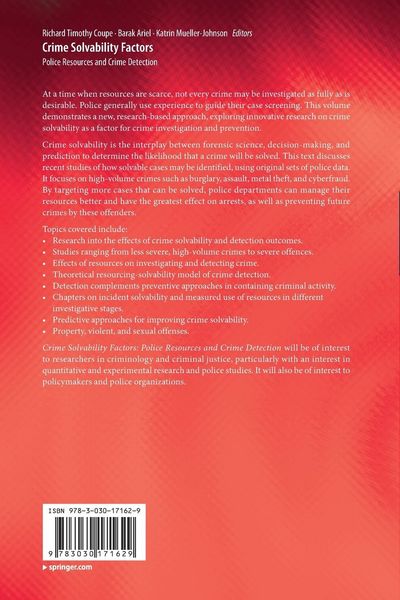
Crime Solvability Factors Police Resources and Crime Detection

158,99 €

inkl. gesetzl. MwSt., Versandkostenfrei


Beschreibung

Produktdetails

Einband

Taschenbuch

Erscheinungsdatum

11.09.2020

Herausgeber

Richard Timothy Coupe + weitere

Verlag

Springer

Seitenzahl

454

Maße (L/B/H)

23,5/15,5/2,5 cm

Gewicht

698 g

Auflage

1st ed. 2019

Sprache

Englisch

ISBN

978-3-030-17162-9

Beschreibung

Portrait

Timothy Coupe researches and lectures criminal justice management, crime investigation and detection in the Institute of Criminology at Cambridge University. He previously worked in operational research, computing science, business management and urban and regional planning. He has been involved in applied research into improving policing performance for the U.K. Home Office and with police services in the U.K., Sweden, Denmark and Australia. He has consultancy experience in a variety of public organisations and commercial companies on the cost-effective use of resources and improving efficiency. He is an advocate of the benefits of using scientific analysis and prediction to complement professional experience for improving the way organisations are managed.

Barak Ariel is a lecturer in the Police Executive Programme. Among other topics, Barak provides seminars on research methods, systematic reviews and statistical analyses. As the chief analyst of the JerryLee Centre of Experimental Criminology, Barak is involved in several field experiments on police tactics in partnership with forces in the UK and abroad, including hotspot policing, restorative justice, use of cameras in police operations, informal crime control, and tax compliance. Barak is working in collaboration with Professor Lawrence Sherman and Dr. Heather Strang on Restorative Justice Trials, as well as in collaboration with Professor David Farrington on blocked randomised experiments. Barak is also working on a series of systematic reviews for the Campbell Collaboration, as well as other methodological issues related to experiments in Criminology.

Katrin Mueller-Johnson is a Senior Lecturer in Applied Criminology at the Institute of Criminology at the University of Cambridge.

Produktdetails

Einband

Taschenbuch

Erscheinungsdatum

11.09.2020

Herausgeber

Verlag

Springer

Seitenzahl

454

Maße (L/B/H)

23,5/15,5/2,5 cm

Gewicht

698 g

Auflage

1st ed. 2019

Sprache

Englisch

ISBN

978-3-030-17162-9

Herstelleradresse

Springer-Verlag GmbH
Tiergartenstr. 17
69121 Heidelberg
DE

Email: ProductSafety@springernature.com

Noch keine Bewertungen vorhanden

Verfassen Sie die erste Bewertung zu diesem Artikel

Helfen Sie anderen Kundinnen und Kunden durch Ihre Meinung.

Kundinnen und Kunden meinen

Bewertungen (0)

  • Produktbild: Crime Solvability Factors
  • Produktbild: Crime Solvability Factors
  • Chapter 1: Introduction.- Chapter 2: Existing Research on Solvability.- Chapter 3: Population-Level Analysis of Residential Burglaries.- Chapter 4: Assessing Solvability Factors in Greater Manchester, England: The Case of Residential Burglaries.- Chapter 5: Solvability Indicators for ‘First Officers’: Targeting Eyewitness Questioning at Non-Residential Burglaries.- Chapter 6: Pickpocketing on Railways.- Chapter 7: Metal Theft Solvability and Detection.- Chapter 8: Detecting and Combating Internet Telephony Fraud.- Chapter 9: Targeting Factors that Predict Clearance of Non-Domestic Assaults.- Chapter 10: Solvability Factors and Investigative Strategy for Faith Hate Crime: Anti-Semitic and Islamophobic Assault, Criminal Damage and Public Order Offences in London.- Chapter 11: Reporting, Detection and Solvability of Sex Offences on Railways.- Chapter 12: Offender–Offence Profiling: Improving Burglary Solvability and Detection.- Chapter 13: Boosting Offence Solvability and Detections: Solving Residential Burglaries by Predicting Single Repeat and Multiple Repeats.- Chapter 14: Improving Offence Solvability and Detection Rates at Non-Residential Burglary: Predicting Single Repeat and Multiple Repeat Incidence.- Chapter 15: Homicide Resources, Solvability and Detection.- Chapter 16: Investigative Activities, Resources and Burglary Detection.- Chapter 17: The Organisation and Deployment of Patrol Resources: Cost-Effective On-Scene Arrest at Burglaries.- Chapter 18: Resources, Solvability and Detection: A Theoretical Model.- Chapter 19: Conclusions.