KI-Beratung Beta

Gutscheinbedingungen

**Gültig am 25.11.2026 auf fremdsprachige Bücher online auf thalia.at und in der Thalia App. Einzelne Artikel können ausgeschlossen sein. Ausgenommen sind preisgebundene Artikel & eBooks. Pro Einkauf einmal einlösbar. Click & Collect nur bei Onlinevorabzahlung möglich. Keine Barauszahlung. Nicht kombinierbar mit anderen Aktionen und Gutscheinen. Gutschein wird auf max. 500€ Bestellwert angerechnet. Nicht gültig für Geschenkkarten, Versandkosten und Services.

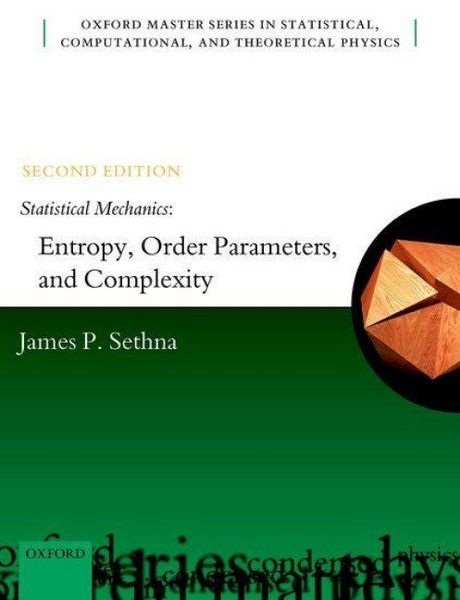
Produktbild: Statistical Mechanics: Entropy, Order Parameters, and Complexity

Statistical Mechanics: Entropy, Order Parameters, and Complexity

133,99 €

inkl. gesetzl. MwSt., Versandkostenfrei


Beschreibung

Statistical mechanics is our tool for deriving the laws that emerge from complex systems. Sethna's text distills the subject to be accessible to those in all realms of science and engineering -- avoiding extensive use of quantum mechanics, thermodynamics, and molecular physics. Statistical mechanics...

Beschreibung

Statistical mechanics is our tool for deriving the laws that emerge from complex systems. Sethna's text distills the subject to be accessible to those in all realms of science and engineering -- avoiding extensive use of quantum mechanics, thermodynamics, and molecular physics. Statistical mechanics explains how bacteria search for food, and how DNA replication is proof-read in biology; optimizes data compression, and explains transitions in complexity in computer science; explains the onset of chaos, and launched random matrix theory in mathematics; addresses extreme events in engineering; and models pandemics and language usage in the social sciences. Sethna's exercises introduce physicists to these triumphs and a hundred others -- broadening the horizons of scholars both practicing and nascent. Flipped classrooms and remote learning can now rely on 33 pre-class exercises that test reading comprehension (Emergent vs. fundamental; Weirdness in high dimensions; Aging, entropy and DNA), and 70 in-class activities that illuminate and broaden knowledge (Card shuffling; Human correlations; Crackling noises). Science is awash in information, providing ready access to definitions, explanations, and pedagogy. Sethna's text focuses on the tools we use to create new laws, and on the fascinating simple behavior in complex systems that statistical mechanics explains.

Produktdetails

Einband

Gebundene Ausgabe

Erscheinungsdatum

26.03.2021

Abbildungen

230 line drawings

Verlag Oxford Academic

Produktdetails

Einband

Gebundene Ausgabe

Erscheinungsdatum

26.03.2021

Abbildungen

230 line drawings

Verlag Oxford Academic
Seitenzahl

496

Maße (L/B/H)

25,2/19,2/3 cm

Gewicht

1274 g

Auflage

2nd edition

Sprache

Englisch

ISBN

978-0-19-886524-7

Herstelleradresse

Libri GmbH
Europaallee 1
36244 Bad Hersfeld
DE

Email: gpsr@libri.de

Noch keine Bewertungen vorhanden

Verfassen Sie die erste Bewertung zu diesem Artikel

Helfen Sie anderen Kundinnen und Kunden durch Ihre Meinung.

Kundinnen und Kunden meinen

Bewertungen (0)

  • Produktbild: Statistical Mechanics: Entropy, Order Parameters, and Complexity
    • Preface
    • Contents
    • List of figures
    • What is statistical mechanics?
    • 1.1: Quantum dice and coins
    • 1.2: Probability distributions
    • 1.3: Waiting time paradox
    • 1.4: Stirling's formula
    • 1.5: Stirling and asymptotic series
    • 1.6: Random matrix theory
    • 1.7: Six degrees of separation
    • 1.8: Satisfactory map colorings
    • 1.9: First to fail: Weibull
    • 1.10: Emergence
    • 1.11: Emergent vs. fundamental
    • 1.12: Self-propelled particles
    • 1.13: The birthday problem
    • 1.14: Width of the height distribution
    • 1.15: Fisher information and Cram¿er-Rao
    • 1.16: Distances in probability space
    • Random walks and emergent properties
    • 2.1: Random walk examples: universality and scale invariance
    • 2.2: The diffusion equation
    • 2.3: Currents and external forces
    • 2.4: Solving the diffusion equation
    • Temperature and equilibrium
    • 3.1: The microcanonical ensemble
    • 3.2: The microcanonical ideal gas
    • 3.3: What is temperature?
    • 3.4: Pressure and chemical potential
    • 3.5: Entropy, the ideal gas, and phase-space refinements
    • Phase-space dynamics and ergodicity
    • 4.1: Liouville's theorem
    • 4.2: Ergodicity
    • Entropy
    • 5.1: Entropy as irreversibility: engines and the heat death of the Universe
    • 5.2: Entropy as disorder
    • 5.3: Entropy as ignorance: information and memory
    • Free energies
    • 6.1: The canonical ensemble
    • 6.2: Uncoupled systems and canonical ensembles
    • 6.3: Grand canonical ensemble
    • 6.4: What is thermodynamics?
    • 6.5: Mechanics: friction and fluctuations
    • 6.6: Chemical equilibrium and reaction rates
    • 6.7: Free energy density for the ideal gas
    • Quantum statistical mechanics
    • 7.1: Mixed states and density matrices
    • 7.2: Quantum harmonic oscillator
    • 7.3: Bose and Fermi statistics
    • 7.4: Non-interacting bosons and fermions
    • 7.5: Maxwell-Boltzmann 'quantum' statistics
    • 7.6: Black-body radiation and Bose condensation
    • 7.7: Metals and the Fermi gas
    • Calculation and computation
    • 8.1: The Ising model
    • 8.2: Markov chains
    • 8.3: What is a phase? Perturbation theory
    • Order parameters, broken symmetry, and topology
    • 9.1: Identify the broken symmetry
    • 9.2: Define the order parameter
    • 9.3: Examine the elementary excitations
    • 9.4: Classify the topological defects
    • Correlations, response, and dissipation
    • 10.1: Correlation functions: motivation
    • 10.2: Experimental probes of correlations
    • 10.3: Equal-time correlations in the ideal gas
    • 10.4: Onsager's regression hypothesis and time correlations
    • 10.5: Susceptibility and linear response
    • 10.6: Dissipation and the imaginary part
    • 10.7: Static susceptibility
    • 10.8: The fluctuation-dissipation theorem
    • 10.9: Causality and Kramers-Kr¿onig
    • Abrupt phase transitions
    • 11.1: Stable and metastable phases
    • 11.2: Maxwell construction
    • 11.3: Nucleation: critical droplet theory
    • 11.4: Morphology of abrupt transitions
    • Continuous phase transitions
    • 12.1: Universality
    • 12.2: Scale invariance
    • 12.3: Examples of critical points
    • A Appendix: Fourier methods
    • A.1: Fourier conventions
    • A.2: Derivatives, convolutions, and correlations
    • A.3: Fourier methods and function space
    • A.4: Fourier and translational symmetry
    • References
    • Index