• Produktbild: Statistical Topics and Stochastic Models for Dependent Data with Applications
  • Produktbild: Statistical Topics and Stochastic Models for Dependent Data with Applications

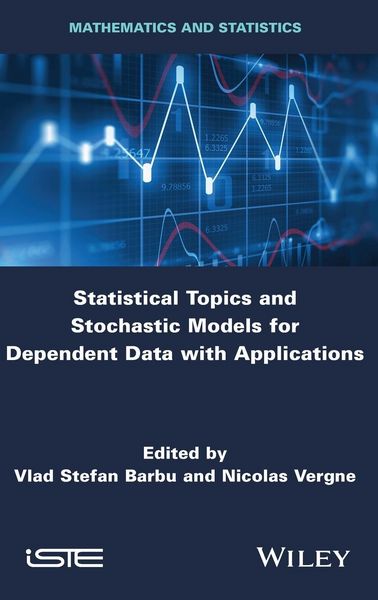
Statistical Topics and Stochastic Models for Dependent Data with Applications

199,99 €

inkl. gesetzl. MwSt., Versandkostenfrei


Beschreibung

Produktdetails

Einband

Gebundene Ausgabe

Erscheinungsdatum

03.12.2020

Herausgeber

Vlad Stefan Barbu + weitere

Verlag

John Wiley & Sons

Seitenzahl

288

Maße (L/B/H)

24/16,1/2 cm

Gewicht

1078 g

Auflage

1. Auflage

Sprache

Englisch

ISBN

978-1-78630-603-6

Beschreibung

Produktdetails

Einband

Gebundene Ausgabe

Erscheinungsdatum

03.12.2020

Herausgeber

Verlag

John Wiley & Sons

Seitenzahl

288

Maße (L/B/H)

24/16,1/2 cm

Gewicht

1078 g

Auflage

1. Auflage

Sprache

Englisch

ISBN

978-1-78630-603-6

Herstelleradresse

Libri GmbH
Europaallee 1
36244 Bad Hersfeld
DE

Email: Libri GmbH

Kundinnen und Kunden meinen

0 Bewertungen

Informationen zu Bewertungen

Zur Abgabe einer Bewertung ist eine Anmeldung im Konto notwendig. Die Authentizität der Bewertungen wird von uns nicht überprüft. Wir behalten uns vor, Bewertungstexte, die unseren Richtlinien widersprechen, entsprechend zu kürzen oder zu löschen.

Die Bewertungen sind nach Format, Anzahl Sterne und Datum sortiert.

Verfassen Sie die erste Bewertung zu diesem Artikel

Helfen Sie anderen Kund*innen durch Ihre Meinung

Kundinnen und Kunden meinen

0 Bewertungen filtern

Die Leseprobe wird geladen.
  • Produktbild: Statistical Topics and Stochastic Models for Dependent Data with Applications
  • Produktbild: Statistical Topics and Stochastic Models for Dependent Data with Applications
  • Preface xi
    Vlad Stefan BARBU and Nicolas VERGNE

    Part 1. Markov and Semi-Markov Processes 1

    Chapter 1. Variable Length Markov Chains, Persistent Random Walks: A Close Encounter 3
    Peggy CÉNAC, Brigitte CHAUVIN, Frédéric PACCAUT and Nicolas POUYANNE

    1.1. Introduction 3

    1.2. VLMCs: definition of the model 6

    1.3. Definition and behavior of PRWs 9

    1.3.1. PRWs in dimension one 9

    1.3.2. PRWs in dimension two 13

    1.4. VLMC: existence of stationary probability measures 15

    1.5. Where VLMC and PRW meet 19

    1.5.1. Semi-Markov chains and Markov additive processes 19

    1.5.2. PRWs induce semi-Markov chains 20

    1.5.3. Semi-Markov chain of the ¿-LIS in a stable VLMC 22

    1.5.4. The meeting point 23

    1.6. References 27

    Chapter 2. Bootstraps of Martingale-difference Arrays Under the Uniformly Integrable Entropy 29
    Salim BOUZEBDA and Nikolaos LIMNIOS

    2.1. Introduction and motivation 29

    2.2. Some preliminaries and notation 30

    2.3. Main results 35

    2.4. Application for the semi-Markov kernel estimators 36

    2.5. Proofs 41

    2.6. References 45

    Chapter 3. A Review of the Dividend Discount Model: From Deterministic to Stochastic Models 47
    Guglielmo D'AMICO and Riccardo DE BLASIS

    3.1. Introduction 47

    3.2. General model 48

    3.3. Gordon growth model and extensions 50

    3.3.1. Gordon model 50

    3.3.2. Two-stage model 51

    3.3.3. H model 52

    3.3.4. Three-stage model 52

    3.3.5. N-stage model 53

    3.3.6. Other extensions 53

    3.4. Markov chain stock models 54

    3.4.1. Hurley and Johnson model 54

    3.4.2. Yao model 56

    3.4.3. Markov stock model 57

    3.4.4. Multivariate Markov chain stock model 61

    3.5. Conclusion 64

    3.6. References 65

    Chapter 4. Estimation of Piecewise-deterministic Trajectories in a Quantum Optics Scenario 69
    Romain AZA¿S and Bruno LEGGIO

    4.1. Introduction 69

    4.1.1. The postulates of quantum mechanics 69

    4.1.2. Dynamics of open quantum Markovian systems 71

    4.1.3. Stochastic wave function: quantum dynamics as PDPs 74

    4.1.4. Estimation for PDPs 76

    4.2. Problem formulation 77

    4.2.1. Atom-field interaction 77

    4.2.2. Piecewise-deterministic trajectories 78

    4.2.3. Measures 80

    4.3. Estimation procedure 80

    4.3.1. Strategy 80

    4.3.2. Least-square estimators 82

    4.3.3. Numerical experiments 83

    4.4. Physical interpretation 86

    4.5. Concluding remarks 87

    4.6. References 88

    Chapter 5. Identification of Patterns in a Semi-Markov Chain 91
    Brenda Ivette GARCIA-MAYA and Nikolaos LIMNIOS

    5.1. Introduction 91

    5.2. The prefix chain 93

    5.3. The semi-Markov setting 94

    5.4. The hitting time of the pattern 100

    5.5. A genomic application 102

    5.6. Concluding remarks 106

    5.7. References 106

    Part 2. Autoregressive Processes 109

    Chapter 6. Time Changes and Stationarity Issues for Continuous Time Autoregressive Processes of Order p 111
    Valérie GIRARDIN and Rachid SENOUSSI

    6.1. Introduction 111

    6.2. Basics 112

    6.3. Stationary AR processes 114

    6.3.1. Formulas for the two first-order moments 114

    6.3.2. Examples 116

    6.3.3. Conditions for stationarity of CAR1(p) processes 118

    6.4. Time transforms 125

    6.4.1. Properties of time transforms 125

    6.4.2. MS processes 131

    6.5. Conclusion 132

    6.6. Appendix 133

    6.7. References 136

    Chapter 7. Sequential Estimation for Non-parametric Autoregressive Models 139
    Ouerdia ARKOUN, Jean-Yves BRUA and Serguei PERGAMENCHTCHIKOV

    7.1. Introduction 139

    7.2. Main conditions 141

    7.3. Pointwise estimation with absolute error risk 142

    7.3.1. Minimax approach 142

    7.3.2. Adaptive minimax approach 144

    7.3.3. Non-adaptive procedure 145

    7.3.4. Sequential kernel estimator 148

    7.3.5. Adaptive sequential procedure 151

    7.4. Estimation with quadratic integral risk 153

    7.4.1. Passage to a discrete time regression model 155

    7.4.2. Model selection 159

    7.4.3. Main results 161

    7.5. References 164

    Part 3. Divergence Measures and Entropies 167

    Chapter 8. Inference in Parametric and Semi-parametric Models: The Divergence-based Approach 169
    Michel BRONIATOWSKI

    8.1. Introduction 169

    8.1.1. Csiszár divergences, variational form 170

    8.1.2. Dual form of the divergence and dual estimators in parametric models 172

    8.1.3. Decomposable discrepancies 178

    8.2. Models and selection of statistical criteria 183

    8.3. Non-regular cases: the interplay between the model and the criterion 184

    8.3.1. Test statistics 185

    8.4. References 187

    Chapter 9. Dynamics of the Group Entropy Maximization Processes and of the Relative Entropy Group Minimization Processes Based on the Speed-gradient Principle 189
    Vasile PREDA and Irina B¿NCESCU

    9.1. Introduction 190

    9.1.1. The SG principle 191

    9.1.2. Entropy groups 193

    9.2. Group entropies and the SG principle 196

    9.2.1. Total energy constraint 199

    9.3. Relative entropy group and the SG principle 202

    9.3.1. Equilibrium stability 205

    9.3.2. Total energy constraint 205

    9.4. A new (G, a) power relative entropy group and the SG principle 206

    9.5. Conclusion 210

    9.6. References 210

    Chapter 10. Inferential Statistics Based on Measures of Information and Divergence 215
    Alex KARAGRIGORIOU and Christos MESELIDIS

    10.1. Introduction 215

    10.2. Divergence measures 216

    10.2.1. ¿-Divergences 216

    10.2.2. ¿-Divergences 217

    10.2.3. Bregman divergences 218

    10.3. Properties of divergence measures 219

    10.4. Model selection criteria 220

    10.5. Goodness of fit tests 222

    10.5.1. Simple null hypothesis 222

    10.5.2. Composite null hypothesis 223

    10.6. Simulation study 227

    10.7. References 231

    Chapter 11. Goodness-of-Fit Tests Based on Divergence Measures for Frailty Models 235
    Filia VONTA

    11.1. Introduction 235

    11.2. The proposed goodness-of-fit test 236

    11.3. Main results 240

    11.4. Frailty models 243

    11.5. Simulations 244

    11.5.1. Linear models for the estimation of critical values 247

    11.5.2. Size of the test 248

    11.6. References 250

    List of Authors 253

    Index 257