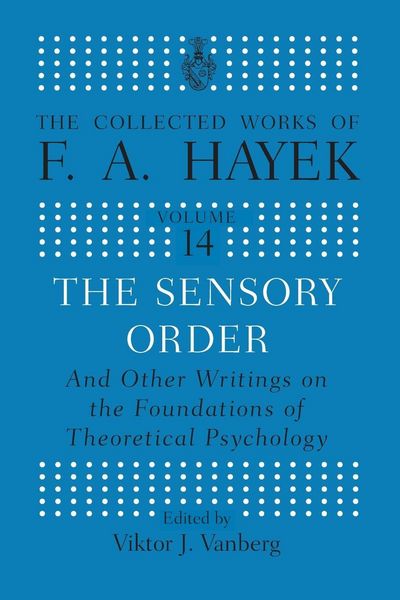
Produktbild: The Sensory Order and Other Writings on the Foundations of Theoretical Psychology

The Sensory Order and Other Writings on the Foundations of Theoretical Psychology Psychology

69,99 €

inkl. gesetzl. MwSt., Versandkostenfrei


Beschreibung

Produktdetails

Einband

Taschenbuch

Erscheinungsdatum

30.09.2020

Herausgeber

Vanberg Viktor J.

Verlag

Taylor and Francis

Seitenzahl

404

Maße (L/B/H)

22,9/15,2/2,2 cm

Gewicht

700 g

Sprache

Englisch

ISBN

978-0-367-66774-0

Beschreibung

Produktdetails

Einband

Taschenbuch

Erscheinungsdatum

30.09.2020

Herausgeber

Vanberg Viktor J.

Verlag

Taylor and Francis

Seitenzahl

404

Maße (L/B/H)

22,9/15,2/2,2 cm

Gewicht

700 g

Sprache

Englisch

ISBN

978-0-367-66774-0

Herstelleradresse

Libri GmbH
Europaallee 1
36244 Bad Hersfeld
DE

Email: gpsr@libri.de

Kundinnen und Kunden meinen

0 Bewertungen

Informationen zu Bewertungen

Zur Abgabe einer Bewertung ist eine Anmeldung im Konto notwendig. Die Authentizität der Bewertungen wird von uns nicht überprüft. Wir behalten uns vor, Bewertungstexte, die unseren Richtlinien widersprechen, entsprechend zu kürzen oder zu löschen.

Die Bewertungen sind nach Format, Anzahl Sterne und Datum sortiert.

Verfassen Sie die erste Bewertung zu diesem Artikel

Helfen Sie anderen Kund*innen durch Ihre Meinung

Kundinnen und Kunden meinen

0 Bewertungen filtern

  • Produktbild: The Sensory Order and Other Writings on the Foundations of Theoretical Psychology
  • Preface Introduction I. The Nature of the Problem 1. What is Mind? 2. The Phenomenal and the Physical World 3. Stimulus, Impulse, and the Theory of the Specific Energy of the Nerves 4. Differences in Quality are Differences in the Effects 5. The Unitary Character of the Sensory Order 6. The Order of Sensory Qualities not Confined to Conscious Experience 7. The Denial or Disregard of Our Problem by Behaviorism 8. The 'Absolute' Qualities of Sensations a Phantom-Problem II. An Outline of the Theory 1. The Principle of the Explanation 2. The Sensory Order in its Static and in its Dynamic Aspects 3. The Principle of Classification 4. Multiple Classification 5. The Central Thesis III. The Nervous System as an Instrument of Classification 1. An Inventory of the Physiological Data 2. Simplifying Assumptions on which the Operation of the Principle will be Discussed 3. Elementary Forms of Classification 4. Complex Forms of Classification 5. The Classification of the Relation Between Classes 6. The Universal Character of the Process of Classification: Gestalt Phenomena and Abstract Concepts IV. Sensation and Behaviour 1. Sensations and the Organism 2. Evolution and the Hierarchal Order of the Nervous System 3. From Specific Reflex to Generalized Evaluation 4. Proprioception of Low-Level Responses 5. Postures and Movements Connected with Perception 6. Patterns of Motor Responses 7. Biogenic Needs and Drives 8. Emotions and the James-Lange Theory V. The Structure of the Mental Order 1. Pre-Sensory Experience or 'Linkages' 2. The Gradual Formation of a 'Map' Reproducing Relations Between Events in the Environment 3. The 'Map' and the 'Model' 4. Associative Processes 5. Mechanical and Purposive Behaviour 6. The Model-Object Relationship VI. Consciousness and Conceptual Thought 1. Conscious and Unconscious Mental Processes 2. Criteria of Consciousness 3. The Common Space-Time Framework 4. Attention 5. The Functions of Consciousness 6. 'Concrete' and 'Abstract' 7. Conceptual Thought VII. Confirmations and Verification of the Theory 1. Observed Facts for which the Theory Accounts 2. Older Theories Comprised as Special Cases 3. New Experiments Suggested 4. Possibilities of Experimental Refutation VIII. Philosophical Consequences 1. Pre-Sensory Experience and Pure Empiricism 2. Phenomenalism and the Inconstancy of Sensory Qualities 3. Dualisms and Materialism 4. The Nature of Explanation 5. Explanation of the Principle 6. The Limits of Explanation 7. The Division of the Sciences and the 'Freedom of the Will' Bibliography Index