Gutscheinbedingungen

**Gültig bis 06.07.2026 auf fremdsprachige Bücher online auf thalia.at, in der Thalia App ab einem Mindestbestellwert von 30€ und in allen Thalia Buchhandlungen in Österreich. In den Buchhandlungen nur gültig auf lagernde Ware. Einzelne Artikel können ausgeschlossen sein. Ausgenommen sind preisgebundene Artikel & eBooks. Pro Einkauf einmal einlösbar. Nur gültig gegen Vorlage oder im Onlineshop hinterlegter Bonuscard. Infos zur Einlösung in der Buchhandlung sind auf der Bonuscard-Vorteilspreisseite zu finden. Click & Collect nur bei Onlinevorabzahlung möglich. Keine Einlösung bei Scan & Go-Bezahlung. Keine Barauszahlung. Nicht kombinierbar mit anderen Aktionen und Gutscheinen. Gutschein wird auf max. 500€ Bestellwert angerechnet. Nicht gültig für Versandkosten und Services.

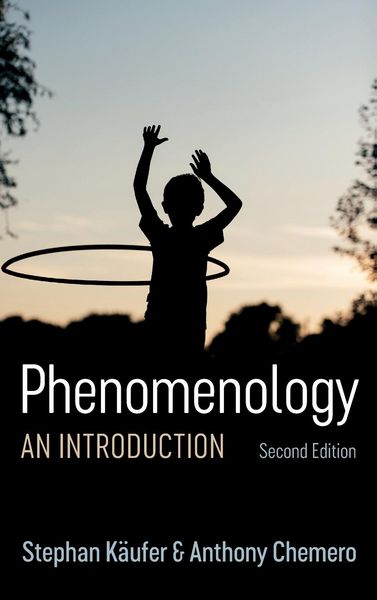
  • Produktbild: Phenomenology
  • Produktbild: Phenomenology

Phenomenology An Introduction

87,99 €

inkl. gesetzl. MwSt., Versandkostenfrei


Beschreibung

Produktdetails

Einband

Gebundene Ausgabe

Erscheinungsdatum

21.05.2021

Verlag

John Wiley & Sons Inc

Seitenzahl

288

Maße (L/B/H)

23,2/15,8/2,2 cm

Gewicht

666 g

Auflage

2. Auflage

Sprache

Englisch

ISBN

978-1-5095-4065-5

Beschreibung

Rezension

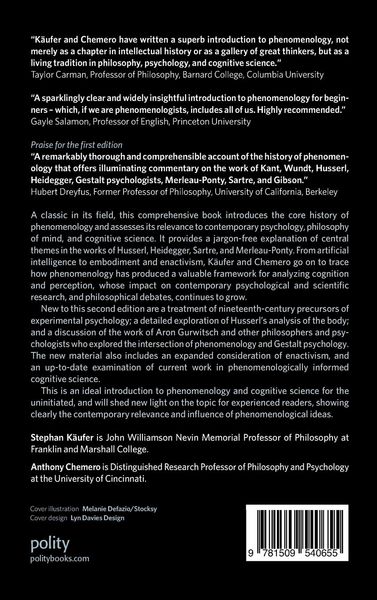
"Käufer and Chemero have written a superb introduction to phenomenology, not merely as a chapter in intellectual history or as a gallery of great thinkers, but as a living tradition in philosophy, psychology, and cognitive science."
Taylor Carman, Professor of Philosophy, Barnard College, Columbia University
 
"A sparklingly clear and widely insightful introduction to phenomenology for beginners - which, if we are phenomenologists, includes all of us. Highly recommended."
Gayle Salamon, Professor of English, Princeton University
 
Praise for the first edition:
"A remarkably thorough and comprehensible account of the history of phenomenology that offers illuminating commentary on the work of Kant, Wundt, Husserl, Heidegger, Gestalt psychologists, Merleau-Ponty, Sartre, and Gibson."
Hubert Dreyfus, Former Professor of Philosophy, University of California, Berkeley

Produktdetails

Einband

Gebundene Ausgabe

Erscheinungsdatum

21.05.2021

Verlag

John Wiley & Sons Inc

Seitenzahl

288

Maße (L/B/H)

23,2/15,8/2,2 cm

Gewicht

666 g

Auflage

2. Auflage

Sprache

Englisch

ISBN

978-1-5095-4065-5

Herstelleradresse

Libri GmbH
Europaallee 1
36244 Bad Hersfeld
DE

Email: gpsr@libri.de

Noch keine Bewertungen vorhanden

Verfassen Sie die erste Bewertung zu diesem Artikel

Helfen Sie anderen Kundinnen und Kunden durch Ihre Meinung.

Kundinnen und Kunden meinen

Bewertungen (0)

Die Leseprobe wird geladen.
  • Produktbild: Phenomenology
  • Produktbild: Phenomenology
  • Acknowledgements
     
    List of Figures
     
    Introduction
     
    1 Kant: Eighteenth and Nineteenth-Century Background
     
    1.1 Kant's critical philosophy
     
    1.2 Intuitions and concepts
    1.3 The transcendental deduction
     
    1.4 Kantian themes in phenomenology
     
    2 The Rise of Experimental Psychology
     
    2.1 Wilhelm Wundt and the rise of scientific psychology
     
    2.2 William James and functionalism
     
    2.3 The structuralism-functionalism debate
     
    3 Edmund Husserl and Transcendental Phenomenology
     
    3.1 Transcendental phenomenology
     
    3.2 Brentano
     
    3.3 Between logic and psychology
     
    3.4 Ideas
     
    3.5 The body
     
    3.6 Phenomenology of time consciousness
     
    4 Martin Heidegger and Existential Phenomenology
     
    4.1 The intelligibility of the everyday world
     
    4.2 Descartes and occurrentness
     
    4.3 Being-in-the-world
     
    4.4 Being-with others and the anyone
     
    4.5 The existential conception of the self
     
    4.6 Death, guilt, and authenticity
     
    5 Gestalt Psychology
     
    5.1 Gestalt criticisms of atomistic psychology
     
    5.2 Perception and the environment
     
    5.3 Influence of Gestalt psychology
     
    6 Aron Gurwitsch: Merging Gestalt Psychology and Phenomenology
     
    6.1 Phenomenology of Thematics and of the Pure Ego
     
    6.2 Others and the Social World
     
    7 Jean-Paul Sartre: Phenomenological Existentialism
     
    7.1 Transcendence of the Ego
     
    7.2 The Imagination and The Imaginary
     
    7.3 Being and Nothingness
     
    8 Maurice Merleau-Ponty: The Body and Perception
     
    8.1 Phenomenology of Perception
     
    8.2 Phenomenology, psychology, and the phenomenal field
     
    8.3 The lived body
     
    8.4 Perceptual constancy and natural objects
     
    9 Critical Phenomenology
     
    9.1 The path not taken
     
    9.2 Phenomenology and Gender
     
    9.3 Phenomenology and Race
     
    10 James J. Gibson and Ecological Psychology
     
    10.1 Gibson's early work: Two examples
     
    10.2 The ecological approach
     
    10.3 Ecological ontology
     
    10.4 Affordances and invitations
     
    11 Hubert Dreyfus and the Phenomenological Critique of Cognitivism
     
    11.1 The cognitive revolution and cognitive science
     
    11.2 "Alchemy and artificial intelligence"
     
    11.3 What Computers Can't Do
     
    11.4 Heideggerian artificial intelligence
     
    12 Enactivism and the Embodied Mind
     
    12.1 Embodied, Embedded, Extended, Enactive
     
    12.2 The Original Enactivism
     
    12.3 Other Enactivisms: The sensorimotor approach and radical enactivism
     
    12.4 Enactivism as a Philosophy of Nature
     
    13 Phenomenological Cognitive Science
     
    13.1 The frame problem
     
    13.2 Radical embodied cognitive science
     
    13.3 Dynamical systems theory
     
    13.4 Heideggerian cognitive science
     
    13.5 The future of scientific phenomenology
     
    References
     
    Index