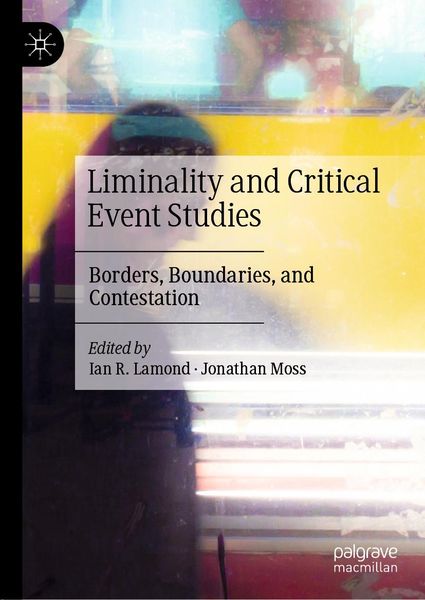
Liminality and Critical Event Studies Borders, Boundaries, and Contestation
-
- Hardcover
- Taschenbuch
- eBook ausgewählt
-
Form:Einzelkauf Download
-
Sprache:Englisch
109,99 €
inkl. gesetzl. MwSt.Beschreibung
Produktdetails
Format
ePUB
Kopierschutz
Nein
Family Sharing
Nein
Text-to-Speech
Ja
Erscheinungsdatum
28.03.2020
Herausgeber
Ian R. Lamond + weitereVerlag
SpringerSeitenzahl
299 (Printausgabe)
Dateigröße
4295 KB
Auflage
1st ed. 2020
Sprache
Englisch
EAN
9783030402563
This book explores and challenges the concept and experience of liminality as applied to critical perspectives in the study of events. It will be of interest to researchers in event studies, social and discursive psychology, cultural and political sociology, and social movement studies. In addition, it will provide interested general readers with new ways of thinking and reflecting on events. Contributing authors undertake a discussion of the borders, boundaries, and areas of contestation between the established social anthropological concept of liminality and the emerging field of critical event studies. By drawing these two perspectives closer together, the collection considers tensions and resonances between them, and uses those connections to enhance our understanding of both cultural and sporting events and offer fresh insight into events of activism, protest, and dissent.
Dr. Ian R. Lamond is a Senior Lecturer at Leeds Beckett University (UK). His work focuses on critical approaches to understanding events. His interests include events of protest and dissent, the eventalisation of the political, the commodification of death, cult fiction fandom, and graphic storytelling. His other works include two edited collections and two co-authored monographs.
Dr. Jonathan Moss is a Senior Lecturer at Leeds Beckett University (UK). His PhD dissertation used phenomenological psychology to situate music festival experiences in the ideographic Lifeworld of the attendees. He is currently writing two papers: one regarding the use of descriptive experience sampling methods in event studies, and the other considering how neurophenomenology contributes to our understanding of collective and shared emotions.
Noch keine Bewertungen vorhanden
Verfassen Sie die erste Bewertung zu diesem Artikel
Helfen Sie anderen Kundinnen und Kunden durch Ihre Meinung.
Kurze Frage zu unserer Seite
Vielen Dank für Ihr Feedback
Wir nutzen Ihr Feedback, um unsere Produktseiten zu verbessern. Bitte haben Sie Verständnis, dass wir Ihnen keine Rückmeldung geben können. Falls Sie Kontakt mit uns aufnehmen möchten, können Sie sich aber gerne an unseren Kund*innenservice wenden.
zum Kundenservice