Gutscheinbedingungen

**Gültig nur für Bestellungen an die Wunsch-Poststation bis 10.06.2026 auf Spielzeug, Schreibwaren, Filme, Geschenke & Trends, Musik, tolino eReader & Zubehör, Hörbücher und Hörbuch-Downloads (außer Abo), nicht preisgebundene Bücher und Kalender online auf thalia.at und in der Thalia App. Einzelne Artikel können ausgeschlossen sein. Aufgrund der Buchpreisbindung sind deutschsprachige Bücher und eBooks ausgenommen. Zusätzlich ausgenommen sind preisgebundene Artikel, Abos & Flatrates, eBooks, Games, Geschenkkarten/-boxen, Shelfies, Software, Zeitschriften sowie einzelne Artikel von tonies®. Pro Einkauf einmal einlösbar. Kein Click & Collect möglich. Keine Barauszahlung. Nicht kombinierbar mit anderen Aktionen und Gutscheinen. Gutschein wird auf max. 500€ Bestellwert angerechnet. Nicht gültig für Versandkosten und Services.

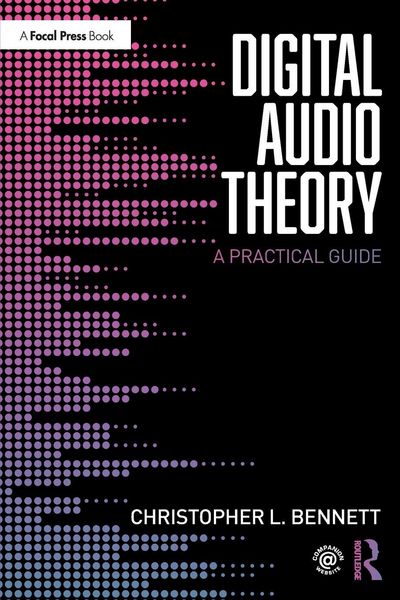
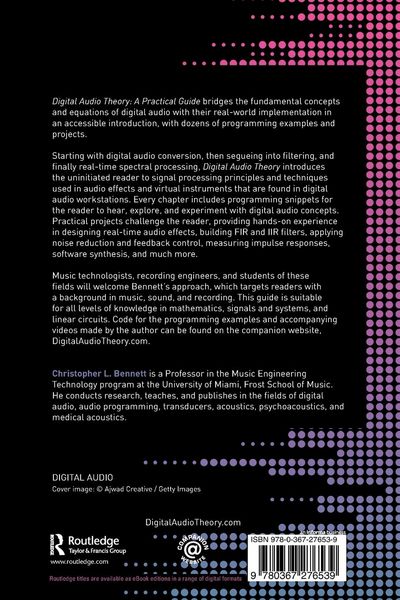
  • Produktbild: Digital Audio Theory
  • Produktbild: Digital Audio Theory

Digital Audio Theory A Practical Guide

58,99 €

inkl. gesetzl. MwSt., Versandkostenfrei


Beschreibung

Produktdetails

Einband

Taschenbuch

Erscheinungsdatum

28.12.2020

Abbildungen

schwarz-weiss Illustrationen, Zeichnungen, schwarz-weiss, Tabellen, schwarz-weiss

Verlag

Taylor & Francis

Seitenzahl

254

Maße (L/B/H)

23,4/15,6/1,4 cm

Gewicht

395 g

Sprache

Englisch

ISBN

978-0-367-27653-9

Beschreibung

Rezension

"Your background in music, sound, and recording makes you a power-user of digital audio signal processors. Wouldn't you like to understand what's going on inside those converters, delays, filters and more? Don't you want to know what to listen for when it's time to choose which one to use? And don't you sort of want to create your own FX? Me too. There is the calculus and coding way into this, and then there is Christopher Bennett's way in. If you want to understand digital audio theory - to have mastery of the theories and intuition about the possibilities - you don't need an engineering degree, you need this book."

Alex U. Case, Sound Recording Technology, University of Massachusetts Lowell, Past President of the Audio Engineering Society, and author of Sound FX: Unlocking the Creative Potential of Recording Studio Effects and Mix Smart: Pro Audio Tips for Your Multitrack Mix

"This book is part of a fresh approach to the challenges that aspiring audio programmers face. Rather than serving as a reference manual, Bennett presents Digital Audio Theory as part of a journey, supplementing the reading material with over 30 video tutorials and code samples. It is essential reading for anyone trying to understand the fundamentals of signal processing. The explanations are clear and well thought out - easy enough for those with a casual math background to follow along, but challenging enough to introduce concepts that reach beyond algorithms covered by other books. Highly recommended!"

Joshua Hodge, a.k.a. The Audio Programmer

Produktdetails

Einband

Taschenbuch

Erscheinungsdatum

28.12.2020

Abbildungen

schwarz-weiss Illustrationen, Zeichnungen, schwarz-weiss, Tabellen, schwarz-weiss

Verlag

Taylor & Francis

Seitenzahl

254

Maße (L/B/H)

23,4/15,6/1,4 cm

Gewicht

395 g

Sprache

Englisch

ISBN

978-0-367-27653-9

Herstelleradresse

Libri GmbH
Europaallee 1
36244 Bad Hersfeld
DE

Email: gpsr@libri.de

Kundinnen und Kunden meinen

0 Bewertungen

Informationen zu Bewertungen

Zur Abgabe einer Bewertung ist eine Anmeldung im Konto notwendig. Die Authentizität der Bewertungen wird von uns nicht überprüft. Wir behalten uns vor, Bewertungstexte, die unseren Richtlinien widersprechen, entsprechend zu kürzen oder zu löschen.

Die Bewertungen sind nach Format, Anzahl Sterne und Datum sortiert.

Verfassen Sie die erste Bewertung zu diesem Artikel

Helfen Sie anderen Kund*innen durch Ihre Meinung

Kundinnen und Kunden meinen

0 Bewertungen filtern

Die Leseprobe wird geladen.
  • Produktbild: Digital Audio Theory
  • Produktbild: Digital Audio Theory
  • 1 Introduction

    1.1 Describing audio signals

    1.2 Digital audio basics

    1.3 Describing audio systems

    1.4 Further reading

    1.5 Challenges

    1.6 Project – audio playback

    2 Complex vectors and phasors

    2.1 Complex number representation and operations

    2.2 Complex conjugates

    2.3 Phasors

    2.4 Beat frequencies

    2.5 Challenges

    2.6 Project – AM and FM synthesis

    Bibliography

    3 Sampling

    3.1 Phasor representation on the complex plane

    3.2 Nyquist frequency

    3.3 Time shift operators

    3.4 Sampling a continuous signal

    3.5 Jitter

    3.6 Challenges

    Bibliography

    4 Aliasing and reconstruction

    4.1 Under-sampling

    4.2 Predicting the alias frequency

    4.3 Anti-aliasing filter

    4.4 Reconstruction

    4.5 Challenges

    4.6 Project – aliasing

    Bibliography

    5 Quantization

    5.1 Quantization resolution

    5.2 Audio buffers

    5.3 Sample-and-hold circuit

    5.4 Quantization error (eq)

    5.5 Pulse code modulation

    5.6 Challenges

    Bibliography

    6 Dither

    6.1 Signal-to-Error Ratio (SER)

    6.2 SER at low signal levels

    6.3 Applying dither

    6.4 Triangular PDF dither

    6.5 High-frequency dither

    6.6 Challenges

    6.7 Project – dither effects

    Bibliography

    7 DSP basics

    7.1 Time-shift operators

    7.2 Time-reversal operator

    7.3 Time scaling

    7.4 Block diagrams

    7.5 Difference equations

    7.6 Canonical form

    7.7 Challenges

    7.8 Project – plucked string model

    Bibliography

    8 FIR filters

    8.1 FIR filters by way of example

    8.2 Impulse response

    8.3 Convolution

    8.4 Cross-correlation

    8.5 FIR filter phase

    8.6 Designing FIR filters

    8.7 Challenges

    8.8 Project – FIR filters

    Bibliography

    9 z-Domain

    9.1 Frequency response

    9.2 Magnitude response

    9.3 Comb filters

    9.4 z-Transform

    9.5 Pole/zero plots

    9.6 Filter phase response

    9.7 Group delay

    9.8 Challenges

    10 IIR filters

    10.1 General characteristics of IIR filters

    10.2 IIR filter transfer functions

    10.3 IIR filter stability

    10.4 Second-order resonators

    10.5 Biquadratic filters

    10.6 Proportional parametric EQ

    10.7 Forward-reverse filtering

    10.8 Challenges

    10.9 Project – resonator

    Bibliography

    11 Impulse response measurements

    11.1 Noise reduction through averaging

    11.2 Capturing IRs with MLS

    11.3 Capturing IRs with ESS

    11.4 Challenges

    11.5 Project – room response measurements

    Bibliography

    12 Discrete Fourier transform

    12.1 Discretizing a transfer function

    12.2 Sampling the frequency response

    12.3 The DFT and inverse discrete Fourier transform

    12.4 Twiddle factor

    12.5 Properties of the DFT

    12.6 Revisiting sampling in the frequency domain

    12.7 Frequency interpolation

    12.8 Challenges

    12.9 Project – spectral filtering

    13 Real-time spectral processing

    13.1 Filtering in the frequency domain

    13.2 Windowing

    13.3 Constant overlap and add

    13.4 Spectrograms

    13.5 Challenges

    13.6 Project – automatic feedback control

    14 Analog modeling

    14.1 Derivation of the z-transform

    14.2 Impulse invariance

    14.3 Bilinear transformation

    14.4 Frequency sampling

    14.5 Non-linear modeling with ESS

    14.6 Challenges

    Bibliography