• Produktbild: AR and VR Using the WebXR API
  • Produktbild: AR and VR Using the WebXR API

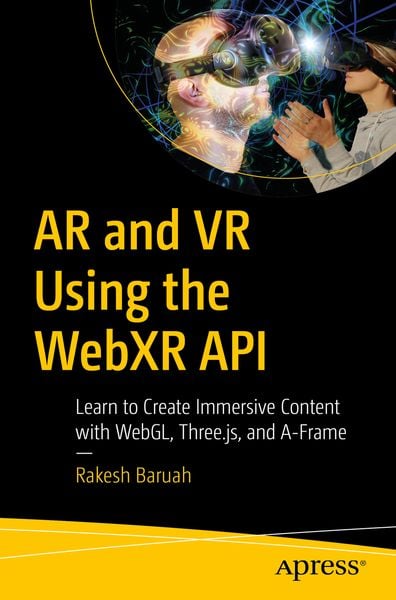
AR and VR Using the WebXR API Learn to Create Immersive Content with WebGL, Three.js, and A-Frame

59,99 €

inkl. gesetzl. MwSt., Versandkostenfrei


Beschreibung

Produktdetails

Einband

Taschenbuch

Erscheinungsdatum

01.12.2020

Verlag

Apress

Seitenzahl

328

Maße (L/B/H)

23,5/15,5/2 cm

Gewicht

534 g

Auflage

1st ed.

Sprache

Englisch

ISBN

978-1-4842-6317-4

Beschreibung

Produktdetails

Einband

Taschenbuch

Erscheinungsdatum

01.12.2020

Verlag

Apress

Seitenzahl

328

Maße (L/B/H)

23,5/15,5/2 cm

Gewicht

534 g

Auflage

1st ed.

Sprache

Englisch

ISBN

978-1-4842-6317-4

Herstelleradresse

Springer-Verlag GmbH
Tiergartenstr. 17
69121 Heidelberg
DE

Email: GPSR Kontakt

Noch keine Bewertungen vorhanden

Verfassen Sie die erste Bewertung zu diesem Artikel

Helfen Sie anderen Kundinnen und Kunden durch Ihre Meinung.

Kundinnen und Kunden meinen

Bewertungen (0)

  • Produktbild: AR and VR Using the WebXR API
  • Produktbild: AR and VR Using the WebXR API
  • Chapter 1: IntroductionSub-Topics:- The Components of WebXR• Pose tracking• Camera data• Scene understanding- Hit-Testing- Anchors- Point-clouds- Surfaces- light-estimation• The webXR API- WebGL 1 → WebGL 2 → WebGPU → WebVR → WebXR- Khronos Group and WC3• The webXR emulator• Industry Standard XR Guidelines (Microsoft, Google)

    Chapter 2: SetupSub-Topics:- Types of Browsers and Requirements- Chrome Canary- Firefox Reality- Oculus Browser• How to setup a local server for development- Node, Python, Servez• Local machine setup- Download and install Visual Studio Code- Create GitHub account• Playgrounds vs. Local development while executive the code in the book

    Chapter 3: Introduction to Web BrowsersSub-Topics:• The Workings of the World Wide Web- Client - Server relationship- HTML, CSS, and Javascript• The Workings of a Web Page- The Document Object Model- The Render Engine- HTML5 and Canvas• Toward Native Code in the Browser- WebAssembly Physics and the GPU

    Chapter 4: A Brief Introduction to WebGLSub-Topics:• The Big Picture of WebGL- A Crash Course in 3D Graphics- The Graphics Rendering → Rasterizing Pipeline• The Difference Between WebGL and JavaScript- CPU vs GPU- Browser vs Native- The Value of Many Threads• The Components of a WebGL Application- Vertex and Fragment Shaders- Uniforms, Attributes, and Buffers- ViewMatrix, ProjectionMatrix, and the WebGL Matrix Math Library• The Cognitive Dissonance between WebGL and Web Programmers

    Chapter 5: WebXR Libraries -- Three.jsSub-Topics:• An Overview of JavaScript Libraries• Introduction to Three.js, which Makes Programming WebGL Easier• Async and Await vs Promises in JavaScript• JavaScript and the GPU

    Chapter 6: WebXR Frameworks: Mozilla’s A-FrameSub-Topics:• A-Frame makes Three.js easier• The Components of A-Frame:- Scenes, Cameras, Objects, Interactions- Light and Shadows- 3D Objects and the gLTF file format

    Chapter 7: WebXR Engines: Babylon.jsSub-Topics:• TypeScript vs JavaScript- Type safety- Parallel Processing• The Babylon.js Tools- Playground- Inspector- Node Creator• What Makes an Engine vs. a Framework?- The role of physics in XR creation

    Chapter 8:  Web Augmented Reality in Chrome CanarySub-Topics:• An Overview of the WebXR Features in the Chrome Canary XR API- Hit-Testing- Camera access• Accessing Developer Features in Chrome• The Browser and Hardware Connection- Final Project: Client-Server database connection for data persistence in AR 

    Chapter 9: The Future of WebXRSub-Topics:• Computer Vision and WebXR- Facial Recognition and Filters• Multi-user Interaction- Spatial / Cloud Anchors- Social XR• Hand Gestures and Voice Commands- Motion Tracking• Cloud-Computing and Privacy- The ethical responsibility of the Immersive Web developer