Gutscheinbedingungen

**Gültig am 28.06.2026 auf Spielzeug, Schreibwaren, Filme, Geschenke & Trends, Musik, tolino eReader & Zubehör, Hörbücher und Hörbuch-Downloads (außer Abo), nicht preisgebundene Bücher und Kalender online auf thalia.at und in der Thalia App. Einzelne Artikel können ausgeschlossen sein. Aufgrund der Buchpreisbindung sind deutschsprachige Bücher und eBooks ausgenommen. Zusätzlich ausgenommen sind preisgebundene Artikel, Abos & Flatrates, eBooks, Games, Geschenkkarten/-boxen, Shelfies, Software, Zeitschriften sowie einzelne Artikel von tonies®. Pro Einkauf einmal einlösbar. Click & Collect nur bei Onlinevorabzahlung möglich. Keine Barauszahlung. Nicht kombinierbar mit anderen Aktionen und Gutscheinen. Gutschein wird auf max. 500€ Bestellwert angerechnet. Nicht gültig für Versandkosten und Services.

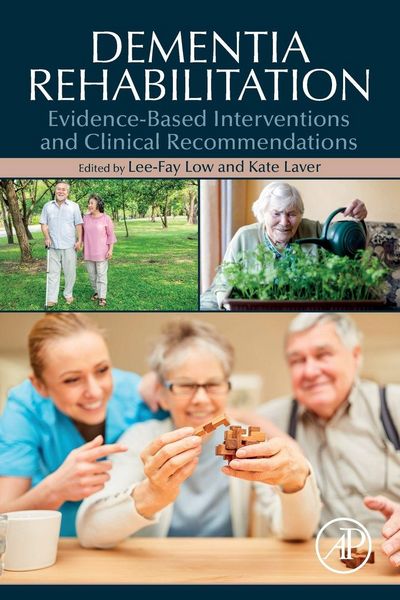
  • Produktbild: Dementia Rehabilitation
  • Produktbild: Dementia Rehabilitation

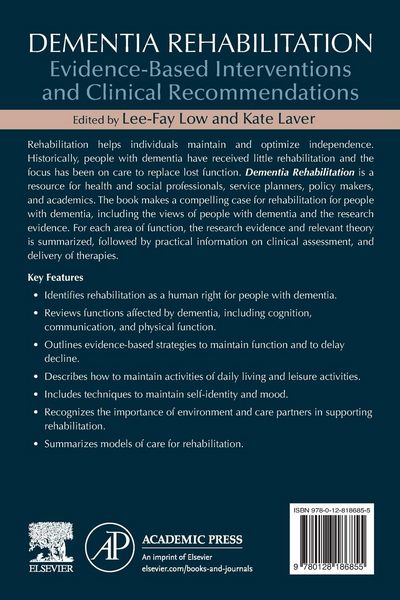
Dementia Rehabilitation Evidence-Based Interventions and Clinical Recommendations

126,99 €

inkl. gesetzl. MwSt., Versandkostenfrei


Beschreibung

Produktdetails

Einband

Taschenbuch

Erscheinungsdatum

23.10.2020

Herausgeber

Lee-Fay Low + weitere

Verlag

Elsevier Science & Technology

Seitenzahl

288

Maße (L/B/H)

22,9/15,2/1,5 cm

Gewicht

390 g

Sprache

Englisch

ISBN

978-0-12-818685-5

Beschreibung

Portrait

Associate Professor Lee-Fay Low is a psychologist, epidemiologist and researcher specialising in developing and evaluating interventions for older people. She has published extensively on dementia and aged care. Lee-Fay brings together people to solve real-world problems so her projects often involve a range of collaborators including people with dementia, care partners, clinicians, service providers and policy makers as well as others with relevant expertise such as designers, artists and marketing experts.

Associate Professor Kate Laver is an occupational therapist with experience working with people in inpatient and community rehabilitation settings. Her work involves collaborating with people with dementia to design research that is relevant and important. Her studies involve testing and implementing non-pharmacological interventions for people with dementia. The aim of her research work is to optimise function and quality of life in people with dementia and their families. She has an interest in technologies in rehabilitation and expertise in knowledge translation.

Produktdetails

Einband

Taschenbuch

Erscheinungsdatum

23.10.2020

Herausgeber

Verlag

Elsevier Science & Technology

Seitenzahl

288

Maße (L/B/H)

22,9/15,2/1,5 cm

Gewicht

390 g

Sprache

Englisch

ISBN

978-0-12-818685-5

EU-Ansprechpartner

Zeitfracht Medien GmbH
Ferdinand-Jühlke-Straße 7|99095|Erfurt|DE
produktsicherheit@zeitfracht.de

Herstelleradresse

Elsevier Science & Technology
125 London Wall|EC2Y 5AS|London|GB
tradeorders@elsevier.com

Kundinnen und Kunden meinen

0 Bewertungen

Informationen zu Bewertungen

Zur Abgabe einer Bewertung ist eine Anmeldung im Konto notwendig. Die Authentizität der Bewertungen wird von uns nicht überprüft. Wir behalten uns vor, Bewertungstexte, die unseren Richtlinien widersprechen, entsprechend zu kürzen oder zu löschen.

Die Bewertungen sind nach Format, Anzahl Sterne und Datum sortiert.

Verfassen Sie die erste Bewertung zu diesem Artikel

Helfen Sie anderen Kund*innen durch Ihre Meinung

Kundinnen und Kunden meinen

0 Bewertungen filtern

Die Leseprobe wird geladen.
  • Produktbild: Dementia Rehabilitation
  • Produktbild: Dementia Rehabilitation
  • Preface

    Introduction: Rehabilitation as a new way of working with people with dementia

    Lee-Fay Low and Kate Laver

    1. Rehabilitation: a human right for everyone

    Kate Swaffer

    2. Cognitively-oriented treatments in dementia

    Alex Bahar-Fuchs, Loren Mowszowski, Nicola T. Lautenschlager and Kay Cox

    3. Communication interventions for people with dementia and communication partners

    Sarah El-Wahsh, Penelope Monroe, Fiona Kumfor and Kirrie Ballard

    4. Maintaining and improving physical function in dementia

    Michele L. Callisaya, Susan W. Hunter and Manuel Montero-Odasso

    5. Optimizing independence in activities of daily living

    Kate Laver, Catherine Verrier Piersol and Rachel Wiley

    6. Active and engaged: Maintaining leisure activities in dementia Claire M. C. O'Connor, Jacqueline Wesson, and Lindy Clemson

    7. Rehabilitation to improve psychological well-being in dementia

    Lee-Fay Low, Monica Cations, Deborah Koder and Annaliese Blair

    8. Driving and community mobility for people with dementia

    Theresa L. Scott, Jacki Liddle and Nancy Pachana

    9. Supporting people with dementia in employment

    David Evans, Carolyn Murray, Angela Berndt and Jacinta Robertson

    10. Can buildings contribute to the rehabilitation of people living with dementia?

    Richard Fleming

    11. Supporting everyday functioning of people living with dementia: The role of care partners

    Laura N. Gitlin and Michael Bruneau, Jr.

    12. Physical comorbidities of dementia: Recognition and rehabilitation

    Sue Kurrle

    13. Improving functional independence: Dementia rehabilitation programs

    Yun-Hee Jeon, Nicole Milne, Cassandra Kaizik and Barbara Resnick