Gutscheinbedingungen

**Gültig bis 17.08.2026 auf Schreibwaren & Office-Artikel online auf thalia.at, in der Thalia App und in teilnehmenden Thalia Buchhandlungen in Österreich mit Schulsortiment. In den Buchhandlungen nur gültig auf lagernde Ware. Einzelne Artikel können ausgeschlossen sein. Ausgenommen sind preisgebundene Artikel. Pro Einkauf einmal einlösbar. Nur gültig gegen Vorlage oder im Onlineshop hinterlegter Bonuscard. Infos zur Einlösung in der Buchhandlung sind auf der Bonuscard-Vorteilspreisseite zu finden. Click & Collect nur bei Onlinevorabzahlung möglich. Keine Einlösung bei Scan & Go-Bezahlung. Keine Barauszahlung. Nicht kombinierbar mit anderen Aktionen und Gutscheinen. Gutschein wird auf max. 500€ Bestellwert angerechnet. Nicht gültig für Geschenkkarten, Versandkosten und Services.

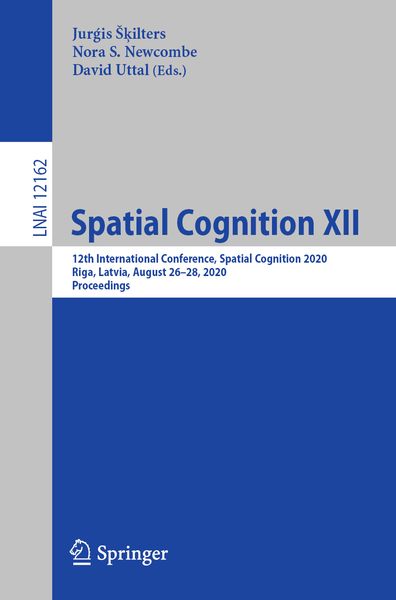
  • Produktbild: Spatial Cognition XII
  • Produktbild: Spatial Cognition XII
Band 12162

Spatial Cognition XII 12th International Conference, Spatial Cognition 2020, Riga, Latvia, August 26–28, 2020, Proceedings

75,99 €

inkl. gesetzl. MwSt., Versandkostenfrei


Beschreibung

Produktdetails

Einband

Taschenbuch

Erscheinungsdatum

20.08.2020

Abbildungen

XI, 336 p. 126 illus., 94 illus. in color.

Herausgeber

Jurǵis Šķilters + weitere

Verlag

Springer

Seitenzahl

336

Maße (L/B/H)

23,5/15,5/1,9 cm

Gewicht

528 g

Auflage

1st ed. 2020

Sprache

Englisch

ISBN

978-3-030-57982-1

Beschreibung

Produktdetails

Einband

Taschenbuch

Erscheinungsdatum

20.08.2020

Abbildungen

XI, 336 p. 126 illus., 94 illus. in color.

Herausgeber

Verlag

Springer

Seitenzahl

336

Maße (L/B/H)

23,5/15,5/1,9 cm

Gewicht

528 g

Auflage

1st ed. 2020

Sprache

Englisch

ISBN

978-3-030-57982-1

Herstelleradresse

Springer-Verlag KG
Sachsenplatz 4-6
1201 Wien
AT

Email: GPSR Kontakt

Noch keine Bewertungen vorhanden

Verfassen Sie die erste Bewertung zu diesem Artikel

Helfen Sie anderen Kundinnen und Kunden durch Ihre Meinung.

Kundinnen und Kunden meinen

Bewertungen (0)

  • Produktbild: Spatial Cognition XII
  • Produktbild: Spatial Cognition XII
  • Spatial representation and cognitive maps.- Dual Population Coding for Path Planning in Graphs with Overlapping Place Representations.- Dynamic Problem Solving in Space.- How to Model (Personalised) Landmarks?.- The Influence of Position on Spatial Representation in Working Memory.- Spatial Representation in Sequential Action Organization of Weakly Constrained    Everyday Activities.- Understanding Cognitive Saliency by Using an Online game.- A Framework for Place-based Survey Implementation.- A Study on Visual and Structural Characteristics of Landmarks and Experts’ and Non-experts’ Evaluations.- Navigation and wayfinding.- Redefining Global and Local Landmarks: When Does a Landmark Stop Being Local and Become a Global One?.- Local Wayfinding Decisions in a Complex Real-World Building.- Developing a Replication of a Wayfinding Study. From a Large-scale Real Building to a Virtual Reality Simulation.- Investigation of Potential Cognition Factors Correlated to Fire Evacuation.- Comparing Human Wayfinding Behavior Between a Real, Existing Building, a Virtual Replica, and Two Architectural Redesigns.- Motion Features of Digital Path Tracing in Urban Map Navigation.- Investigating Wayfinding under Inconsistent Information.- Applying Psychophysics to Applied Spatial Cognition Research.- Spatial representation in language, logic, and narrative.- Spatial Descriptions on a Functional-geometric Spectrum: the Location of Objects.- Cross-linguistic Differences in Side Assignment to Objects and Interpretation of Spatial Relations: Right and Left in German and Italian.- Local Alignment of Frame of Reference Assignment in English and Swedish Dialogue.- A Logical Framework for Spatial Mental Models.- The Spatiotemporal Dimension of Singular Reference.- Spatial abilities and learning.- Minecraft as a Generative Platform for Analyzing and Practicing Spatial Reasoning.- ERMENTAL: A Simple Web Environment to Design and Teach the Effects ofCognitive Training Experiments.- The Function of Gesture in Architectural-Design-Related Spatial Ability.- Impacts of Scent on Mental Cutting Ability for Industrial and Engineering Technology Students as Measured through a Sectional View Drawing.