KI-Beratung Beta

  • Produktbild: Topics in Theoretical Computer Science
  • Produktbild: Topics in Theoretical Computer Science
Band 12281

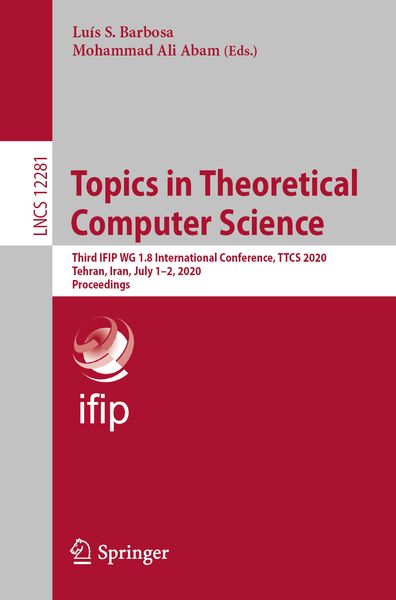
Topics in Theoretical Computer Science Third IFIP WG 1.8 International Conference, TTCS 2020, Tehran, Iran, July 1–2, 2020, Proceedings

52,99 €

inkl. gesetzl. MwSt., Versandkostenfrei


Beschreibung

This book constitutes the refereed proceedings of the Third IFIP WG 1.8 International Conference on Topics in Theoretical Computer Science, TTCS 2020, held in Tehran, Iran, in July 2020. The conference was held virtually due to the COVID-19 pandemic.

The 8 papers presented in this volume were carefully...

Beschreibung

This book constitutes the refereed proceedings of the Third IFIP WG 1.8 International Conference on Topics in Theoretical Computer Science, TTCS 2020, held in Tehran, Iran, in July 2020. The conference was held virtually due to the COVID-19 pandemic.

The 8 papers presented in this volume were carefully reviewed and selected from 24 submissions. They focus on novel and high-quality research in all areas of theoretical computer science, such as algorithms and complexity; logic, semantics, and programming theory; and more.

Produktdetails

Einband

Taschenbuch

Erscheinungsdatum

13.08.2020

Abbildungen

IX, 117 p. 33 illus., 9 illus. in color.

Herausgeber Luís S. Barbosa + weitere

Produktdetails

Einband

Taschenbuch

Erscheinungsdatum

13.08.2020

Abbildungen

IX, 117 p. 33 illus., 9 illus. in color.

Herausgeber
Verlag Springer
Seitenzahl

117

Maße (L/B/H)

23,5/15,5/0,8 cm

Gewicht

207 g

Auflage

1st ed. 2020

Sprache

Englisch

ISBN

978-3-030-57851-0

Herstelleradresse

Springer-Verlag KG
Sachsenplatz 4-6
1201 Wien
AT

Email: ProductSafety@springernature.com

Noch keine Bewertungen vorhanden

Verfassen Sie die erste Bewertung zu diesem Artikel

Helfen Sie anderen Kundinnen und Kunden durch Ihre Meinung.

Kundinnen und Kunden meinen

Bewertungen (0)

  • Produktbild: Topics in Theoretical Computer Science
  • Produktbild: Topics in Theoretical Computer Science
  • Dirac-based Reduction Techniques for Quantitative Analysis of Discrete-time Markov Models.- Combining Machine and Automata Learning for Network Traffic Classification.- On the complexity of the upper r-tolerant edge cover problem.- Margin-based Semi-supervised Learning Using Apollonius circle.- Computing Boundary Cycle of a Pseudo-Triangle Polygon from its Visibility Graph.- Improved Algorithms for Distributed Balanced Clustering.- Finite Interval-Time Transition System for Real-Time Actors.- Path Planning with Objectives Minimum Length and Maximum Clearance.