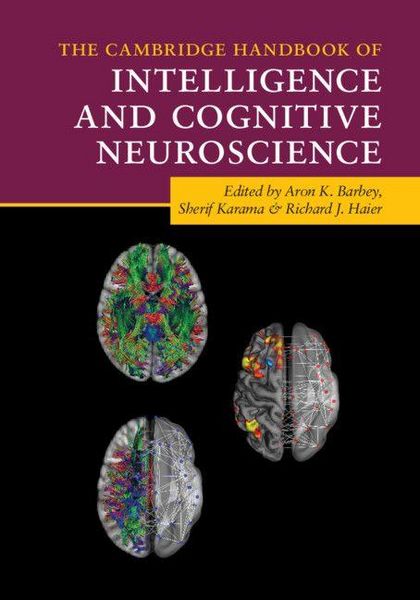
Produktbild: The Cambridge Handbook of Intelligence and Cognitive Neuroscience

The Cambridge Handbook of Intelligence and Cognitive Neuroscience

158,99 €

inkl. gesetzl. MwSt., Versandkostenfrei


Beschreibung

Produktdetails

Einband

Taschenbuch

Erscheinungsdatum

01.07.2021

Herausgeber

Aron K. Barbey + weitere

Verlag

Cambridge Academic

Seitenzahl

504

Maße (L/B/H)

25,4/17,8/2,7 cm

Gewicht

958 g

Sprache

Englisch

ISBN

978-1-108-72772-3

Beschreibung

Produktdetails

Einband

Taschenbuch

Erscheinungsdatum

01.07.2021

Herausgeber

Verlag

Cambridge Academic

Seitenzahl

504

Maße (L/B/H)

25,4/17,8/2,7 cm

Gewicht

958 g

Sprache

Englisch

ISBN

978-1-108-72772-3

Herstelleradresse

Libri GmbH
Europaallee 1
36244 Bad Hersfeld
DE

Email: gpsr@libri.de

Noch keine Bewertungen vorhanden

Verfassen Sie die erste Bewertung zu diesem Artikel

Helfen Sie anderen Kundinnen und Kunden durch Ihre Meinung.

Kundinnen und Kunden meinen

Bewertungen (0)

Die Leseprobe wird geladen.
  • Produktbild: The Cambridge Handbook of Intelligence and Cognitive Neuroscience
  • Part I. Fundamental Issues: 1. Defining and Measuring Intelligence - The Psychometrics and Neuroscience of G Thomas R. Coyle; 2. Network Neuroscience Methods for Studying Intelligence Kirsten Hilger and Olaf Sporns; 3. Imaging the Intelligence of Humans Kenia Martínez and Roberto Colom; 4. Research Consortia and Large-Scale Data Repositories for Studying Intelligence Budhachandra Khundrakpam, J B Poline, and Alan Evans; Part II. Theories, Models, and Hypotheses: 5. Evaluating the Weight of the Evidence - Cognitive Neuroscience Theories of Intelligence Matthew J. Euler and Ty L. McKinney; 6. Human Intelligence and Network Neuroscience Aron K. Barbey; 7. It's About Time - Toward a Longitudinal Cognitive Neuroscience of Intelligence Rogier A. Kievit and Ivan L. Simpson-Kent; 8. A Lifespan Perspective on the Cognitive Neuroscience of Intelligence Joseph P. Hennessee and Denise C. Park; 9. Predictive Intelligence for Learning and Optimization - Multidisciplinary Perspectives from Social, Cognitive and Affective Neuroscience Christine Ahrends, Peter Vuust, and Morten L. Kringelbach; Part III. Neuroimaging Methods and Findings: 10. Structural and Diffusion-Weighted Imaging of Intelligence Erhan Genç and Christoph Fraenz; 11. Structural Neuroimaging of Intelligence Differences Stefan Drakulich and Sherif Karama; 12. Functional Brain Imaging of Intelligence Ulrike Basten and Christian J. Fiebach; 13. An Integrated, Dynamic Functional Connectome Underlies Intelligence Jessica R. Cohen and Mark D'Esposito; 14. Biochemical Correlates of Intelligence Rex E. Jung and Marwa O. Chohan; 15. Good Sense and Good Chemistry: Neurochemical Correlates of Cognitive Performance Assessed in Vivo through Magnetic Resonance Spectroscopy Naftali Raz, Jeffrey A. Stanley; Part IV. Predictive Modeling Approaches: 16. Predicting Individual Differences in Cognitive Ability from Brain Imaging and Genetics Kevin M Anderson and Avram J Holmes; 17. Predicting Cognitive-Ability Differences from Genetic and Brain-Imaging Data Emily A. Willoughby and James J. Lee; Part V. Translating Research on the Neuroscience of Intelligence into Action: 18. Enhancing Cognition Michael I. Posner and Mary K. Rothbart; 19. Patient-Based Approaches to Understanding Intelligence and Problem-Solving Shira Cohen-Zimerman, Carola Salvi, and Jordan Grafman; 20. Implications of Biological Research on Intelligence for Education and Public Policy Kathryn Asbury and Diana Fields; 21. Vertical and Horizontal Levels of Analysis in the Study of Human Intelligence Robert J. Sternberg; 22. How Intelligence Research Can Inform Education and Public Policy Jonathan Wai and Drew H. Bailey.