• Produktbild: Learning from Animations in Science Education
  • Produktbild: Learning from Animations in Science Education
Band 25 - 11%

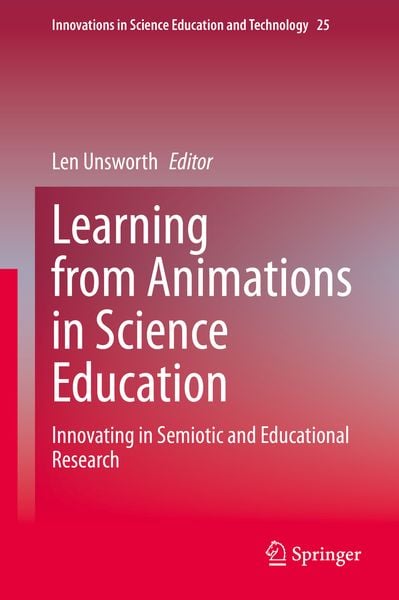
Learning from Animations in Science Education Innovating in Semiotic and Educational Research

11% sparen

154,99 € UVP 175,99 €

inkl. gesetzl. MwSt., Versandkostenfrei


Beschreibung

Produktdetails

Einband

Gebundene Ausgabe

Erscheinungsdatum

11.11.2020

Abbildungen

VIII, 322 p. 228 illus.

Herausgeber

Len Unsworth

Verlag

Springer

Seitenzahl

322

Maße (L/B/H)

24,1/16/2,4 cm

Gewicht

664 g

Auflage

1st ed. 2020

Sprache

Englisch

ISBN

978-3-030-56046-1

Beschreibung

Portrait


Len Unsworth is Professor in English and Literacies Education in the Institute for Learning Sciences and Teacher Education (ILSTE), at the Australian Catholic University in Sydney, Australia. Len’s current research interests include systemic functional semiotic perspectives on multimodal and digital literacies in English and in curriculum area teaching and learning in primary and secondary schools. He is the lead researcher on an Australian Research Council funded project on 
Multiliteracies for Addressing Disadvantage in Senior High School Science
and has published in the 
International Journal of Science Education 
and in Research in Science Education with an extensive record of publication in leading journals in literacy and education as well book chapters and a number of books, including recently: 
Functional Grammatics: Reconceptualising Knowledge about Language and Image for School English
 with Mary Macken-Horarik, Kristina Love and Carmel Sandiford (Routledge, 2017);
 English Teaching and New Literacies Pedagogy: Interpreting and authoring digital multimedia narratives 
with Angela Thomas (Peter Lang Publishing 2014); and
 Reading Visual Narratives
 (Equinox, 2013) with Clare Painter and Jim Martin.

Produktdetails

Einband

Gebundene Ausgabe

Erscheinungsdatum

11.11.2020

Abbildungen

VIII, 322 p. 228 illus.

Herausgeber

Len Unsworth

Verlag

Springer

Seitenzahl

322

Maße (L/B/H)

24,1/16/2,4 cm

Gewicht

664 g

Auflage

1st ed. 2020

Sprache

Englisch

ISBN

978-3-030-56046-1

Herstelleradresse

Springer-Verlag GmbH
Tiergartenstr. 17
69121 Heidelberg
DE

Email: ProductSafety@springernature.com

Noch keine Bewertungen vorhanden

Verfassen Sie die erste Bewertung zu diesem Artikel

Helfen Sie anderen Kundinnen und Kunden durch Ihre Meinung.

Kundinnen und Kunden meinen

Bewertungen (0)

  • Produktbild: Learning from Animations in Science Education
  • Produktbild: Learning from Animations in Science Education

  • SECTION I: Introduction.-
    1 A multidisciplinary perspective on designing and using animations in school science education;
    Len Unsworth.- SECTION II: Educational Semiotics and the Representation of Knowledge in School Science.-
    2 A functional perspective on the semiotic features of science animation;
    Yufei He.-
    3 Spatiality and temporality in the visual representation of science diagrams and animations;
    Theo van Leeuwen.-
    4 Infusing pro-environmental values in science education: A multimodal analysis of attitudinal meaning in ecology animations for children;
    William Feng and Len Unsworth.-
    5 Multimodal Affordances of Virtual Reality (VR) for Visualising and Learning Molecular Interactions;
    Kok-Sing Tang.- SECTION III: Strategic Integration of Animation in Science Education.-
    6 Using animated simulations to support young students’ science learning;
    Garry Falloon.-
    7 Promoting Scientific Understanding through Animated Multimodal Texts;
    Maximiliano Montenegro, Alejandra Meneses, Soledad Véliz, Pablo Escobar, Marión Garolera

    and María Paz Ramírez.- SECTION IV: Learning through Creating Science Animations.-
    8 Constructing a Representational System: Engaging Students with Science Content using Student-generated Animations;
    Garry Hoban.-
    9 Student-Generated Animations for Knowledge Building in the Chemistry Class;
    Zeynep Yaseen.- 10 Animation construction as cross-mode recasting in Year 11 biology; Russell Tytler, Peta White and Wendy Nielson.-
    11 Creating a digital explanation in preservice teacher education: Preparing primary teachers for the literacy demands of a complex digital task;
    Wendy Nielsen.- SECTION V: Using Animation in Assessing Students’ Science Learning,-
    12 Towards more valid assessment of learning from animations;
    Ric Lowe.-
    13 Exploring students’ scientific competency performance on PISA paper-based assessment and computer-based assessment;
    Ya-Chun Chen, Zuway-R Hong, and Huann-shyang Lin.-
    14 Animation in online school science assessment:
    The Validation of Assessment for Learning and Individual Development (VALID) Program;
    Jennifer English and Annalies van Westenbrugge.-