Gutscheinbedingungen

**Gültig bis 14.09.2026 auf Spielzeug, Schreibwaren, Filme, Geschenke & Trends, Musik, tolino eReader & Zubehör, Hörbücher, nicht preisgebundene Bücher und Kalender in der Thalia App. Einzelne Artikel können ausgeschlossen sein. Aufgrund der Buchpreisbindung sind deutschsprachige Bücher und eBooks ausgenommen. Zusätzlich ausgenommen sind Abos & Flatrates, Games, Geschenkkarten/-boxen, Shelfies, Software, Zeitschriften sowie einzelne Artikel von tonies®. Pro Einkauf einmal einlösbar. Nur gültig mit im Onlineshop hinterlegter Bonuscard. Click & Collect nur bei Onlinevorabzahlung möglich. Keine Barauszahlung. Nicht kombinierbar mit anderen Aktionen und Gutscheinen. Gutschein wird auf max. 500€ Bestellwert angerechnet. Nicht gültig für Versandkosten und Services.

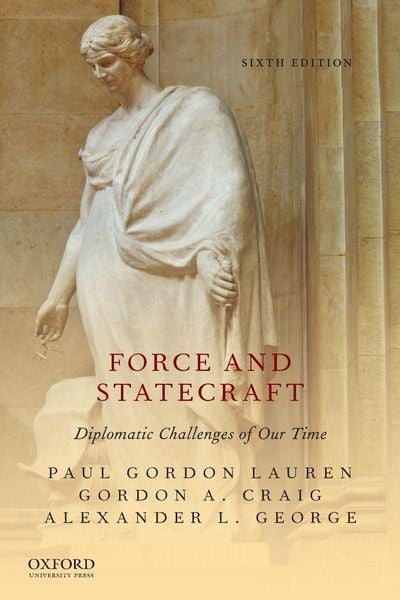
Produktbild: Force and Statecraft

Force and Statecraft

136,99 €

inkl. gesetzl. MwSt., Versandkostenfrei


Beschreibung

Produktdetails

Einband

Taschenbuch

Erscheinungsdatum

17.08.2020

Verlag

Oxford University Press

Seitenzahl

354

Maße (L/B/H)

23,4/15,6/2 cm

Gewicht

538 g

Auflage

6. Auflage

Sprache

Englisch

ISBN

978-0-19-006263-7

Beschreibung

Produktdetails

Einband

Taschenbuch

Erscheinungsdatum

17.08.2020

Verlag

Oxford University Press

Seitenzahl

354

Maße (L/B/H)

23,4/15,6/2 cm

Gewicht

538 g

Auflage

6. Auflage

Sprache

Englisch

ISBN

978-0-19-006263-7

Herstelleradresse

Libri GmbH
Europaallee 1
36244 Bad Hersfeld
DE

Email: gpsr@libri.de

Noch keine Bewertungen vorhanden

Verfassen Sie die erste Bewertung zu diesem Artikel

Helfen Sie anderen Kundinnen und Kunden durch Ihre Meinung.

Kundinnen und Kunden meinen

Bewertungen (0)

  • Produktbild: Force and Statecraft
    • Preface to the Sixth Edition
    • Introduction
    • PART ONE: FROM THE PAST TO THE PRESENT
    • Chapter 1: The Emergence of Diplomacy and the Great Powers
    • The Early Practices, Techniques, and Ideas of Diplomacy
    • War, States, and Raison d'état in the Seventeenth Century
    • War and Competition in the Eighteenth Century
    • Chapter 2: The Classical System of Diplomacy, 1815-1914
    • Building a System with a Balance of Power and a Concert
    • Change and an Experiment with a Defensive Alliance System
    • Further Change and an Experiment with Bipolar Alignment
    • Characteristics of the System
    • Chapter 3: The Diplomatic Revolution Begins, 1919-1939
    • Attempts at Peacemaking and System Building
    • Public Opinion and "Public Diplomacy"
    • Economics and "Economic Diplomacy"
    • A Dialogue des Sourds with Contrasting Norms and Objectives
    • Chapter 4: A Postwar System of Security: Great Power Directorate or United Nations?
    • Lessons from the Past and Plans for the Future
    • Force and Statecraft as Envisioned by the UN Charter
    • Changing World Conditions and Readjustments
    • Chapter 5: The Cold War
    • The Origins and Escalation of the Cold War
    • Seeking Restraints Through Deterrence, Diplomacy, and Détente
    • Persistent Problems and the Final Demise of the Cold War
    • Chapter 6: The Evolving International System
    • "A World in a Rapid State of Transition"
    • Challenges to Nation-States and National Sovereignty
    • Terrorists and the "Global War on Terror"
    • Partners and/or Rivals?
    • PART TWO: HISTORY, THEORY, AND PRACTICE
    • Chapter 7: Lessons of History and Knowledge for Statecraft
    • Classical Writers on the Importance of Historical Lessons
    • The Historical Habit of Mind
    • The Challenges of Learning and Applying Lessons of History
    • Structured, Focused Comparisons
    • Chapter 8: Negotiation
    • Principles of Negotiation
    • The Congress of Vienna, 1814-1815
    • The Conference on Security and Cooperation in Europe, 1972-1975
    • Contemporary Negotiations Over Nuclear Weapons in North Korea
    • Analysis
    • Chapter 9: Deterrence
    • Principles of Deterrence
    • Collective Security for the Post-1815 Settlement
    • British and French Attempts to Deter Hitler, 1939
    • Contemporary American Deterrence Over Taiwan
    • Analysis
    • Chapter 10: Coercive Diplomacy
    • Principles of Coercive Diplomacy
    • American "Gunboat Diplomacy," 1852-1854
    • The Cuban Missile Crisis, 1962
    • Contemporary Coercion Against Iran and Its Nuclear Program
    • Analysis
    • Chapter 11: Crisis Management
    • Principles of Crisis Management
    • Bismarck as an "Honest Broker" in the Crisis of 1878
    • The "Guns of August," 1914
    • Terrorism and the Mumbai Crisis, 2008
    • Analysis
    • PART THREE: RESTRAINTS AND REFLECTIONS
    • Chapter 12: Ethics and Other Restraints on Force and Statecraft
    • Practical, Structural, and Political Restraints
    • Ethics and International Politics
    • Ethical Restraints for Statecraft
    • Ethical Restraints for Armed Force
    • Conclusion: Reflections on Force and Statecraft and the Challenges of Our Time
    • Credits
    • Index