• Produktbild: Wheat Production in Changing Environments
  • Produktbild: Wheat Production in Changing Environments
- 12%

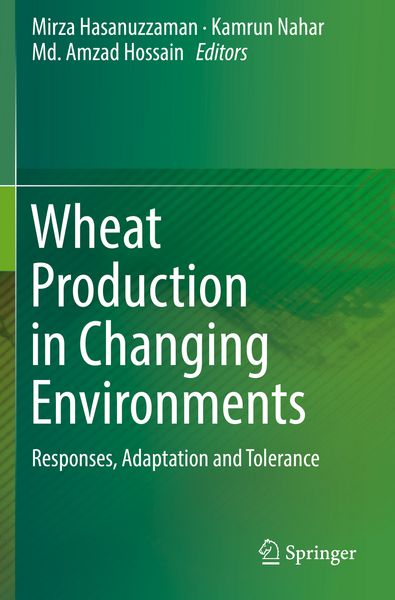
Wheat Production in Changing Environments Responses, Adaptation and Tolerance

12% sparen

144,99 € UVP 164,99 €

inkl. gesetzl. MwSt., Versandkostenfrei


Beschreibung

Produktdetails

Einband

Taschenbuch

Erscheinungsdatum

14.08.2020

Abbildungen

XX, 685 p. 65 illus., 45 illus. in color.

Herausgeber

Mirza Hasanuzzaman + weitere

Verlag

Springer Singapore

Seitenzahl

685

Maße (L/B/H)

23,5/15,5/3,8 cm

Gewicht

1054 g

Auflage

1st ed. 2019

Sprache

Englisch

ISBN

978-981-13-6885-1

Beschreibung

Portrait


Dr. Mirza Hasanuzzaman
 is a Professor of Agronomy at Sher-e-Bangla Agricultural University in Dhaka, Bangladesh. His current work is focused on the physiological and molecular mechanisms of environmental stress tolerance. Dr. Hasanuzzaman has published over 80 articles in peer-reviewed journals, edited six books and written 30 book chapters on various aspects of plant physiology, plant stress tolerance, and crop production. He serves as an editor and reviewer for more than 50 peer-reviewed international journals and was a recipient of the ‘Publons Peer Review Award 2017 and 2018’. In addition, he was selected for the World Academy of Science Young Scientist Award (2014). 


Dr. Kamrun Nahar
 is an Associate Professor at the Department of Agricultural Botany, Sher-e-Bangla Agricultural University, Dhaka, Bangladesh. An expert on plant stress physiology, she serves as an editor and reviewer for numerous international journals, and is an active memberof 20 professional societies. 


Dr. Mohammad Amzad Hossain
is a Professor at the Subtropical Field Science Center, University of the Ryukyus, Okinawa, Japan. An expert on tropical plant cultivation science, agronomy, organic farming, and weed science, he received the Weed Science Society of Japan Award for Prominent Achievements and the Okinawa Research Encouragement Award (Natural Science) in 2005 and 2014, respectively. 

Produktdetails

Einband

Taschenbuch

Erscheinungsdatum

14.08.2020

Abbildungen

XX, 685 p. 65 illus., 45 illus. in color.

Herausgeber

Verlag

Springer Singapore

Seitenzahl

685

Maße (L/B/H)

23,5/15,5/3,8 cm

Gewicht

1054 g

Auflage

1st ed. 2019

Sprache

Englisch

ISBN

978-981-13-6885-1

Herstelleradresse

Springer-Verlag KG
Sachsenplatz 4-6
1201 Wien
AT

Email: ProductSafety@springernature.com

Noch keine Bewertungen vorhanden

Verfassen Sie die erste Bewertung zu diesem Artikel

Helfen Sie anderen Kundinnen und Kunden durch Ihre Meinung.

Kundinnen und Kunden meinen

Bewertungen (0)

  • Produktbild: Wheat Production in Changing Environments
  • Produktbild: Wheat Production in Changing Environments

  • Chapter 1. Abiotic stresses-induced physiological alteration in wheat.- Chapter 2. Physiological responses of wheat to environmental stresses.- Chapter 3. Abiotic stress and wheat grain quality: A comprehensive review.- Chapter 4. Salt stress responses and tolerance in wheat.- Chapter 5. Wheat responses and tolerance to drought stress.- Chapter 6. Wheat responses and tolerance to high temperature.- Chapter 7. Wheat responses and tolerance to terminal heat stress- A review.- Chapter 8. Wheat responses and tolerance to UV-B radiation: an overview.- Chapter 9. Tropospheric ozone and its impact on wheat productivity.- Chapter 10. Abiotic stress-induced oxidative stress in wheat.- Chapter 11. Trending Methods to Enhance Antioxidant Activities in Wheat.- Chapter 12. Abiotic stress signaling in wheat crop.- Chapter 13. Molecular and biotechnological tools in developing abiotic stress tolerance in wheat.- Chapter 14. Wheat Responses to Stress and Biotechnological Approaches for Improvement.- Chapter 15. Applications of molecular markers to develop resistance against abiotic stresses in wheat.- Chapter 16. Identification of Stress Responsive Genes by using Molecular Markers to develop tolerance in wheat.- Chapter 17. Omics approaches in developing abiotic stress tolerance in wheat.- Chapter 18. Use of Phytohormones to Improve Abiotic Stress Tolerance in Wheat.- Chapter 19. Use of plant nutrients in improving abiotic stress tolerance in wheat.- Chapter 20. Use of osmolytes in improving abiotic stress tolerance to wheat (
    Triticum aestivum
    L.).- Chapter 21. Induction of wheat plants resistance to stressors by donors of nitric oxide and hydrogen sulfide.- Chapter 22. Targeting plant hormones to develop stress resistant in wheat.- Chapter 23. Plant growth promoting bacteria: Biotic strategy to cope with abiotic stresses in wheat
    .-
    Chapter 24. Progress and Challenges of Wheat Production in the Era of Climate Change: A Bangladesh Perspective.