KI-Beratung Beta

Gutscheinbedingungen

**Gültig am 25.11.2026 auf fremdsprachige Bücher online auf thalia.at und in der Thalia App. Einzelne Artikel können ausgeschlossen sein. Ausgenommen sind preisgebundene Artikel & eBooks. Pro Einkauf einmal einlösbar. Click & Collect nur bei Onlinevorabzahlung möglich. Keine Barauszahlung. Nicht kombinierbar mit anderen Aktionen und Gutscheinen. Gutschein wird auf max. 500€ Bestellwert angerechnet. Nicht gültig für Geschenkkarten, Versandkosten und Services.

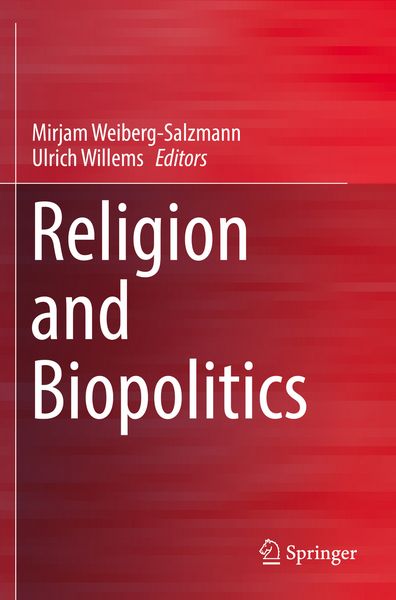
  • Produktbild: Religion and Biopolitics
  • Produktbild: Religion and Biopolitics

Religion and Biopolitics

99,99 €

inkl. gesetzl. MwSt., Versandkostenfrei


Beschreibung

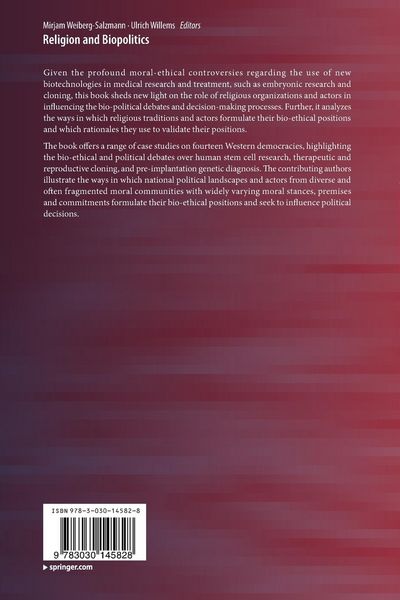
Given the profound moral-ethical controversies regarding the use of new biotechnologies in medical research and treatment, such as embryonic research and cloning, this book sheds new light on the role of religious organizations and actors in influencing the bio-political debates and decision-making processes....

Beschreibung

Given the profound moral-ethical controversies regarding the use of new biotechnologies in medical research and treatment, such as embryonic research and cloning, this book sheds new light on the role of religious organizations and actors in influencing the bio-political debates and decision-making processes. Further, it analyzes the ways in which religious traditions and actors formulate their bio-ethical positions and which rationales they use to validate their positions. 
The book offers a range of case studies on fourteen Western democracies, highlighting the bio-ethical and political debates over human stem cell research, therapeutic and reproductive cloning, and pre-implantation genetic diagnosis. The contributing authors illustrate the ways in which national political landscapes and actors from diverse and often fragmented moral communities with widely varying moral stances, premises and commitments formulate their bio-ethical positions and seek to influence political decisions. 

Portrait


Mirjam Weiberg-Salzmann
 is a senior research fellow at the Cluster of Excellence "Religion and Politics" of the University of Münster, Germany. She received her Ph.D. in Political Sciences in 2009. Her research areas are international politics, comparative government and peace and conflict studies. She focuses on the topics religion and politics, violence and conflicts in multi-ethnic and multi-religious states, democracy, democratization and biopolitics. Her regional interests are the USA, Great Britain, Germany, Ireland, Norway and South Asia. She wrote books on the deconstruction of democracy by culture (Nomos 2011) and violent conflicts of democratic states in the Third World (University of Rostock 2008). Her most recent publications are
Illiberal Politics and Religion: Actors, Ideologies, and Identity Narrrativews in Europe and Beyond
(with Anja Hennig; Campus), "The Radicalisation of Buddhism in the Twentieth and Twenty-first Centuries" (Politics, Religion& Ideology) and "Ending Ethnic Civil Wars by Negotiations or by Military Defeat?" (Journal of Asian and African Studies). 
Ulrich Willems
 is a professor of Political Theory and currently director of the Institute of Political Science of the University of Münster, Germany. He is also principal investigator at the Cluster of Excellence "Religion and Politics in Pre-modern and Modern Times". From 2012 to 2016, he was the director of the "Centre for Religion and Modernity" and a member of the "Centre for Advanced Studies in Bioethics" (2010-2017); both located at the University of Münster. Previously, Willems taught at the Darmstadt University of Technology and the University of Hamburg, Germany. His research interests include political theory, political pluralism, democracy and pluralism, interest groups, politics and religion, and morality policy, especially biopolitics. His recent books include
The Political Theory of Modus Vivendi
(with John Horton and Manon Westphal; Springer 2019) and
Wertkonflikte als Herausforderung der Demokratie
(Springer VS 2016)
.
Produktdetails

Einband

Taschenbuch

Erscheinungsdatum

15.08.2020

Abbildungen

XV, 354 p.

Herausgeber Mirjam Weiberg-Salzmann + weitere

Produktdetails

Einband

Taschenbuch

Erscheinungsdatum

15.08.2020

Abbildungen

XV, 354 p.

Herausgeber
Verlag Springer
Seitenzahl

354

Maße (L/B/H)

23,5/15,5/2,1 cm

Gewicht

563 g

Auflage

1st ed. 2020

Sprache

Englisch

ISBN

978-3-030-14582-8

Herstelleradresse

Springer-Verlag KG
Sachsenplatz 4-6
1201 Wien
AT

Email: ProductSafety@springernature.com

Noch keine Bewertungen vorhanden

Verfassen Sie die erste Bewertung zu diesem Artikel

Helfen Sie anderen Kundinnen und Kunden durch Ihre Meinung.

Kundinnen und Kunden meinen

Bewertungen (0)

  • Produktbild: Religion and Biopolitics
  • Produktbild: Religion and Biopolitics

  • Introduction: Challenging the Political - Religious Actors and Religious Arguments in Liberal Democracies (Mirjam Weiberg-Salzmann and Ulrich Willems).-
    Part I: Catholic-Latin states with low level or little religious pluralism.-
    Discursive Strategies of Catholic Churches in Assisted Reproduction Technology Regulation: Poland and Spain in Comparison (Anja Hennig).- The Role of Religion in Debates on Embryo Research and Surrogacy in France (Jennifer Merchant).- Embryonic Silences: Human Life Between Biomedicine, Religion, and State Authorities in Austria (Ingrid Metzler and Anna Pichelstorfer).- Religion and Biopolitics in Ireland (Mirjam Weiberg-Salzmann).-
    Part II: Protestant(-English) states with high or moderate level religious pluralism.-
     Biotechnology and the Non-religious Uses of God Talk (John H. Evans).- The Political Debate on Embryo Research in New Zealand and the Role of Religious Actors and Arguments (David Gareth Jones).- The Political Debate on Embryo Research in Australia and the Role of Religious Actors and Arguments (Frank O’Keeffe and Kevin McGovern).-
    Part III: Protestant(-Scandinavian) states with low level religious pluralism.- 
    The Status of the Human Embryo: A Case Study of Embryo Experiments and Embryo Research in Denmark (Jacob Dahl Rendtorff).- Religion and Biopolitics in Sweden (Göran Hermerén and Mats Johansson).- Negotiating Embryo Politics in Norway and Italy (Mirjam Weiberg-Salzmann and Massimiliano Passerini).- 
    Part IV: Mixed-confession states with high level religious pluralism.-
    The Role of Religion in the Political Debate on Embryo Research in the Netherlands (Wybo J. Dondorp and Guido M. W. R. de Wert).- Moralizing Embryo Politics in Germany (Mirjam Weiberg-Salzmann).- Bioethics and Biopolitics in Switzerland: Stem Cell Research and Pre-Implantation Diagnostics in the Public Discourse (Monika Bobbert and Yvonne Zelter).- Morality Policies: How Religion and Politics Interplayin Democratic Decision-making in Belgium (Nathalie Schiffino).-