Gutscheinbedingungen

**Gültig bis 06.07.2026 auf fremdsprachige Bücher online auf thalia.at, in der Thalia App ab einem Mindestbestellwert von 30€ und in allen Thalia Buchhandlungen in Österreich. In den Buchhandlungen nur gültig auf lagernde Ware. Einzelne Artikel können ausgeschlossen sein. Ausgenommen sind preisgebundene Artikel & eBooks. Pro Einkauf einmal einlösbar. Nur gültig gegen Vorlage oder im Onlineshop hinterlegter Bonuscard. Infos zur Einlösung in der Buchhandlung sind auf der Bonuscard-Vorteilspreisseite zu finden. Click & Collect nur bei Onlinevorabzahlung möglich. Keine Einlösung bei Scan & Go-Bezahlung. Keine Barauszahlung. Nicht kombinierbar mit anderen Aktionen und Gutscheinen. Gutschein wird auf max. 500€ Bestellwert angerechnet. Nicht gültig für Versandkosten und Services.

  • Produktbild: Bridging the Family Care Gap
  • Produktbild: Bridging the Family Care Gap

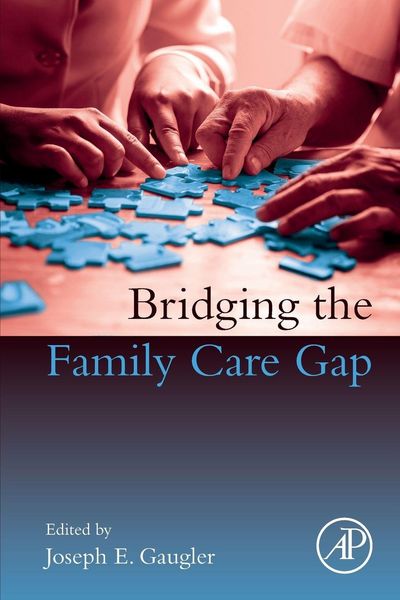
Bridging the Family Care Gap

105,99 €

inkl. gesetzl. MwSt., Versandkostenfrei


Beschreibung

Produktdetails

Einband

Taschenbuch

Erscheinungsdatum

18.01.2021

Herausgeber

Joseph E. Gaugler

Verlag

Elsevier Science & Technology

Seitenzahl

498

Maße (L/B/H)

22,9/15,2/2,5 cm

Gewicht

661 g

Sprache

Englisch

ISBN

978-0-12-813898-4

Beschreibung

Rezension

"This book is useful to identify issues, resources, and solutions based on the current inconsistency in coverage for the care of family members. A key factor this book considers is nontraditional family units as diversity in families grows. The book also presents academic models for helping caregivers in different work settings and what resources may be available to support them as they bridge the gap in family care needs." --© Doody's Review Service, 2021, Crystal L Plank, RN, BSN, RAC-CTA(MU Sinclair School of Nursing), reviewer, expert opinion

Portrait

Joseph E. Gaugler, PhD is a Professor in the School of Nursing and Center on Aging at The University of Minnesota.". Dr. Gaugler's research examines the sources and effectiveness of long-term care for chronically disabled older adults. A developmental psychologist with an interdisciplinary research focus, Dr. Gaugler's interests include Alzheimer's disease and long-term care, the longitudinal ramifications of family care for disabled adults, and the effectiveness of community-based and psychosocial services for chronically ill adults and their caregiving families. Underpinning these substantive areas, Dr. Gaugler also has interests in longitudinal and mixed methods.

Dr. Gaugler currently serves as Editor-in-Chief for the Journal of Applied Gerontology and on the editorial boards of Journals of Gerontology: Psychological Sciences, Journals of Gerontology: Social Sciences, and Psychology and Aging. He was awarded the 2003 Springer Early Career Achievement Award in Adult Development and Aging Research, the 2011 M. Powell Lawton Distinguished Contribution Award for Applied Gerontology from the American Psychological Association (Division 20: Adult Development and Aging), the 2011 Dean's Award from the University of Minnesota School of Nursing, and the 2015 Gordon Streib Distinguished Academic Gerontologist Award from the Southern Gerontological Society. He is a Fellow of the Gerontological Society of America and the American Psychological Association.

Produktdetails

Einband

Taschenbuch

Erscheinungsdatum

18.01.2021

Herausgeber

Joseph E. Gaugler

Verlag

Elsevier Science & Technology

Seitenzahl

498

Maße (L/B/H)

22,9/15,2/2,5 cm

Gewicht

661 g

Sprache

Englisch

ISBN

978-0-12-813898-4

EU-Ansprechpartner

Zeitfracht Medien GmbH
Ferdinand-Jühlke-Straße 7|99095|Erfurt|DE
produktsicherheit@zeitfracht.de

Herstelleradresse

Elsevier Science & Technology
125 London Wall|EC2Y 5AS|London|GB
tradeorders@elsevier.com

Noch keine Bewertungen vorhanden

Verfassen Sie die erste Bewertung zu diesem Artikel

Helfen Sie anderen Kundinnen und Kunden durch Ihre Meinung.

Kundinnen und Kunden meinen

Bewertungen (0)

Die Leseprobe wird geladen.
  • Produktbild: Bridging the Family Care Gap
  • Produktbild: Bridging the Family Care Gap
  • Section I    The contexts of the family care gap

    1. Public health perspectives on the family care gap
    Erin D. Bouldin, Elena M. Andresen, Valerie J. Edwards, Justin P. Kearley, Nia Reed, and Lisa C. McGuire

    2. Diverse, culturally rich approaches to family care in the United States
    Manka J. Nkimbeng and Lauren J. Parker

    3. Caregiving in a rural context: Challenges and recommendations
    Carrie Henning-Smith and Megan Lahr

    Section II    Leveraging the past to inform the future

    4. A systematic review of interventions that reduce family/friend caregiving time
    Zachary G. Baker, Eric Jutkowitz, and Joseph E. Gaugler

    5. Recommendations for the future science of family caregiving services and supports: A synthesis of recent summits and national reports
    Lauren L. Mitchell and Joseph E. Gaugler

    Section III    Getting the best evidence into the real world

    6. Implementing and sustaining family care programs in real-world settings: Barriers and facilitators
    Nancy Hodgson and Laura N. Gitlin

    7. Unique models and initiatives that states are working on to "close? the family care gap
    Christine J. Jensen and Laura J. Bauer

    8. Update on the status of effective programs to help dementia family caregivers in the United States: Observations from the search for programs to include in Best Practice Caregiving
    Katie Maslow, David M. Bass, and Julie H. Rentsch

    Section IV    Innovative solutions

    9. Driving change: Advancing policies to address the escalating complexities and costs of family care
    Lynn Friss Feinberg, Susan C. Reinhard, and Rita B. Choula

    10. Developing a quality home care workforce to complement family caregivers and bridge the emerging care gap
    Robyn Stone

    11. Identifying, assessing, and supporting family caregivers in health and long-term care: Current progress and future opportunities
    Catherine A. Riffin and Jennifer L. Wolff

    12. Technology-based solutions to address the family care gap challenge
    George Demiris

    13. Leveraging volunteers to support dementia family caregivers: An innovative approach to care and support
    Noelle L. Fields, Erin M. Roark, and Ling Xu

    14. Health information technology and family caregiving: Policy initiatives
    Nicole Ruggiano

    Section V    Conclusion

    15. Supporting family care for older adults: Building a better bridge
    Joseph E. Gaugler