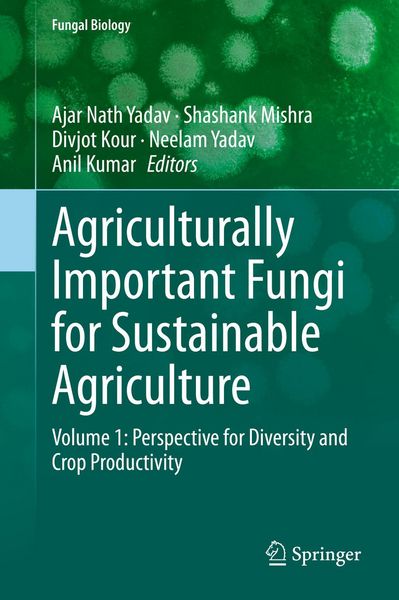
Agriculturally Important Fungi for Sustainable Agriculture Volume 1: Perspective for Diversity and Crop Productivity
-
- Hardcover
- Taschenbuch
- eBook ausgewählt
-
Form:Einzelkauf Download
-
Sprache:Englisch
153,99 €
inkl. gesetzl. MwSt.Beschreibung
Produktdetails
Format
Kopierschutz
Nein
Family Sharing
Nein
Text-to-Speech
Nein
Erscheinungsdatum
25.06.2020
Herausgeber
Ajar Nath Yadav + weitereVerlag
SpringerSeitenzahl
300 (Printausgabe)
Dateigröße
6384 KB
Sprache
Englisch
EAN
9783030459710
Microbes are ubiquitous in nature. Among microbes, fungal communities play an important role in agriculture, the environment, and medicine. Vast fungal diversity has been associated with plant systems, namely epiphytic fungi, endophytic fungi, and rhizospheric fungi.
These fungi associated with plant systems play an important role in plant growth, crop yield, and soil health. Rhizospheric fungi, present in rhizospheric zones, get their nutrients from root exudates released by plant root systems, which help with their growth, development, and microbe activity. Endophytic fungi typically enter plant hosts through naturally occurring wounds that are the result of plant growth, through root hairs, or at epidermal conjunctions. Phyllospheric fungi may survive or proliferate on leaves depending on material influences in leaf diffuseness or exudates.
The diverse nature of these fungal communities is a key component of soil-plant systems, where they are engaged in anetwork of interactions endophytically, phyllospherically, as well as in the rhizosphere, and thus have emerged as a promising tool for sustainable agriculture. These fungal communities promote plant growth directly and indirectly by using plant growth promoting (PGP) attributes. These PGP fungi can be used as biofertilizers and biocontrol agents in place of chemical fertilizers and pesticides for a more eco-friendly method of promoting sustainable agriculture and environments.
This first volume of a two-volume set covers the biodiversity of plant-associated fungal communities and their role in plant growth promotion, the mitigation of abiotic stress, and soil fertility for sustainable agriculture. This book should be useful to those working in the biological sciences, especially for microbiologists, microbial biotechnologists, biochemists, and researchers and scientists of fungal biotechnology.
Noch keine Bewertungen vorhanden
Verfassen Sie die erste Bewertung zu diesem Artikel
Helfen Sie anderen Kundinnen und Kunden durch Ihre Meinung.
Kurze Frage zu unserer Seite
Vielen Dank für Ihr Feedback
Wir nutzen Ihr Feedback, um unsere Produktseiten zu verbessern. Bitte haben Sie Verständnis, dass wir Ihnen keine Rückmeldung geben können. Falls Sie Kontakt mit uns aufnehmen möchten, können Sie sich aber gerne an unseren Kund*innenservice wenden.
zum Kundenservice