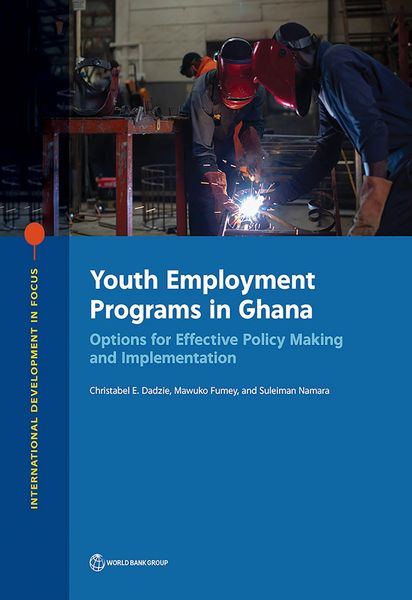
Youth Employment Programs in Ghana Options for Effective Policy Making and Implementation
-
- Englisch ausgewählt
48,99 €
inkl. gesetzl. MwSt.,
Beschreibung
Produktdetails
Einband
Taschenbuch
Erscheinungsdatum
08.09.2020
Abbildungen
col. figs, tables
Verlag
World Bank PublicationsSeitenzahl
80
Maße (L/B/H)
27,9/21,6/0,4 cm
Gewicht
209 g
Sprache
Englisch
ISBN
978-1-4648-1579-9
Unemployment and underemployment are global development challenges. The situation in Ghana is no different. In 2016, it was projected that, given the country's growing youth population, 300,000 new jobs would need to be created each year to absorb the increasing numbers of unemployed young people. Yet the employment structure of the Ghanaian economy has not changed much from several decades ago. Most jobs are low skill, requiring limited cognitive or technology know-how, reflected in low earnings and work of lower quality. An additional challenge for Ghana is the need to create access to an adequate number of high-quality, productive jobs. This report seeks to increase knowledge about Ghana's job landscape and youth employment programs to assist policy makers and key stakeholders in identifying ways to improve the effectiveness of these programs and strengthen coordination among major stakeholders. Focused, strategic, short- to medium-term and long-term responses are required to address current unemployment and underemployment challenges. Effective coordination and synergies among youth employment programs are needed to avoid duplication of effort while the country's economic structure transforms. Effective private sector participation in skills development and employment programs is recommended. The report posits interventions in five priority areas that are not new but could potentially make an impact through scaling up: (1) agriculture and agribusiness, (2) apprenticeship (skills training), (3) entrepreneurship, (4) high-yielding areas (renewable energy-solar, construction, tourism, sports, and green jobs), and (5) preemployment support services. Finally, with the fast-changing nature of work due to technology and artificial intelligence, Ghana needs to develop an education and training system that is versatile and helps young people to adapt and thrive in the twenty-first century world of work.
Noch keine Bewertungen vorhanden
Verfassen Sie die erste Bewertung zu diesem Artikel
Helfen Sie anderen Kundinnen und Kunden durch Ihre Meinung.
Kurze Frage zu unserer Seite
Vielen Dank für Ihr Feedback
Wir nutzen Ihr Feedback, um unsere Produktseiten zu verbessern. Bitte haben Sie Verständnis, dass wir Ihnen keine Rückmeldung geben können. Falls Sie Kontakt mit uns aufnehmen möchten, können Sie sich aber gerne an unseren Kund*innenservice wenden.
zum Kundenservice