
Time in Education Intertwined Dimensions and Theoretical Possibilities
-
- Englisch ausgewählt
19,99 €
inkl. gesetzl. MwSt.,
- Kostenlose Lieferung ab 30 € Einkaufswert
- Versandkostenfrei für Bonuscard-Kund*innen
Beschreibung
Produktdetails
Einband
Taschenbuch
Erscheinungsdatum
29.06.2020
Herausgeber
Bobbie KabutoVerlag
Garn PressSeitenzahl
110
Maße (L/B/H)
20,3/12,7/0,6 cm
Gewicht
128 g
Sprache
Englisch
ISBN
978-1-942146-80-3
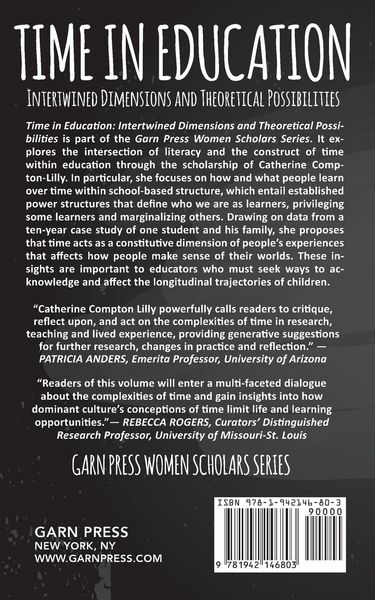
Time in Education: Intertwined Dimensions and Theoretical Possibilities is part of the Garn Press Women Scholars Series. It explores the intersection of literacy and the construct of time within education through the scholarship of Catherine Compton-Lilly, who highlights the complexity of studying learning. In particular, she focuses on how and what people learn over time within school-based structure, which entail established power structures that define who we are as learners, privileging some learners and marginalizing others.Catherine Compton-Lilly presents a theoretical kaleidoscope of learning and literacy over time and illustrates how understandings of learners and learning shift as educators cast their gaze through different theoretical lenses. She asks how people reconcile, or strive to reconcile, complementary and contradictory framings of learners-a dilemma often faced by educators and parents. Specifically, Compton-Lilly proposes that time acts as a constitutive dimension of people's experiences that significantly affects how people make sense of their worlds by exploring the temporal affordances of three highly influential theories: Jay Lemke, Mikhail Bakhtin, and Pierre Bourdieu. To illustrate the temporal potential of these theories, she draws upon data from a ten-year case study of one student and his family. Attending to how people operate within time provides important insights into longitudinal processes including identity construction, literacy learning, and becoming a student. These insights are important not only to researchers who attempt to make sense of the experiences of children and teachers, but also to educators who must seek ways to acknowledge and effect the longitudinal trajectories of children.
Noch keine Bewertungen vorhanden
Verfassen Sie die erste Bewertung zu diesem Artikel
Helfen Sie anderen Kundinnen und Kunden durch Ihre Meinung.
Kurze Frage zu unserer Seite
Vielen Dank für Ihr Feedback
Wir nutzen Ihr Feedback, um unsere Produktseiten zu verbessern. Bitte haben Sie Verständnis, dass wir Ihnen keine Rückmeldung geben können. Falls Sie Kontakt mit uns aufnehmen möchten, können Sie sich aber gerne an unseren Kund*innenservice wenden.
zum Kundenservice