KI-Beratung Beta

Gutscheinbedingungen

**Gültig am 25.11.2026 auf fremdsprachige Bücher online auf thalia.at und in der Thalia App. Einzelne Artikel können ausgeschlossen sein. Ausgenommen sind preisgebundene Artikel & eBooks. Pro Einkauf einmal einlösbar. Click & Collect nur bei Onlinevorabzahlung möglich. Keine Barauszahlung. Nicht kombinierbar mit anderen Aktionen und Gutscheinen. Gutschein wird auf max. 500€ Bestellwert angerechnet. Nicht gültig für Geschenkkarten, Versandkosten und Services.

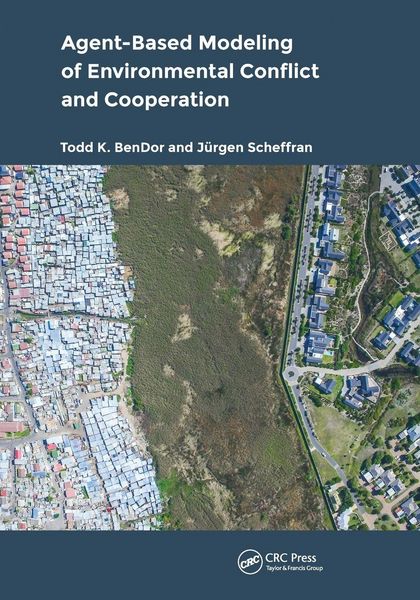
  • Produktbild: Agent-Based Modeling of Environmental Conflict and Cooperation
  • Produktbild: Agent-Based Modeling of Environmental Conflict and Cooperation

Agent-Based Modeling of Environmental Conflict and Cooperation

72,99 €

inkl. gesetzl. MwSt., Versandkostenfrei


Beschreibung

Conflict is a major facet of many environmental challenges of our time. However, growing conflict complexity makes it more difficult to identify win-win strategies for sustainable conflict resolution. Innovative methods are needed to help predict, understand, and resolve conflicts in cooperative ways....

Beschreibung

Conflict is a major facet of many environmental challenges of our time. However, growing conflict complexity makes it more difficult to identify win-win strategies for sustainable conflict resolution. Innovative methods are needed to help predict, understand, and resolve conflicts in cooperative ways.

Agent-Based Modeling of Environmental Conflict and Cooperation examines computer modeling techniques as an important set of tools for assessing environmental and resource-based conflicts and, ultimately, for finding pathways to conflict resolution and cooperation. This book has two major goals. First, it argues that complexity science can be a unifying framework for professions engaged in conflict studies and resolution, including anthropology, law, management, peace studies, urban planning, and geography. Second, this book presents an innovative framework for approaching conflicts as complex adaptive systems by using many forms of environmental analysis, including system dynamics modeling, agent-based modeling, evolutionary game theory, viability theory, and network analysis. Known as VIABLE (Values and Investments from Agent-Based interaction and Learning in Environmental systems), this framework allows users to model advanced facets of conflicts-including institution building, coalition formation, adaptive learning, and the potential for future conflict-and conflict resolution based on the long-term viability of the actors' strategies.

Written for scholars, students, practitioners, and policy makers alike, this book offers readers an extensive introduction to environmental conflict research and resolution techniques. As the result of decades of research, the text presents a strong argument for conflict modeling and reviews the most popular and advanced techniques, including system dynamics modeling, agent-based modeling, and participatory modeling methods. This indispensable guide uses NetLogo, a widely used and free modeling software package, to implement the VIABLE modeling approach in three case study applications around the world. Readers are invited to explore, adapt, modify, and expand these models to conflicts they hope to better understand and resolve.

Produktdetails

Einband

Taschenbuch

Erscheinungsdatum

30.06.2020

Verlag Taylor & Francis
Seitenzahl

366

Produktdetails

Einband

Taschenbuch

Erscheinungsdatum

30.06.2020

Verlag Taylor & Francis
Seitenzahl

366

Maße (L/B/H)

25,4/17,8/2 cm

Gewicht

688 g

Sprache

Englisch

ISBN

978-0-367-57082-8

Herstelleradresse

Libri GmbH
Europaallee 1
36244 Bad Hersfeld
DE

Email: gpsr@libri.de

Noch keine Bewertungen vorhanden

Verfassen Sie die erste Bewertung zu diesem Artikel

Helfen Sie anderen Kundinnen und Kunden durch Ihre Meinung.

Kundinnen und Kunden meinen

Bewertungen (0)

Die Leseprobe wird geladen.
  • Produktbild: Agent-Based Modeling of Environmental Conflict and Cooperation
  • Produktbild: Agent-Based Modeling of Environmental Conflict and Cooperation
  • Part I: Conflict and the Promise of Conflict Modeling 1. Environmental Conflicts in a Complex World 2. Why Model? How Can Modeling Help Resolve Conflict? 3. The History and Types of Conflict Modeling 4. Participatory Modeling and Conflict Resolution Part II: Modeling Environmental Conflict 5. System Dynamics and Conflict Modeling 6. Agent-Based Modeling and Environmental Conflict 7. Modeling Conflict and Cooperation as Agent Action and Interaction Part III: Applications of the VIABLE Model Framework 8. A Viability Approach to Understanding Fishery Conflict and Cooperation 9. An Adaptive Dynamic Model of Emissions Trading 10. Modeling Bioenergy and Land Use Conflict 11. The Future of Modeling Environmental Conflict and Cooperation