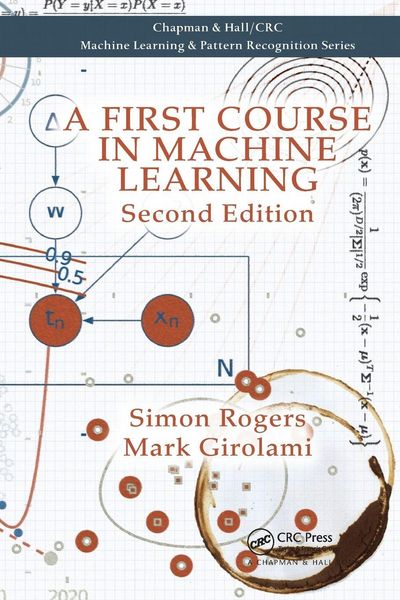
A First Course in Machine Learning
-
- Hardcover
- Taschenbuch ausgewählt
- eBook
-
Sprache:Englisch
59,99 €
inkl. gesetzl. MwSt.,
Beschreibung
Produktdetails
Einband
Taschenbuch
Erscheinungsdatum
30.06.2020
Verlag
Taylor & FrancisSeitenzahl
428
Maße (L/B/H)
23,4/15,6/2,3 cm
Gewicht
646 g
Auflage
2. Auflage
Sprache
Englisch
ISBN
978-0-367-57464-2
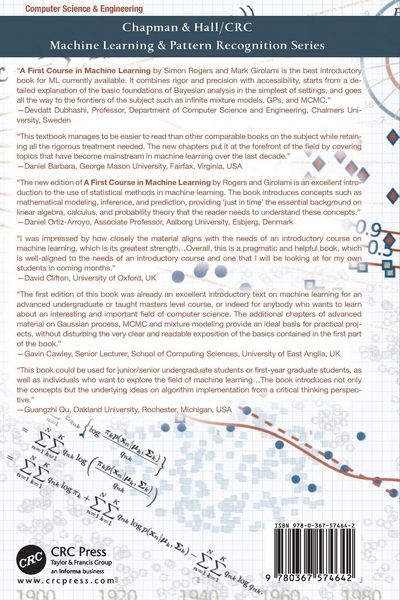
"A First Course in Machine Learning by Simon Rogers and Mark Girolami is the best introductory book for ML currently available. It combines rigor and precision with accessibility, starts from a detailed explanation of the basic foundations of Bayesian analysis in the simplest of settings, and goes all the way to the frontiers of the subject such as infinite mixture models, GPs, and MCMC."
-Devdatt Dubhashi, Professor, Department of Computer Science and Engineering, Chalmers University, Sweden
"This textbook manages to be easier to read than other comparable books in the subject while retaining all the rigorous treatment needed. The new chapters put it at the forefront of the field by covering topics that have become mainstream in machine learning over the last decade."
-Daniel Barbara, George Mason University, Fairfax, Virginia, USA
"The new edition of A First Course in Machine Learning by Rogers and Girolami is an excellent introduction to the use of statistical methods in machine learning. The book introduces concepts such as mathematical modeling, inference, and prediction, providing 'just in time' the essential background on linear algebra, calculus, and probability theory that the reader needs to understand these concepts."
-Daniel Ortiz-Arroyo, Associate Professor, Aalborg University Esbjerg, Denmark
"I was impressed by how closely the material aligns with the needs of an introductory course on machine learning, which is its greatest strength...Overall, this is a pragmatic and helpful book, which is well-aligned to the needs of an introductory course and one that I will be looking at for my own students in coming months."
-David Clifton, University of Oxford, UK
"The first edition of this book was already an excellent introductory text on machine learning for an advanced undergraduate or taught masters level course, or indeed for anybody who wants to learn about an interesting and important field of computer science. The additional chapters of advanced material on Gaussian process, MCMC and mixture modeling provide an ideal basis for practical projects, without disturbing the very clear and readable exposition of the basics contained in the first part of the book."
-Gavin Cawley, Senior Lecturer, School of Computing Sciences, University of East Anglia, UK
"This book could be used for junior/senior undergraduate students or first-year graduate students, as well as individuals who want to explore the field of machine learning...The book introduces not only the concepts but the underlying ideas on algorithm implementation from a critical thinking perspective."
-Guangzhi Qu, Oakland University, Rochester, Michigan, USA
Noch keine Bewertungen vorhanden
Verfassen Sie die erste Bewertung zu diesem Artikel
Helfen Sie anderen Kundinnen und Kunden durch Ihre Meinung.
Kurze Frage zu unserer Seite
Vielen Dank für Ihr Feedback
Wir nutzen Ihr Feedback, um unsere Produktseiten zu verbessern. Bitte haben Sie Verständnis, dass wir Ihnen keine Rückmeldung geben können. Falls Sie Kontakt mit uns aufnehmen möchten, können Sie sich aber gerne an unseren Kund*innenservice wenden.
zum Kundenservice