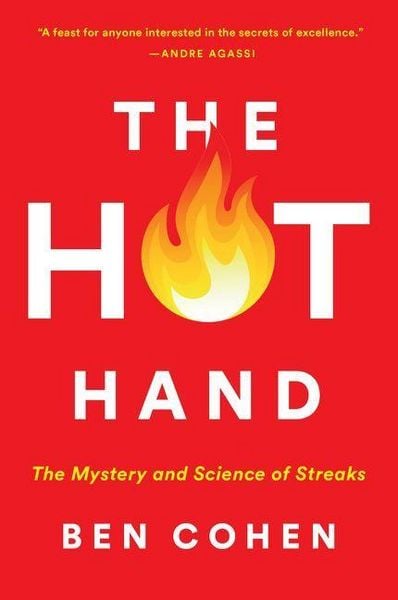
Hot Hand, The The Mystery and Science of Streaks
-
- Hardcover
- Taschenbuch ausgewählt
- eBook
-
Sprache:Englisch
16,99 €
inkl. gesetzl. MwSt.,
- Kostenlose Lieferung ab 30 € Einkaufswert
- Versandkostenfrei für Bonuscard-Kund*innen
Beschreibung
Produktdetails
Einband
Taschenbuch
Erscheinungsdatum
11.03.2024
Verlag
HarperCollinsSeitenzahl
306
Maße (L/B/H)
20,1/13,2/2,2 cm
Gewicht
310 g
Sprache
Englisch
ISBN
978-0-06-282073-0
How can you
maximize success—and limit failure? Wall Street Journal reporter
Ben Cohen brilliantly investigates the mystery and science of streaks, from basketball to business.
"A feast
for anyone interested in the secrets of excellence." —Andre Agassi
For decades, statisticians,
social scientists, psychologists, and economists (among them Nobel Prize
winners) have spent massive amounts of precious time thinking about whether
streaks actually exist. After all, a substantial number of decisions that we
make in our everyday lives are quietly rooted in this one question: If
something happened before, will it happen again? Is there such a thing as being
in the zone? Can someone have a “hot hand”? Or is it simply a case of seeing
patterns in randomness? Or, if streaks are possible, where can they be found?
In The Hot Hand, Wall Street
Journal reporter Ben Cohen offers an unfailingly entertaining and
provocative investigation into these questions. He begins with how a $35,000
fine and a wild night in New York revived a debate about the existence of
streaks that was several generations in the making. We learn how the ability to
recognize and then bet against streaks turned a business school dropout named
David Booth into a billionaire, and how the subconscious nature of
streak-related bias can make the difference between life and death for asylum
seekers. We see how previously unrecognized streaks hidden amidst archival data
helped solve one of the most haunting mysteries of the twentieth century, the
disappearance of Raoul Wallenberg. Cohen also exposes how streak-related
incentives can be manipulated, from the five-syllable word that helped break
arcade profit records to an arc of black paint that allowed Stephen Curry to
transform from future junior high coach into the greatest three-point shooter
in NBA history. Crucially, Cohen also explores why false recognition of
nonexistent streaks can have cataclysmic results, particularly if you are a
sugar beet farmer or the sort of gambler who likes to switch to black on the
ninth spin of the roulette wheel.
Noch keine Bewertungen vorhanden
Verfassen Sie die erste Bewertung zu diesem Artikel
Helfen Sie anderen Kundinnen und Kunden durch Ihre Meinung.
Kurze Frage zu unserer Seite
Vielen Dank für Ihr Feedback
Wir nutzen Ihr Feedback, um unsere Produktseiten zu verbessern. Bitte haben Sie Verständnis, dass wir Ihnen keine Rückmeldung geben können. Falls Sie Kontakt mit uns aufnehmen möchten, können Sie sich aber gerne an unseren Kund*innenservice wenden.
zum Kundenservice