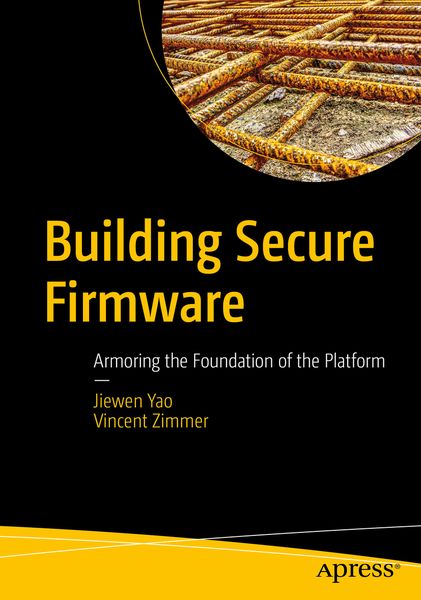
Building Secure Firmware Armoring the Foundation of the Platform
-
- Taschenbuch ausgewählt
- eBook
-
Sprache:Englisch
49,99 €
inkl. gesetzl. MwSt.,
Beschreibung
Produktdetails
Einband
Taschenbuch
Erscheinungsdatum
28.10.2020
Abbildungen
XXX, 930 p. 423 illus.
Verlag
ApressSeitenzahl
930
Maße (L/B/H)
25,4/17,8/5 cm
Gewicht
1765 g
Auflage
1st ed.
Sprache
Englisch
ISBN
978-1-4842-6105-7
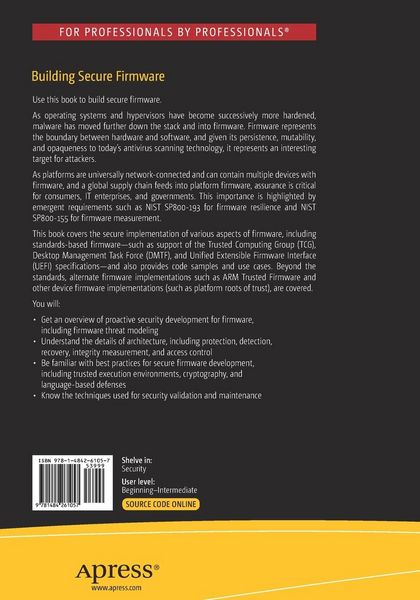
As operating systems and hypervisors have become successively more hardened, malware has moved further down the stack and into firmware. Firmware represents the boundary between hardware and software, and given its persistence, mutability, and opaqueness to today’s antivirus scanning technology, it represents an interesting target for attackers.
As platforms are universally network-connected and can contain multiple devices with firmware, and a global supply chain feeds into platform firmware, assurance is critical for consumers, IT enterprises, and governments. This importance is highlighted by emergent requirements such as NIST SP800-193 for firmware resilience and NIST SP800-155 for firmware measurement.
This book covers the secure implementation of various aspects of firmware, including standards-based firmware—such as support of the Trusted Computing Group (TCG), Desktop Management Task Force (DMTF), and UnifiedExtensible Firmware Interface (UEFI) specifications—and also provides code samples and use cases. Beyond the standards, alternate firmware implementations such as ARM Trusted Firmware and other device firmware implementations (such as platform roots of trust), are covered.
What You Will Learn
- Get an overview of proactive security development for firmware, including firmware threat modeling
- Understand the details of architecture, including protection, detection, recovery, integrity measurement, and access control
- Be familiar with best practices for secure firmware development, including trusted execution environments, cryptography, and language-based defenses
- Know the techniques used for security validation and maintenance
Who This Book Is For
Given the complexity of modern platform boot requirements and the threat landscape, this book is relevant for readers spanning from IT decision makers to developers building firmware
Noch keine Bewertungen vorhanden
Verfassen Sie die erste Bewertung zu diesem Artikel
Helfen Sie anderen Kundinnen und Kunden durch Ihre Meinung.
Kurze Frage zu unserer Seite
Vielen Dank für Ihr Feedback
Wir nutzen Ihr Feedback, um unsere Produktseiten zu verbessern. Bitte haben Sie Verständnis, dass wir Ihnen keine Rückmeldung geben können. Falls Sie Kontakt mit uns aufnehmen möchten, können Sie sich aber gerne an unseren Kund*innenservice wenden.
zum Kundenservice