KI-Beratung Beta

Produktbild: Hitler and Mussolini in Churches
Band 14

Hitler and Mussolini in Churches The Church Painter’s Subversion of Fascism: The Ideological Marking of Space along the Slovene–Italian Border

Aus der Reihe Cultural Memories

77,50 €

inkl. gesetzl. MwSt., Versandkostenfrei


Beschreibung

When Europe fell prey to totalitarian regimes in the twentieth century, the Slovene artist Tone Kralj responded to the cruellest oppression by systematically depicting his own and his community’s resistance against Fascism and Nazism in public spaces, under the very nose of the regime. As incredible...

Beschreibung

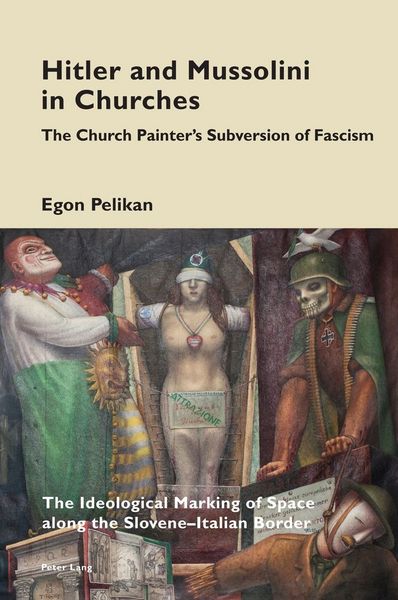
When Europe fell prey to totalitarian regimes in the twentieth century, the Slovene artist Tone Kralj responded to the cruellest oppression by systematically depicting his own and his community’s resistance against Fascism and Nazism in public spaces, under the very nose of the regime. As incredible as it may seem, the regime never discovered and punished his rebellious actions. The painter embedded his ideological subversion of Fascism and Nazism in wall paintings in more than fifty Catholic churches along the Slovene–Italian ethnic border, thus disseminating his subversive message among the people with whom he shared the same cultural memory. With many of them covering a surface area of several square metres, the church paintings introduced Hitler and Mussolini into Biblical visual narratives, portraying the two dictators with irony and grotesqueness as villainous Biblical characters, often in the role of hangmen, murderers or clowns. The symbols of their regimes were incorporated into Biblical scenes depicting eschatological dimensions of the struggle between good and evil, thus spreading – in the time of the most brutal fascistization – the painter’s firm belief in the historical downfall of the Fascist and Nazi regimes.

Rezension

«Whether casting Mussolini as Pontius Pilate or as Nero or depicting a bleeding sheep to represent the Slovene nation during the war or placing two Fascists in the crowd watching St Vitus being thrown to hungry lions, the anti-Fascist Kralj showed how art can be powerfully subversive. Egon Pelikan has produced an exciting book on an important chapter in anti-fascist history. Highly recommended.» (Sabrina P. Ramet, Author of
Alternatives to Democracy in Twentieth-Century Europe: Collectivist Visions of Modernity
(2019))


«Rarely are we confronted with such commanding visual assertions of identity as we are in the public works of the artist Tone Kralj. Egon Pelikan’s authoritative analysis of Kralj’s wall paintings, found in churches that dot the countryside in the Slovene/Italian borderland Primorska, reveals a deeply humane view of a disturbing world. As Pelikan shows, their iconography lends the local space powerful alternative meanings that consistently subvert the efforts of the region’s varied twentieth-century rulers to transform it.» (Pieter M. Judson, European University Institute, Florence)

Produktdetails

Einband

Taschenbuch

Erscheinungsdatum

01.06.2020

Abbildungen

240

Herausgeber Katia Pizzi

Produktdetails

Einband

Taschenbuch

Erscheinungsdatum

01.06.2020

Abbildungen

240

Herausgeber Katia Pizzi
Verlag Peter Lang Ltd. International Academic Publishers
Seitenzahl

310

Maße (L/B/H)

22,9/15,2/1,9 cm

Gewicht

492 g

Auflage

1

Sprache

Englisch

ISBN

978-1-78997-149-1

EU-Ansprechpartner

Kolibri 360 GmbH
Ettore-Bugatti-Straße 6-14
51149 Köln
DE
produktsicherheit@kolibri360.de

Herstelleradresse

Peter Lang
Avenue du Théâtre 7
1005 Lausanne
CH
orders@peterlang.com

Noch keine Bewertungen vorhanden

Verfassen Sie die erste Bewertung zu diesem Artikel

Helfen Sie anderen Kundinnen und Kunden durch Ihre Meinung.

Kundinnen und Kunden meinen

Bewertungen (0)

Die Leseprobe wird geladen.
  • Produktbild: Hitler and Mussolini in Churches

  • Chapter 1 Church Paintings as a Spatial Phenomenon – Chapter 2 Tone Kralj’s Artistic Development – Chapter 3 The Historical Context of Kralj’s Church Paintings – Chapter 4 A Church within the Church – Chapter 5 Selected Paintings – Conclusion – Appendix: Tone Kralj’s Works in Primorska – Bibliography – Index.