
KI-Beratung Beta

Gutscheinbedingungen

**Gültig am 20.11.2026 ab einem Mindestbestellwert von 30€ auf Spielzeug, Schreibwaren, Filme, Geschenke & Trends, Musik, tolino eReader & Zubehör, Hörbücher und Hörbuch-Downloads, nicht preisgebundene Bücher und Kalender online auf thalia.at und in der Thalia App. Einzelne Artikel können ausgeschlossen sein. Aufgrund der Buchpreisbindung sind deutschsprachige Bücher und eBooks ausgenommen. Zusätzlich ausgenommen sind Abos & Flatrates, Games, Geschenkkarten/-boxen, Shelfies, Software, Zeitschriften sowie einzelne Artikel von tonies®. Pro Einkauf einmal einlösbar. Click & Collect nur bei Onlinevorabzahlung möglich. Keine Barauszahlung. Nicht kombinierbar mit anderen Aktionen und Gutscheinen. Gutschein wird auf max. 500€ Bestellwert angerechnet. Nicht gültig für Versandkosten und Services. Preisgebundene Artikel sind vom Mindestbestellwert ausgeschlossen.

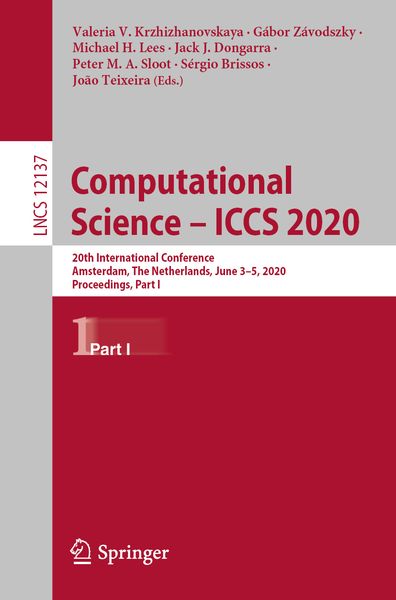
  • Produktbild: Computational Science – ICCS 2020
  • Produktbild: Computational Science – ICCS 2020
Band 12137

Computational Science – ICCS 2020 20th International Conference, Amsterdam, The Netherlands, June 3–5, 2020, Proceedings, Part I

51,99 €

inkl. gesetzl. MwSt., Versandkostenfrei


Beschreibung

The seven-volume set LNCS 12137, 12138, 12139, 12140, 12141, 12142, and 12143 constitutes the proceedings of the 20th International Conference on Computational Science, ICCS 2020, held in Amsterdam, The Netherlands, in June 2020.*

The total of 101 papers and 248 workshop papers presented in this book...

Beschreibung

The seven-volume set LNCS 12137, 12138, 12139, 12140, 12141, 12142, and 12143 constitutes the proceedings of the 20th International Conference on Computational Science, ICCS 2020, held in Amsterdam, The Netherlands, in June 2020.*

The total of 101 papers and 248 workshop papers presented in this book set were carefully reviewed and selected from 719 submissions (230 submissions to the main track and 489 submissions to the workshops). The papers were organized in topical sections named:

Part I: ICCS Main Track

Part II: ICCS Main Track

Part III: Advances in High-Performance Computational Earth Sciences: Applications and Frameworks; Agent-Based Simulations, Adaptive Algorithms and Solvers; Applications of Computational Methods in Artificial Intelligence and Machine Learning; Biomedical and Bioinformatics Challenges for Computer Science

Part IV: Classifier Learning from Difficult Data; Complex Social Systems through the Lens of Computational Science; Computational Health; Computational Methods for Emerging Problems in (Dis-)Information Analysis

Part V: Computational Optimization, Modelling and Simulation; Computational Science in IoT and Smart Systems; Computer Graphics, Image Processing and Artificial Intelligence

Part VI: Data Driven Computational Sciences; Machine Learning and Data Assimilation for Dynamical Systems; Meshfree Methods in Computational Sciences; Multiscale Modelling and Simulation; Quantum Computing Workshop

Part VII: Simulations of Flow and Transport: Modeling, Algorithms and Computation; Smart Systems: Bringing Together Computer Vision, Sensor Networks and Machine Learning; Software Engineering for Computational Science; Solving Problems with Uncertainties; Teaching ComputationalScience; UNcErtainty QUantIficatiOn for ComputationAl modeLs

*The conference was canceled due to the COVID-19 pandemic.

Produktdetails

Einband

Taschenbuch

Erscheinungsdatum

19.06.2020

Abbildungen

XIX, 707 p. 469 illus., 278 illus. in color.

Herausgeber Valeria V. Krzhizhanovskaya + weitere

Produktdetails

Einband

Taschenbuch

Erscheinungsdatum

19.06.2020

Abbildungen

XIX, 707 p. 469 illus., 278 illus. in color.

Herausgeber
Verlag Springer
Seitenzahl

707

Maße (L/B/H)

23,5/15,5/4 cm

Gewicht

1089 g

Auflage

1st ed. 2020

Sprache

Englisch

ISBN

978-3-030-50370-3

Herstelleradresse

Springer-Verlag GmbH
Europaplatz 3
69115 Heidelberg
DE

Email: ProductSafety@springernature.com

Noch keine Bewertungen vorhanden

Verfassen Sie die erste Bewertung zu diesem Artikel

Helfen Sie anderen Kundinnen und Kunden durch Ihre Meinung.

Kundinnen und Kunden meinen

Bewertungen (0)

  • Produktbild: Computational Science – ICCS 2020
  • Produktbild: Computational Science – ICCS 2020
  • ICCS Main Track.- An efficient new static scheduling heuristic for accelerated architectures.- Multilevel Parallel Computations for Solving Multistage Multicriteria Optimization Problems.- Enabling Hardware Affinity in JVM-based Applications: A Case Study for Big Data.- An optimizing multi-platform source-to-source compiler framework for the NEURON MODeling Language.- Parallel numerical solution of a 2D Chemotaxis-Stokes system on GPUs technology.- Automatic management of cloud applications with use of Proximal Policy Optimization.- Utilizing GPU Performance Counters to Characterize GPU Kernels via Machine Learning.- A massively parallel algorithm for the three-dimensional Navier-Stokes-Boussinesq simulations of the atmospheric phenomena.- Reconstruction of Low Energy Neutrino Events with GPUs at IceCube.- Cache-Aware Matrix Polynomials.- QEScalor: Quantitative Elastic Scaling Framework in Distributed Streaming Processing.- From Conditional Independence to Parallel Execution inHierarchical Models.- Improving performance of the Hypre iterative solver for Uintah combustion codes on manycore architectures using MPI Endpoints and Kernel Consolidation.- Analysis of Checkpoint I/O behavior.- Enabling EASEY deployment of containerized applications for future HPC systems.- Reproducibility of computational experiments on Kubernetes-managed container clouds with HyperFlow.- GPU-accelerated RDP Algorithm for Data Segmentation.- Sparse Matrix-Based HPC Tomography.- heFFTe: Highly Efficient FFT for Exascale.- Scalable Workflow-Driven Hydrologic Analysis in HydroFrame.- Patient-specific cardiac parametrization from Eikonal simulations.- An Empirical Analysis of Predictors for Workload Estimation in Healthcare.- How You Say Or What You Say? Neural Activity in Message Credibility Evaluation.- Look Who’s Talking: Modeling Decision Making Based on Source Credibility.- An Adaptive Network Model for Burnout and Dreaming.- Computational Analysis of the Adaptive Causal Relationships between Cannabis, Anxiety and Sleep.- Detecting Critical Transitions in the Human Innate Immune System Post-Cardiac Surgery.- Using individual-based models to look beyond the horizon: the changing effects of household-based clustering of susceptibility to measles in the next 20 years.- Modelling the effects of antibiotics on gut flora using a nonlinear compartment model with uncertain parameters.- Stochastic volatility and early warning indicator.- Boost and Burst: Bubbles in the Bitcoin Market.- Estimation of tipping points for critical and transitional regimes in the evolution of complex interbank network.- Modeling of Fire Spread including Different Heat Transfer Mechanisms using Cellular Automata.- Narrow passage problem solution for motion planning.- Fault Injection, Detection and Treatment in Simulated Autonomous Vehicles.- Using Cellular Automata to Model High Density Pedestrian Dynamics.- Autonomous Vehicles as Local Traffic Optimizers.- Modeling Helping Behavior in EmergencyEvacuations using Volunteer’s Dilemma Game.- Learning Mixed Traffic Signatures in Shared Networks.- A Novel Metric to Evaluate In Situ Workflows.- Social Recommendation in Dynamic Evolving Relation Network.- DDNE: Discriminative Distance Metric Learning for Network Embedding.- Extracting Backbone Structure of a Road Network from Raw Data.- Look Deep into the New Deep Network: A Measurement Study on the ZeroNet.- Identifying influential spreaders on a weighted network using HookeRank method.- Community aware models of meme spreading in micro-blog social networks.- Dynamic Vote-Rank Based Approach for Effective Sequential Initialization of Information Spreading Processes within Complex Networks.- On the Planarity of Validated Complexes of Model Organisms in Protein-Protein Interaction Networks.- Towards Modeling of Information Processing within Business-Processes of Service-Providing Organizations.- A Probabilistic Infection Model for Efficient Trace-Prediction of Disease Outbreaks in Contact Networks.- Eigen-AD: Algorithmic Differentiation of the Eigen Library.