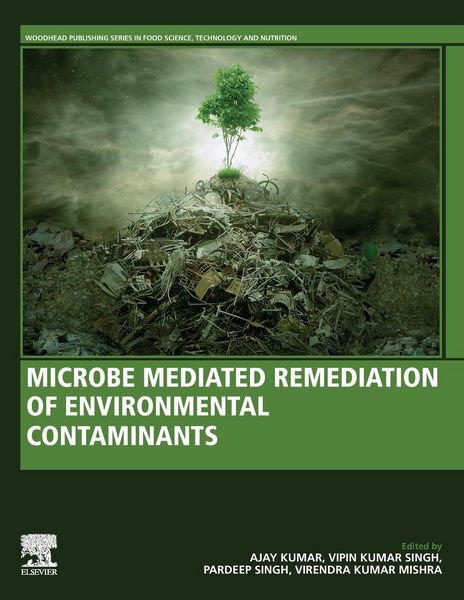
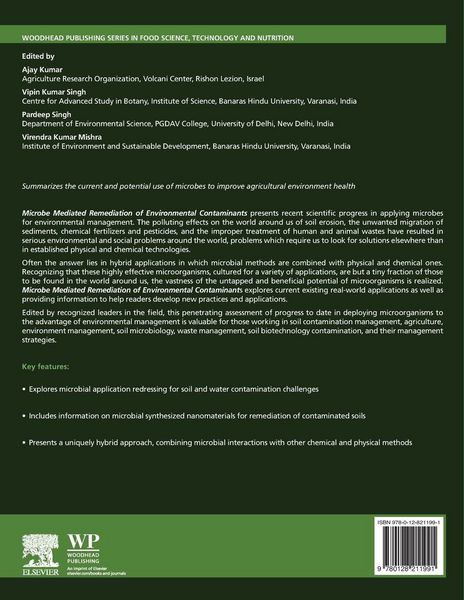
• Produktbild: Microbe Mediated Remediation of Environmental Contaminants
  • Produktbild: Microbe Mediated Remediation of Environmental Contaminants
- 13%

Microbe Mediated Remediation of Environmental Contaminants

13% sparen

194,99 € UVP 225,20 €

inkl. gesetzl. MwSt., Versandkostenfrei


Beschreibung

Produktdetails

Einband

Taschenbuch

Erscheinungsdatum

01.11.2020

Herausgeber

Ajay Kumar + weitere

Verlag

Elsevier Science & Technology

Seitenzahl

474

Maße (L/B/H)

27,9/21,6/2,4 cm

Gewicht

1090 g

Sprache

Englisch

ISBN

978-0-12-821199-1

Beschreibung

Portrait

Dr. Ajay Kumar is currently working as an assistant professor at Amity Institute of Biotechnology, Amity University, Noida, India. Dr. Kumar completed his tenure (2018-2022) as a visiting scientist from Agriculture Research Organization, Volcani Center, Israel and doctoral research from Department of Botany, Institute of Science, Banaras Hindu University, Varanasi, India on the theme "Plant microbe interaction". In his research tenures, Dr. Kumar has published more than 235 scientific contributions in the form of research and review articles, books or book chapters with the leading International Journals or Publishers. He has wide area of research experience, especially in the field of Plant-Microbe Interactions, Microbial biocontrol, Postharvest management of fruits, Microbial endophytes related with the medicinal plants and cyanobacteria-pesticides interactions. Dr. Kumar actively engaged in editing book with the leading publisher like Elsevier, Springer, CRC Press, Willey and edited more than 48 books and currently serving as an Associate editor in Frontier in Microbiology, BMC Microbiology and special guest editor in Microorganisms or Plants MDPI, Journal.
Dr. Vipin Kumar Singh is currently working as CSIR Research Associate in the Department of Botany, Centre of Advanced Study, Banaras Hindu University, Varanasi, Uttar Pradesh, India. He obtained his Ph.D. degree in Botany from the Banaras Hindu University, Varanasi, Uttar Pradesh, India in the year 2015. He has worked in the UGC project entitled "Detoxification of arsenic contaminated groundwater by transgenic eco-friendly microbes.” He has more than nine years of research experience in the area of groundwater hydro-geochemistry and bioremediation approaches to clean the contaminated groundwater sites. His area of interest includes the use of fast-growing plants and microbes to clean the contaminated soil and water system. Dr. Singh has published eight book chapters, twenty-one research articles in journals of national and international repute. He is a life time member of Indian Association of Hydrologists (IAH) and Association of Microbiologists of India (AMI). Currently, he is the member of editorial board in Indian Journal of Microbiology research and Water open access journal. So far, he has reviewed more than dozens of research articles and book chapters of international repute. He has actively participated in many national and international seminars, symposia, conferences and workshop related to the application of microbes in the management of contaminated sites.
Dr. Pardeep Singh is presently working as an assistant professor at the Department of Environment Studies, PGDAV College, University of Delhi, India. He obtained his master's degree from the Department of Environmental Science at Banaras Hindu University, India in 2011 and then his PhD from the Indian Institute of Technology (Banaras Hindu University), India, in 2017. He has published more than 35 papers in international journals in the field of waste management and co-edited over 30 books with various publishers.
Dr. Virendra Kumar Mishra currently working as Associate Professor at the Institute of Environment and Sustainable Development, Banaras Hindu University, Varanasi (India). He has done Ph.D. from Banaras Hindu University on water pollution in coal mines and treatment of coal miming effluent. He has expertise in analysis of water and wastewater, bioremediation and phytoremediation, environmental microbiology. After obtaining doctoral degree Dr. Mishra has worked at various levels at different National and international institution viz. Sejong University, Seoul, South Korea, IDAEA-CSIC, Barcelona Spain, IIT BHU. During the last fifteen years he has been an integral part in various research project related to wastewater treatment.

Produktdetails

Einband

Taschenbuch

Erscheinungsdatum

01.11.2020

Herausgeber

Verlag

Elsevier Science & Technology

Seitenzahl

474

Maße (L/B/H)

27,9/21,6/2,4 cm

Gewicht

1090 g

Sprache

Englisch

ISBN

978-0-12-821199-1

Herstelleradresse

Libri GmbH
Europaallee 1
36244 Bad Hersfeld
DE

Email: GPSR Kontakt

Noch keine Bewertungen vorhanden

Verfassen Sie die erste Bewertung zu diesem Artikel

Helfen Sie anderen Kundinnen und Kunden durch Ihre Meinung.

Kundinnen und Kunden meinen

Bewertungen (0)

Die Leseprobe wird geladen.
  • Produktbild: Microbe Mediated Remediation of Environmental Contaminants
  • Produktbild: Microbe Mediated Remediation of Environmental Contaminants
  • 1. Emerging contaminants in the environment: Occurrence, toxicity and management2. Role of bacteria and mycorrhizal fungi in phytomining: Status and future perspectives3. Biotization and in vitro plant cell cultures: Plant endophytes strategy in response to heavy metals knowledge in assisted phytoremediation4. Organic contaminants in soil and their management by microorganisms5. Environmental factors affecting the bioremediation potential of microbes6. Microbial enzymes and their exploitation in remediation of environmental contaminants7. Plant growth promoting bacteria (PGPB): Application and challenges in bioremediation of metal and salt contaminated soils8. Role of plant-microbe systems in remediation of petrochemicals contaminated water and soil environment9. Bio-surfactant producing microbes for clean-up of soil contaminants10. Rhizoremediation for efficient management of inorganic and organic contaminants in soil11. Metal oxidizing microbes and potential application in bioremediation12. Extremophilc microbes and application in bioremediation of environmental contaminants13. Microbes as natural degraders of polychlorinated biphenyls (PCBs)14. Perspectives in desulfurization of coal using microbes15. Microbially synthesized nanomaterials for remediation of contaminated soil and water environment16. Bacterial systems as a source of novel genes for enhanced phytoremediation of contaminated soils17. Methylotrophic bacteria for control of environmental pollution18. Advancement in bioinformatics and microarray-based technologies for genome sequence analysis and its application in bioremediation of soil and water pollutants19. Application of plant-microbe systems in bioremediation of metalloid contaminated soils20. Microbe based bioreactor system for bioremediation of organic contaminants: Present and future perspectives21. Microbial biofilms for remediation of contaminated water22. Microbial Technologies for Environmental Remediation: Potential Issues, Challenges, and Future Prospects23. Microbially Synthesized Nanomaterials for Remediation of Organic Contaminants24. Bioremediation of radionuclides by plant-microbe system: current progress and challenges25. Environmental pollution and their socio-economic impacts26. Remediation action on POPs by wonder weeds and associated microbiomes27. Genetically engineered microbes for decontamination of polluted soil and water system28. Electrochemical technologies for wastewater treatment and resource reclamation29. Removal of pharmaceutical contaminants by microbiological processes30. Mycoremediation: A Novel Approach for Sustainable Development31. Heavy metals toxicity to food crops and application of microorganisms in bioremediation32. Role of Omics-Approaches in Microbial Bioremediation