Gutscheinbedingungen

**Gültig am 28.06.2026 auf Spielzeug, Schreibwaren, Filme, Geschenke & Trends, Musik, tolino eReader & Zubehör, Hörbücher und Hörbuch-Downloads (außer Abo), nicht preisgebundene Bücher und Kalender online auf thalia.at und in der Thalia App. Einzelne Artikel können ausgeschlossen sein. Aufgrund der Buchpreisbindung sind deutschsprachige Bücher und eBooks ausgenommen. Zusätzlich ausgenommen sind preisgebundene Artikel, Abos & Flatrates, eBooks, Games, Geschenkkarten/-boxen, Shelfies, Software, Zeitschriften sowie einzelne Artikel von tonies®. Pro Einkauf einmal einlösbar. Click & Collect nur bei Onlinevorabzahlung möglich. Keine Barauszahlung. Nicht kombinierbar mit anderen Aktionen und Gutscheinen. Gutschein wird auf max. 500€ Bestellwert angerechnet. Nicht gültig für Versandkosten und Services.

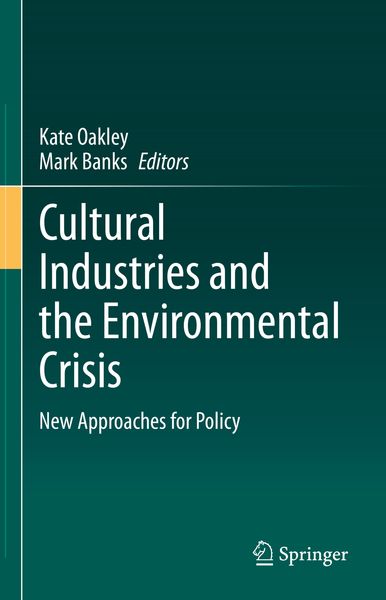
Produktbild: Cultural Industries and the Environmental Crisis

Cultural Industries and the Environmental Crisis New Approaches for Policy

139,99 €

inkl. gesetzl. MwSt., Versandkostenfrei


Beschreibung

Produktdetails

Einband

Gebundene Ausgabe

Erscheinungsdatum

15.09.2020

Herausgeber

Kate Oakley + weitere

Verlag

Springer

Seitenzahl

166

Maße (L/B/H)

24,3/16,3/1,4 cm

Gewicht

413 g

Auflage

1st ed. 2020

Sprache

Englisch

ISBN

978-3-030-49383-7

Beschreibung

Portrait

Dr. Kate Oakley is Professor of Cultural Policy at the School of Media and Communication, University of Leeds. She was previously Head of the Centre for Cultural Policy and Management at City University, London and a Visiting Professor at the University of the Arts London. Her research interests include the politics of cultural policy, work in the cultural industries, and regional development. She came into academia following careers as a journalist, market researcher and civil servant and for 15 years she ran a successful consultancy and research business in the cultural sectors. Her portfolio of projects included: work on cultural and creative industry strategies; work on the social impacts of culture and the arts; work on skills and employment in the cultural industries and cultural policy advice at a variety of spatial levels.

Dr. Mark Banks is Professor and Director of CAMEo Research Institute for Cultural and Media Economies, Universityof Leicester - an interdisciplinary institute launched in 2016 to explore the changing productive dynamics of the cultural and creative industries, cultural consumption, media and arts. Prior to this, he was Director of Research (2015-16) and Academic Programme Director (2014-15) in the Department of Media and Communication. His research is mostly concerned with the relationships between culture and economy, mainly in the context of the cultural industries, and he is especially interested in issues of cultural work in relation to identity, access and opportunity, social justice, and moral economy.

Produktdetails

Einband

Gebundene Ausgabe

Erscheinungsdatum

15.09.2020

Herausgeber

Verlag

Springer

Seitenzahl

166

Maße (L/B/H)

24,3/16,3/1,4 cm

Gewicht

413 g

Auflage

1st ed. 2020

Sprache

Englisch

ISBN

978-3-030-49383-7

Herstelleradresse

Springer International Publishing AG
Gewerbestr. 11
6330 Cham
Schweiz
Url: www.springer.com

Kundinnen und Kunden meinen

0 Bewertungen

Informationen zu Bewertungen

Zur Abgabe einer Bewertung ist eine Anmeldung im Konto notwendig. Die Authentizität der Bewertungen wird von uns nicht überprüft. Wir behalten uns vor, Bewertungstexte, die unseren Richtlinien widersprechen, entsprechend zu kürzen oder zu löschen.

Die Bewertungen sind nach Format, Anzahl Sterne und Datum sortiert.

Verfassen Sie die erste Bewertung zu diesem Artikel

Helfen Sie anderen Kund*innen durch Ihre Meinung

Kundinnen und Kunden meinen

0 Bewertungen filtern

  • Produktbild: Cultural Industries and the Environmental Crisis
  • Chapter 1-Creative economy, degrowth and limitation.- Chapter 2-Towards a new paradigm of the creative city or the same devil in disguise? culture-led urban (re)development and sustainability.- Chapter 3-Creative industries and the crisis of social reproduction.- Chapter 4-Re-thinking the creative economy towards social justice: can action-research help change policy direction in the field?.- chapter 5-Green accounting for a creative economy.- Chapter 6-The environmental sustainability of the music industries.- Chapter 7-The promise of e-commerce: interrogating notions of sustainability in Amazon's logistics.- Chapter 8-Cultural production beyond extraction? questioning the present and future of the creative industries in Argentina.- Chapter 9-Ferality: nature, culture and creative economy.- Chapter 10-La vie épuisée? exhaustion as a driver for change in the cultural sector in Scotland.- Chapter 11-Getting on and getting out.